Pageviews from the past week

Showing posts with label Blogathons. Show all posts

Monday, 1 August 2016

Against the Crowd Blogathon: Two-For-One Spielberg Extravaganza


Wendell Ottley over at Dell on Movies is hosting his annual Against the Crowd Blogathon. I have participated in this one before, and it's a great opportunity to share some of those feelings you have. The nature of the blogathon is pretty straight forward; as the name implies, it is all about those movies that you hate but everyone else loves for some reason, and the movies everyone else seems to hate but you love. The idea is to do one of each, and it just so happens I have something very special for this year, because this time it is all about Steven Spielberg. I happened to take a class on directors this year, and we spent several week studying his work, from which I have drawn the following statements.

Now, when it comes to Spielberg, there are a variety of directions I can go. His work is all over the place in terms of quality ranging from brilliant to awful. I am after all in the small group of people who found that E.T.: The Extra-Terrestrial was actually a very weak film when you look past the then-revolutionary effects. The best part about that film is I've found that it makes a great drinking game (take a shot every time there is a random Star Wars-related inside joke). He has also made plenty of great films; I finally saw Schindler's List which proved to be a very interesting film if not entirely what I expected.

For the purposes of this activity, I have chosen to go all out. I will be defending one of Spielberg's most hated films, and deriding one of his most beloved.

AI: Artificial Intelligence (2001)
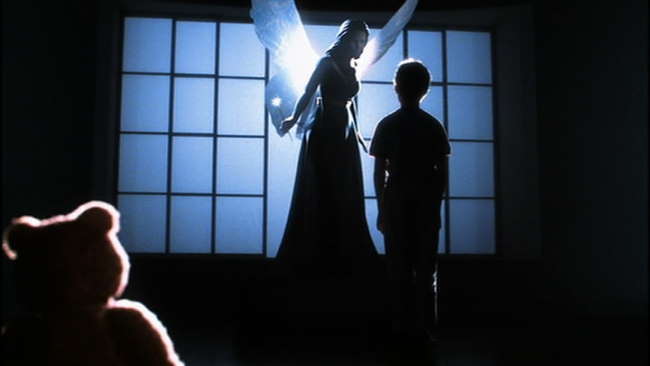

Spielberg's tribute to Kubrick I found was actually not all that bad. Yes, as a Kubrick fan, I will admit that of course I would have wanted to see how the film would have turned out had he lived to see it finished, but for what Spielberg came up with, I think his interpretation is a pretty good one. It actually does feel very much like a Kubrick film, largely because Spielberg worked with the notes, storyboards, and early screen treatments that his friend had spent years assembling. It actually can be very difficult upon a close examination to tell where Kubrick's vision ends and Spielberg's begins (the apparently Spielbergian ending was actually Kubrick's idea). One can tell watching it that Spielberg really wanted to be show his respect for Kubrick, even if he could not perfectly replicate the director's ideas.

Even disregarding the obvious details about whether this is a Spielberg or Kubrick film, it is actually really well made in its own right. AI is surprisingly effective in exploring the age-old question of just what it means to be human (a subject that fascinated Kubrick). The androids we see actually do feel human, their emotions appear genuine even when balanced with their uncanny appearances. There is also a bitter sense of hopelessness that emerges throughout, as the viewer knows very well that David's goal of becoming a "real-live boy" is impossible, and yet they can easily relate to his struggle and desire to be loved. Haley Joe Osmond actually makes a very good android, balancing his uncanny appearance with emotional depth that is not immediately obvious.

Now for the really daring part that will no doubt get a lot of readers very angry with me because it relates to the final act of the film. This was of course the part where David is found buried in the ice after humanity's extinction; the part that gets the most flak. I felt this might have actually been the strongest part of the film. Of course, the idea behind it (which was Kubrick's, by the way) makes a lot more sense when you realize (as I did, thanks to class readings) that the beings who find David are not in fact aliens (as they are often mistakenly assumed), but extremely advanced robots searching for their own origins. It is here that David really gets to show his humanity, and where the film's themes of whether a machine can think or feel are resolved. The ending offers closure to David's story, but also allows David to "grow up" in a way (though he still looks like a child).

Munich (2005)


I really don't get what everyone else saw in this movie. To me, the plot amounted essentially to "some guys kill some other guys so Geoffrey Rush decides the logical response to run around Europe blowing up random Arabs." The film claims to be based on a true story, but the only part that I have been able to definitively verify actually happened was the mass murder of 11 Israeli athletes which sets the film in motion. After seeing it, I felt skeptical about how much of the rest of the film was real and a strong desire to get dirt on the movie. This is a strange reaction, I know, to such an acclaimed feature. Far from a tense thriller, Munich is nothing but a racist, sexist, and in general poorly executed film and a waste of time.

I found the movie frustrating and impossible to follow, and those were the parts that didn't seem racist or sexist (more on that later). There was a lot going on at once and it was never clear what was supposed to be happening at a given moment. I remember my professor mentioning in class some of the techniques Spielberg used to make the narrative easier to follow and I just wanted to blurt out "uh... did we see the same movie?" I found the main cast dull and unrelatable, and strangely enough, hard to tell apart. While it is true that they did look different, none of them really had anything to make them stand out in terms of personality. They were just a bunch of guys with a set of vaguely defined skills that were required to kill some people. There was a French guy, Louis, who apparently had detailed information on the terrorists, and absolutely no explanation is given for how or why he does this; especially given that the parts of the film which allegedly detail his operation instead opt to focus entirely on his father's cooking.

To bring up the film's racism, the same can be said for much of the cast. The "targets" are apparently supposed to be people involved with the terrorist operation, but it isn't made clear how they are involved. None of the men targeted are seen among the terrorists when they are shown at the beginning (or in later flashbacks), and beyond a few vague lines of dialogue it is not made clear why they are the targets. This gives the sense that the protagonists are not actually going after terrorists, but that they are just blowing up random people who happen to have an Arabic background. It almost seems like Spielberg is promoting the idea that being Middle Eastern is automatically linked to terrorism, especially as the viewer is meant to feel emotionally invested in the actions of the so-called protagonists.

Now we can get into the sexism that is prevalent throughout Munich. Throughout the movie, I remember wondering if it would really have hurt to have some female operatives in the team. Now one could argue that the reason the actual task force is all men has to do with the historical events that inspired the film, but that still does not excuse the poor treatment of the few women who do appear. For most of the film, there is only one woman who has any kind of role in the story; Daphna Kaufman, Avner's wife who serves mainly to motivate him. She is generally depicted as submissive towards him, making little in the way of her own choices or thinking for herself.

The real bit of wasted potential comes in the form of Jeanette, someone who could easily have had potential to be a very interesting and strong female role. Her character is that of an assassin apparently hired to kill the protagonists. She is built up as a professional who doesn't let her emotions get in the way. Now, if she had been introduced earlier in the film, she could have made for a very strong and memorable antagonist. We could have gotten to know her on a psychological level, and then she would become an interesting part of the movie. Maybe they could have even gotten into what makes her work and allow her to become somewhat relatable, adding to the moral ambiguity. Of course, Spielberg does none of these things. Instead, Jeanette is shoved into the end of the film where she ends up feeling very out of place, appears out of nowhere, and then gets killed. There is so much wasted potential here.


Thursday, 18 June 2015

Anouncing The Origin of An Auteur Blogathon


The term "auteur" comes from French and translates roughly as "author". The idea of a cinematic auteur is based on the theory that the director is the "author" of their films. This idea was first pioneered by French Critics in the 1950's and 1960's, including future filmmakers Francois Truffaut and... a certain other French New Wave director who shall not be named. These critics were watching American films and looking at films produced by major Hollywood directors of the era such as Howard Hawks, John Ford, and Alfred Hitchcock. People like Truffaut and that other guy realized that there were patterns which could be found among their films. For instance there were traits that defined a Howard Hawks movie and which could distinguish it from say... an Alfred Hitchcock film.

Now this is not the only way of looking at things. Technically, similar patterns could be found among... say... different screenplays by the same writer. Just look at a few of my own scripts and you'll quickly notice a few trademarks that keep popping up, such as the prominence of strong female characters (in most cases including the protagonist; so far the only exception has been an adaptation). Similarly, some producers have patterns that emerge in their films. A director is by no means the only "author" of his or her film. That does not make auteurism an invalid theory, however.

It is debatable if the director can truly be considered the "author" of their film, but every director has their own style. There are patterns you can trace simply by looking at any director's body of work. Once these patterns and styles are identified it becomes easier to identify the film of one director from another. For instance, having intensely studied a few auteurs myself I could easily tell a film by David Lynch from a film by John Carpenter or Sergio Leone. Similarly it would not be hard to distinguish a film by Alfred Hitchcock from something directed by Georges Méliès or Kathryn Bigelow. Even the worst scum in the history of film, directors like Ed Wood, Uwe Boll, and Michael Bay, have patterns that characterize their films. After all, anyone with common sense could easily distinguish one of Michael Bay's blockbusters from one of Ed Wood's b-movies.

However, there is something that every major director has in common: they had a beginning. There is always that one film they have at the very start of their filmography which launched their cinematic careers (for better or worse) and set the stage for everything that would follow. For this blogathon, you will be examining one such film in detail.

Rules

  1. Pick one director and identify his or her first feature film. It must be the first feature film (i.e. over one hour runtime) listed in her/his filmography.
  2. While you will be primarily discussing that one film, you should have an understanding at least some of the director's later films, enough to be able to recognize his or her style.
  3. Analyze your chosen film in relation to the director's later projects. What elements of his or her style do you see here?
  4. Keep in mind that this blogathon is based on critical thinking and analysis, not simply on whether you liked the film. Your post should not be so much on the film itself as what it says about the director.
  5. Repeats (i.e. two people writing about the same director and film) are acceptable, but discouraged. If you do choose a topic someone else is writing about, try to find something different to say on the subject.
  6. Include a banner and a link back to this post. There are several banners to choose from below, and you are permitted to create your own provided they fit the blogathon's themes.

As long as you follow the above rules, there are no restrictions on which directors you can or cannot choose just so long as you have access to their movies. You could look at an auteur from the beginnings of cinema (provided you can find their first movie) or you could look at someone working today. You could write about a mainstream director who worked in the Studio Era or some obscure foreign director nobody's heard of. In fact, I'm encouraging diversity as much as possible. Obviously, it should come as no surprise that I'd like to see both male and female directors examined this way, but variety in time periods, ethnicities, nationalities, genres, etc. are all very good as well.

Technically it doesn't even have to be a good director you study. You could if you wanted write a whole piece on Michael Bay. However, my advice would be to pick a director you like or would be interested in studying. It should make the experience of watching and analyzing their first feature film more enjoyable. I suspect everyone has their own range of directors they admire so there should be plenty of variety on that front.

Normally I would provide a list of suggestions to help give participants some ideas, but I presume we're not likely to get any interest from non-film bloggers (if by some chance I do, you can e-mail me and I'll try to help you find something to contribute). You people write about movies, I expect that you're familiar with a few directors. Maybe a different assortment of directors from me but still directors nonetheless. 

I'm looking at running this toward the end of August, from the 23-29. Hopefully that should give everyone interested enough time to think about their choices, watch their films, and write up their pieces. As is the custom, each day I'll post the links as I get them.

If you have any questions, you can share them in the comments and I will get to you as soon as possible. If you need help, I can't make any promises but I'm happy to try and assist you any way I can. I'm hoping to see some really great stuff here so start thinking about whose first film you'd want to look at and let me know what you decide.

Current Participants

Due to the structure of this blogathon, and my discouraging of repeats, I'd like to ask that anyone who is interested in taking part tell me ahead of time what they would like to discuss. There's no hurry so if you'd like to join in but don't know yet who you want to write about yet that is perfectly fine. Once you have your topic, make sure to notify me and I'll add you to the list. This just so we can keep track of what has and has not already been selected.


Banners

I've assembled several banners here for you to use in your posts. Each one contains a still from a different directorial debut, and I've tried to diversify the range as much as possible, but if none of them are to your satisfaction you may create your own banner. Just make sure it contains the title of the blogathon, my blog name, and imagery that fits the themes we're exploring here.


Wednesday, 13 May 2015

Society and Science Fiction


In terms of story, Gravity and Conquest of Space are two very different ideas. Gravity is more about the individual and self-reliance while Conquest of Space becomes more about humanity as a whole. Conquest of Space therefore makes use of an ensemble cast while Gravity focuses almost exclusively on one individual (George Clooney's brief role the only exception). Conquest of Space involves a mission to Mars, while Gravity remains closer to Earth. In many ways, both films are products of very different eras, with different social standards and views on space travel, something especially evident in how they address the subject of gender.

Conquest of Space, as I have discussed before, utilizes an all-male cast. Producer George Pal also made a similar choice in his earlier science fiction film Destination Moon (which, interestingly, corresponds to the fact that even today we still have yet to put a woman on the moon). The film constantly uses the word "man" in place of humanity.  The trailer proudly boasted that the viewer would live "a strange topsy-turvy life of men who live as no other men have lived before" and the opening narration describes how "men" have built the wheel. When we get to see inside the Wheel, it quickly becomes clear that there are no women aboard. There are only men (though there does seem to be racial equality among those men).

The only women seen in the film are back on Earth, wives, girlfriends, and relatives of the astronauts sending them goodbye messages like the old stories of soldiers' wives saying goodbye before they were sent off to battle or sailors' wives saying goodbye before the start of a long voyage. Basically, female astronauts don't seem to exist in this world, and it is very likely that the space program has restrictions against women serving as anything other than nurses and secretaries (if even that, considering none appear in those roles on the Wheel). That is not to say the film was intentionally sexist. In fact, technically in 1955 there were no female astronauts, at least none of American birth who actually went into orbit. It would not be until almost ten years later that a female astronaut, Valentina Tereshkova, would be launched into orbit, and the first American woman in space, Sally Ride, did not happen until 28 years after the release of Conquest of Space. It is therefore likely that the idea of female astronauts simply never occurred to the filmmakers.


This detail is somewhat ironic today, as there is a small amount of evidence which actually suggests that, at least on average, women are often better adapted physically and mentally to living in space than men, but there was a reason the filmmakers made these choices. In 1955, the space program was still under military control and in those days it had a very specific list of where women were accepted, which was greatly outnumbered by the positions that were willing to take men. Early experiments in space travel were overseen by the army and the air force, and most early astronauts had experience serving as one of those two groups. For this reason, the space program is still shown as being run by the military, and thus all-male as it is not likely that George Pal anticipated the gender integration that would occur in the military decades later.

This was also a time when women were expected to cook, clean, and make babies, thus the idea of female astronauts may have seemed unlikely for the era. As a result, the space program is seen as militaristic and being an astronaut is treated as "men's work". The first mission to Mars is treated like a naval expedition to explore a new world, a group of brave men going on a daring mission to find new resources for humanity. The few women that do appear stay behind and wait for the return of their men, much like the wives of sailors in the olden days. Though this line of thinking may seem backwards today, it would have made perfect sense to filmmakers of the era, who lacked the foresight to recognize future social developments.


Gravity, released 58 years later, has precisely the opposite treatment of gender due to being released under very different social circumstances. In 1955, feminism was making progress, but still was seen as little more than a passing fad by many men of the era. By 2013, it was more widely recognized by people of both genders, and audiences were ready to accept a female astronaut taking on the central role in a science fiction film. Throughout the film the heroine, Ryan Stone, is the only character given any real focus. The only other character whose face is even seen (at least, before his death) is her partner Matt Kowalski. In fact, the movie literally begins with Ryan being cut off from just about everyone. Fifteen minutes in, three of the five astronauts are killed and contact with mission control is lost. The only other person Ryan can turn to is Matt, who is lost soon after.

Ryan stone is therefore forced to rely on herself for the majority of Gravity's narrative. Matt's only role is to help put her on the right track. When Matt "returns" late in the film, he serves a similar function, helping Ryan to regain her confidence. However, what distinguished Matt in this later scene from his earlier role is that his appearance here is nothing more than a dream. There is no way Matt could have caught up with the Soyuz after being left in orbit, and by this point in the film he was likely either already dead or slowly dying of asphyxiation. Matt is instead merely a construct of Ryan's frightened mind, or more accurately her survival instincts.

The conversation they engage in is actually a mental conflict occurring in Ryan's own head between two different sides of her personality. Ryan herself plays the suicidal part of her character, since in a moment of despair she has proven herself ready to accept death by asphyxiation, while Matt represents that small part of her that still wants to survive. The conversation between Matt and Ryan is therefore a symbol of her thought processes as she falls asleep in the Soyuz. The solution that she finds to her problem (using the launching gear to propel the Soyuz toward the Chinese space station), was all her idea, continuing the theme of self-reliance.


The scope of the movie's themes shift. It no longer becomes about the survival of humanity or even humanity in general, just about her own struggle to survive. She has no simple solution or procedure for dealing with the situation as the men seen in Conquest of Space did. Ryan has very little experience as an astronaut to begin with, with this mission being explicitly identified as her first, and this in turn contrasts the militaristic aspect of the space program depicted in Conquest of Space. In that film, the space program is depicted as an organized branch of the military, with spaceships and space stations being run like navy crews. Gravity was affected by one development in space travel that went completely unnoticed by the filmmakers of Conquest of Space.

In 1955, the assumption that the military would still be running the space program in the future would have made sense. However, George Pal and Byron Haskin failed to anticipate the biggest flaw in that system, and the reason why the army is no longer in charge of space exploration. The American army and the American Air Force were both involved in early rocketry experiments, but they became very competitive about it. Both sides were trying to best each other, and neither wanted to share their results. They were wasting money and resources to the point where it started to cause trouble for the government. The solution was therefore to no longer allow the American Armed Forces access to rocketry. Instead, a civilian organization was assembled to take charge of space exploration, this being the origins of NASA, which is still in operation today.


Gravity therefore eliminates the militaristic qualities of the space program. None of the characters are explicitly identified to have any military background. Ryan Stone herself is even established to be a doctor, precisely the opposite of what soldiers are expected to do. In Conquest of Space, the men are established as a unit, or as a team, with each one having something valuable to contribute to the mission. There is a certain unifying quality among them. When something goes wrong, such as their commanding officer's breakdown, everyone has to stick together to continue the mission. For most of Gravity, Ryan Stone has nobody to turn to. She has to rely purely on herself to survive and return home.

The one thing both films have in common is that they aimed to create a realistic vision of outer space. Conquest of Space had to work with extreme limitations compared to Gravity. The former was made in the early days of space travel, long before even the Apollo Missions. Most of the information that was available would have been theoretical, extrapolations based on what could be understood from Earth. By the time Gravity was made, NASA had been functioning for decades: they had successfully put men on the moon, launched probes to other worlds and, through satellite technology like the Hubble, developed the beginnings of a map of the universe.

The models used in Conquest of Space are still very impressive today, but in other areas its limited information shows, particularly in the matte paintings used to depict Earth, and the scenes depicting Mars. When Conquest of Space came out in 1955, there were no clear images of the Earth as seen from space. Even 2001: A Space Odyssey, made a year before the first moon landing, had to take an educated guess on what the Earth looked like. The filmmakers were fortunate to come as close as they did. Meanwhile, the shots of Earth depicted in Gravity could pass for actual photographs taken from orbit, at least by today's standards (the effects in Conquest of Space were cutting edge for its day, it is not inconceivable that decades from now Gravity's special effects might look a little dated to a future audience).


The scope of both films naturally shifts with regards to their respective social climates. Conquest of Space attempts to present a grand narrative of humanity's future. It envisions space travel as the next step forward. The opening narration describes space travel as "the last and greatest adventure of mankind", implying that something amazing is in store. The story centers on a mission to Mars but the film suggests that humanity will go on to explore other worlds in "the vast universe itself". Gravity has a more mundane look at space travel, with a group of civilians who have been living in space for some time but show little enthusiasm for their job. Matt is more interested in breaking a spacewalk record than he is about being in space. Ryan seems more interested in her immediate task of installing a new piece of equipment onto the Hubble Space Telescope than she is in the possible new discoveries it might allow.

Space seems to have lost the excitement that was portrayed in Conquest of Space, and instead living in space has become dull and routine. In the case of Gravity, the crew are confined to Earth's orbit. They have no chance of even visiting the moon, let alone other planets. All they are doing is venturing into orbit to install some equipment into a satellite. When Conquest of Space was produced, it was still in the early days of the space program. Sputnik would not be launched for another two years. Nobody knew for sure where the space program would go, but many science fiction stories envisioned an exciting future of space travel in the near future. It therefore came as a surprise to everyone when that vision did not come true after the moon landings.

Today, "space travel" is largely confined to Earth's orbit in the form of space stations, though probes have been launched to other worlds (and outside the Solar System, in the cases of Voyager 1 and 2) and orbital sattelites such as the Hubble Space Telescope have proven crucial to developing a modern understanding of the universe. This is reflected in Gravity, in which the Explorer's crew is merely a group of civilians doing their job. At best space is dull, and at worst it is a living nightmare. This element is not entirely absent from Conquest of Space, where some of the crew talk about missing their families back home, but they simultaneously recognize the significance of their mission. Gravity refrains from addressing any potential significance of the protagonist's mission. If anything it is nothing more than a routine job, probably not much different from anything that many other astronauts before Ryan have done.

Looking at these two films, it becomes clear that science fiction is a genre that has evolved drastically over the years. Conquest of Space may have been intended as a look into the future, but it also works the other way, as a window into the past. It shows the universe as it was understood in the 1950's, and what men of the time thought space travel might one day look like in a way that seemed to make the most sense to them. By comparing it to a contemporary science fiction film like Gravity, the social changes start to become clear. In both films there was a similar aim of realistically envisioning outer space, but ultimately they are both simultaneously reflections of the eras in which they were made.

This Post was written for the Film Preservation Blogathon hosted by This Island RodFerdy on Films, and Wonders in the Dark


Sunday, 5 April 2015

Film Fortress 2


So there was recently this strange political development in which the Prime Minister of Canada was kidnapped by Neo-Nazi communist hippy ninjas who want Belgium's nuclear launch codes or something. I don't know. I don't follow politics much. All I know is that some United Nations official showed up at my house, said that the Prime Minister has been kidnapped by Neo-Nazi communist hippy ninjas, and asked if I was a "bad enough dude" to save the him. I don't know what that means, but I told them I was. They then shoved some paperwork in my face and told me I had to assemble a team of the toughest men and women available to save him and if the team I put together was composed entirely of white men they'd throw me in prison.

It wasn't easy, but I think I've found a good team to get the job done. Just for fun, I've decided to base most of my team on the classes from Team Fortress 2, and use that as a guide for assembling them. I've also been trying to offer a balance of gender and hopefully race. I got six men and six women, plus a decent balance of race among both sexes. This should be enough to meet the quota I was given.

By the way, yes, I know that some of these people are dead (though I won't say which ones to avoid spoilers). I found this crazy scientist who built a time-travelling DeLorean and he took me back in time so that I could recruit those people before they died and then bring them back to the present.


Ground Force

Tech Sgt. Elena Santos (Battle: Los Angeles, 2011)- Scout


Santos might not technically be infantry, but she has shown that she is certainly capable of defending herself (considering how much time she spent on her own in a war zone, initially without assistance). If she could hold her own in an alien invasion, Neo-Nazi communist hippy ninjas shouldn't be that big a problem. She is one who can fit right into the squad, but she also has experience in reconnaissance. Before the team can storm the Neo-Nazi communist hippy ninjas' carefully hidden headquarters, somebody has to get the information on their hideout and their activities. That's where a scout comes in handy, someone who can observe the enemy from a distance undetected.

Co (Rambo: First Blood Part II, 1985)- Soldier


I know, much as I dislike this film, Co was probably the one decent thing it had to offer (I'm pretty sure it was James Cameron who put her in the script, and Sylvester Stallone who ruined it). For the (frustratingly) short amount of screen time she had, this girl had a lot of skill. She showed that she was certainly capable of looking after herself and she even ended up in a situation where she had to save Rambo, and succeeded. We're talking about a one-woman extraction team. If something goes wrong with Evelyn Salt, this is the person who's going to get her to safety. She knows how to use the environment to her advantage, and she can handle a machine gun. Trust me, you'll want this girl watching your back, and her teammates will actually be able to understand what she is saying, certainly more than can be said for her partner.

Ellen Ripley (Aliens, 1986)- Pyro


This girl was able to take on an army of monstrous aliens several times before they finally killed her (and even that didn't stop her from facing them again). Her weapon of choice is a flamethrower and she definitely knows how to use it. After facing down Xenomorphs several times, (an entire hive in the case of Aliens), Neo-Nazi communist hippy ninjas should be pretty simple to deal with by comparison. Besides, she could use a change in activity, considering how she can't seem to go anywhere without having to face these aliens I think having a new enemy to deal with might be refreshing for her. Don't you?

Blaine (Predator, 1987)- Heavy


One thing we're going to need on a mission like this is lots of firepower. Aside from being specially trained for these types of missions, this is a guy armed with some very large guns and capable of doing a lot of damage with little trouble. Ninjas might be fast, but they can't outrun bullets. If we can get this guy in position with his minigun he should be able to take out large amounts of Neo-Nazi communist hippy ninjas at once, and with little damage to himself, at least as long as one of them doesn't manage to use their throwing stars to slice his heart out. Even if that does happen, he should be able to at least drastically reduce the enemy's numbers first, making them an easier target for everyone else.

Sgt. First Class William James (The Hurt Locker, 2008)- Demoman


Well, knowing the way these kinds of situations often go, it's inevitable that something is going to get destroyed sooner or later, and we'd better make sure that works in our favor. We'll have to pull James out of Iraq, but I don't think he'll mind too much. This guy's services will be valuable in two ways. First of all, and perhaps most obviously, James would be the guy to call if the team has to deal with a live explosive. He will know precisely how to disarm it. On the flip side, James has so much experience in disarming bombs, and knows them inside out, he could probably make one if necessary. With the collection of bomb parts he has accumulated, he probably has enough pieces to make at least two or three just for fun long before they are actually needed. Of course, the rest of the team will need to keep an eye on him to make sure his adrenaline fix doesn't get in the way of the mission, but his skills should be enough to make up for that.

Lisbeth Salander (The Girl With the Dragon Tattoo, 2009)- Engineer


Okay, so maybe she can't build sentries and teleporters, but this girl is resourceful and has a lot of technical skills that could be very useful. After all, everybody knows how much ninjas love to use computers, and those could hold a lot of extremely important information on their operations. That kind of information would be extremely valuable for the scout and spy, but she should also be able to get eyes in the building and remain in contact with everyone else. It does mean that she will be spending a lot of time in the background, but even if she does encounter trouble, Lisbeth can take care of herself, especially once Blaine has done his part.

Ensign Monk (The Abyss, 1989)- Medic


There are a few good reasons to put a guy like this on the team. For one thing, he is a trained Navy SEAL, which means he can definitely take care of himself, but as a medic he also knows how to keep calm while looking after wounded comrades under stressful circumstances. With an army of Neo-Nazi communist hippy ninjas on the loose, it's likely that someone might get hurt, so we'll need a person who can patch up their wounds when that does happen. Also, Monk is just such a nice guy for a SEAL, a very good quality for a doctor to have to be sure, and his bedside manner can certainly be helpful under pressure.

Jason Bourne (The Bourne Supremacy, 2004)- Sniper


It might be hard to convince a man like Bourne to take part in a mission like this (though some sort of guarantee that he'll be left alone afterwards might help), but his skills would be incredibly valuable in many ways. He has shown that he is a talented sniper, and he is very good at finding vantage points from which to observe. This would almost certainly be valuable when we are sending in our scout or our spy, since he will be able to see any danger coming long before they do. The other thing is that in addition to being a sniper, he is also more than capable of defending himself at close range, so if the Neo-Nazi communist hippy ninjas manage to find him we shouldn't have to worry too much about his safety.

Evelyn Salt (Salt, 2009)- Spy


Sometimes having a scout isn't enough. They can be great for observing the enemy but we might need someone who can actually get into the enemy base in order to get all the facts. The scout might be good for helping her to get in, but someone is going to have to be able to infiltrate the enemy. Salt is a girl who can do that, seeing as she can get in, get the information, and perhaps even work undercover (it's not that hard to disguise yourself as a ninja after all). She also has communist ties herself, so she should be able to blend in without much trouble, and she is very good and taking out these kinds of organizations from within. Also, Salt has been dealing with a lot of undercover Russian agents, a change in objective would probably do her some good.

Sgt. West (Basic, 2003)- Team Leader


We have a good team here, but somebody is going to have to take command in order to keep them organized. This guy might be hard, but if there is one thing that's certain it is that he knows what he is doing. He doesn't like to play by the rules, for sure, but he knows how to put together a team to get things done, and he should be able to handle a job like this without much trouble. I won't deny that West is tough and that some of the people under his command might have more than a few reasons to dislike him, but he is a capable (if unconventional) leader and he will do what he feels needs to be done to complete the mission. 


Support


Captain Steven Hiller (Independence Day, 1996)- Pilot


We've got here a great team to take out the enemy and get back the Prime Minister, but before they can do anything we need someone to get them to the necessary drop point, and to pick them up when the job is done. That's where Captain Hiller will be useful. Aside from being a fully qualified air force pilot, Hiller has certainly survived against far worse, so he will definitely be helpful if the team runs into trouble while trying to get to the chopper. Nobody's going to get this guy's machine as long as he can help it, but then again ninjas aren't exactly prepared much for aerial combat, so he should have a pretty easy time with this job.

Connie Hooper (Unstoppable, 2010)- Dispatcher


Somebody is going to have to keep track of everything that is going on. We'll need someone back at base who can keep in constant contact with our heroes and make sure everything goes smoothly (as well as deal with all the inevitable bureaucracy of her superiors). Connie is someone who is certainly able to commit herself when trouble arises (even if it runs the risk of getting fired) and her experience in coordinating railways should be useful under these circumstances. If there is anything that the team needs, this is the girl who is going to make sure it gets to them, and who will make sure everyone gets pulled out safely.

Wednesday, 1 April 2015

Summer Blockbuster Cast-A-Thon


Oh no! It seems the Prime Minister of Canada was on a flight to a very important U.N. conference when his plane was shot down somewhere over an isolated war-torn location and now he has been kidnapped by Neo-Nazi communist hippy ninjas. We received a message from them demanding that the United Nations deliver Belgium's top-secret nuclear launch codes by May 31 or they will kill the Prime Minister. Oh, it's a catastrophe. Whatever shall we do? If the Prime Minister doesn't make it to the conference in time for his speech and fails to present the contents of his top-secret briefcase it could mean the end of civilization as we know it!

It seems the only thing we can do is find the toughest men and women available and put them together as a ragtag force of crack commandos who can get in there, find the Prime Minister, take out the enemy, and bring him back in time for the conference. Are you a bad enough dude (or dudette) to organize this team and rescue the Prime Minister?

Rules:

  1. Select a group of 12-15 characters from action movies. They are not required to be military, but they should be tough enough to look after themselves when things inevitably go wrong.
  2. For each character you choose, include a few words on why you selected him/her and what skills they have that could contribute to saving the Prime Minister of Canada.
  3. Much like my Voyage to the Stars Blogathon, there must be gender and/or racial diversity. Ideally, I would prefer it if you could manage both but one or the other is acceptable. If possible, national and sexual diversity is also greatly encouraged (but not required). Either way, I do not want to see any all-white, all-male squads. Doing so means an automatic disqualification.
  4. There are no restrictions regarding the era in which your chosen characters originated or their nationality. You could in theory assign Vazquez from Aliens with Nantz from Battle: Los Angeles and Dutch from Predator.
  5. You cannot include two or more characters from the same film.
  6. I would like you to include the above banner in your post. However, if you want, you may design your own provided it contains the title of the blogathon and imagery that fits.
You have until May 31 to rescue the Prime Minister and bring him back safely before the Neo-Nazi communist hippy ninjas kill him. If all goes well, then on June 1, I will post a list of everyone who contributed to saving him and any messages he would like to give you.


Saturday, 17 January 2015

On Desk Set and the Implications of Identifying Genre With Gender


I guess I should start by giving a little bit of background on the history behind this awful movie and how I came to be acquainted with it. It all started when I was registering for my classes during the summer and encountered a film class simply known as "Selected Topics". From the description it sounded like an extension of the great film classes I had been taking over the previous year, with a randomly-selected group of film-related topics being covered in more detail. Unless it turned out that they were going to be spending several weeks talking about why Jean-Luc Godard is the greatest director of all time, it should be okay. Boy, was I wrong?

Instead of an interesting film class, it turned out to be a dull, boring media studies class. I found it horrendous and could barely concentrate. At first it seemed to be just a matter of me being confused by it not being what I expected, or me not fitting in. After listening to the testimony of a classmate, I've been led to suspect it was just a poorly-run class. Eventually after a few weeks and a guest lecturer I could not keep up with I decided I couldn't take it anymore and dropped the course. I still have yet to find anyone who had anything positive to say about it.

It did not help that the class in question was three hours long, and the few actually film-related topics were dull at best. Instead we spent a lot of time talking about the internet and computers. We talked a little bit about how computers are shown on film, but the professor kept insisting on showing clips from cheesy movies like The Computer Wore Tennis Shoes and Rollerball when she could have gotten the same idea across through a good movie about artificial intelligence like, oh I don't know... 2001: A Space Odyssey.


Every couple of weeks, there would be an actual screening, and for the short period of time I was there, every single one was boring. There was one infuriating one in particular that helped draw the line, and that was the movie Desk Set. This was a movie that drove me insane. When I heard Katherine Hepburn was in it I was excited, hoping that maybe she could bring something good to this movie, but instead it was a film with a production history that indicates it to have been made by misogynistic idiots and in general was so bad that even Katherine Hepburn couldn't make it at all bearable. Even more repulsive is that this horrendously sexist movie somehow has a 7.3 rating on IMDB. I would have given it a 5.0 if I were feeling generous, but only because there were one or two scattered moments of actual humor, though they were few and far between.

I should get into a bit of the history behind why we were forced to watch Desk Set. Prior to the screening, we were discussing the history of computers, and it turns out that computers and women have something of a history together. Back in the olden days there was a much stricter division of labour between men and women. It was normal for some jobs to be considered "men's work" and some to be considered "women's work". There was no middle ground. Job advertisements could legally say "men wanted" or women wanted, and it didn't matter how qualified you were for the job, if you had the wrong genitalia they wouldn't take you.

There is a story in the field of astronomy about one Edward Charles Pickering, an American astronomer in the late 18th and early 19th century who got so annoyed with the incompetence of his male colleagues that he told them "my housekeeper could do a better job than you" and brought her in just to prove it. Said housekeeper turned out to be brilliant, and went on to assemble an entire team of female "computers". Edward Pickering and his "computers" would make some of the most important astronomical discoveries of all time. The term "computer" literally originated with groups of trained women like those under Edward Pickering whose jobs consisted of "computing" data.

By the time actual computers were being developed, women were playing a crucial role as they were the ones feeding it data and essentially programming it. Computer programming, of all the possible jobs at the time, was considered "women's work". Unfortunately, the media of the time tried to cover it up, pretending it was a man's job in order to avoid shocking a public that could not handle the idea of women having a part in such an important development.

However, this was the influence behind Desk Set, a movie which aimed to address concerns of women at the time. The film's story concerned an engineer hired to deliver a computer to a resource department in which a group of women apparently spend all day collecting random facts and receive calls from various people asking all kinds of weird questions (basically a more primitive and convoluted version of Google). The women are naturally concerned that having a computer that might be able to do all the research for them could leave them unemployed, but when the computer (finally) shows up it turns out that nobody is getting fired. That's basically the whole story, and all it needed to be. They even personify the computer as female in keeping with the way programming was often considered "woman's work".

Check out this amazingly advanced technology!

That's not such a bad aim, is it? There were some very valid concerns in the 1950's that computers would replace people and leave them unemployed. Women who were already having a difficult time making it in the workplace would have every right to be worried, and it therefore makes sense that companies would want to alleviate those concerns, perhaps by making a film that demonstrates how they can co-exist with the computer. So we want to make a movie that appeals to women and touches on some issues they can relate to, fair enough. However, there is a line between making a movie that is relevant to issues commonly faced by women, and making a film based on absurd misogynistic biases. Desk Set crossed that line and beyond.

For whatever reason, the filmmakers concluded that the only possible way they could make women want to see their terrible overly elaborate computer advertisement was to make it as a romantic comedy. This wasn't just an issue of the movie being a product of its time. They consciously sat down, discussed every possible option, and concluded that female audiences will never go to see anything besides a romantic comedy or something with a romance in it. Apparently they honestly believed that romantic comedies were "women's films". As someone who has enjoyed multiple romantic comedies simply for being fun movies with good humor, I find the implications of this idea particularly offensive. The whole idea of a "chick flick" needs to die.


The idea of identifying genre with genre with gender is easily debunked if you actually talk to some people who have seen some movies. When I took my class about action cinema there was a very large number of women present, and I've known a few women who love action films. I've even encountered a handful of women who are, much to my bafflement, die-hard fans of Sean Connery's James Bond films despite the blatant sexism. I'm not entirely sure I can understand women being fans of Connery's Bond any more than I would a black viewer citing Birth of a Nation as their favourite movie, but the fact that women are in fact attracted to these films shows that attempting to identify "men's films" and "women's films" is absurd.

The sad thing is that this idea still persists today. To provide a simple example, we still have toy divided up into those for girls and those for boys. Girls get to play with princesses, and boys play with trucks. If a boy is seen wearing pink or with a Barbie doll there's something wrong with him. I was very much a victim of this marketing campaign and brainwashed by it (amusingly, though, the Barbie movies were something of a guilty pleasure I had at the time, even if I wasn't always ready to admit it).

As a kid, I was in large part alienated from the Disney animated films (with a handful of exceptions such as Peter Pan and The Aristocats of all things) because of the "Disney Princess" franchise. That left a large number of movies that turned out to be pretty good when I finally gave them a chance seemed cut off from me because I was led to think they were "girl's movies" and that I wasn't supposed to watch them. It didn't help that the whole franchise depicted the "princesses" as submissive women who existed for no reason besides to find a prince.

While this is true of Snow White, many of the later Disney animated films have made a conscious effort to create better images of women. They even play on it in Frozen, where the "true love" required to break the spell turns out to be between sisters, and not between a man and a woman. Despite all this, the "princess" franchise persists and completely strips strong female characters like Belle or Mulan (who wasn't even a princess to begin with) of their dignity.


I don't see why gender-based marketing is necessary in this day and age. Why can't products be aimed toward boys and girls simultaneously? Maybe it's about time that boys started realizing that there was nothing wrong with them liking princesses, and that maybe they aren't always the best role models for girls. It also implies that, much like Desk Set, the only way to attract women is if there is a love story. Why does a woman have to find her man? Why can't a woman find her woman? In fact why does she have to find anyone at all?

Desk Set is a perfect example of this sexist marketing in action. The filmmakers consciously sat down and concluded that no woman would go to see the movie if it were a drama, a science fiction movie, a film noir, a crime thriller, a musical, or a detective story. All the movie was intended to do was address issues that concerned women of the time, and that is all it needed to do. Instead, it barely even touches on them focusing instead on the romance between Spencer Tracy and Katherine Hepburn. The romance gets to an absurd height at the end when Tracy actually enables the computer's self-destruct button to prove his love for Hepburn, making the entire film completely pointless and un-doing the message it set out to present.

If these people really wanted to appeal to female audiences, what they should have done is focus on addressing the issues relevant to women in 1950's America. There was no reason why there even had to be a romance between Spencer Tracy and Katherine Hepburn. I almost wonder if the movie could have worked better as simply a drama with a strong female protagonist. Take out the pointless romance with the guy who as far as these women are concerned might just be putting them out of their job, and instead perhaps focus more on the bonding between the female employees and their concerns the changes that could come from bringing in a computer. Once the computer finally comes in (which should have happened a lot earlier) we can spend some time looking at how it make it makes their work more efficient.

That could have been a good movie, maybe even one that would still be relevant today. It would have been simple and to the point, directly addressing the concerns of its audience in a serious fashion, creating characters they can relate to. Instead, the film was made by a group of misogynistic idiots who actually thought that no woman would ever go to see that movie. They decided the only logical way to do it was to make a goofy romantic comedy (and there absolutely had to be a romance, apparently).

It completely detracts from the movie's messages, especially when Spencer Tracy tries to prove his love for Katharine Hepburn by destroying the computer, making the entire movie completely pointless. Even disregarding the sexist implications of the film, Desk Set is a poorly written, poorly-directed, and just plain poorly-executed mess. Katharine Hepburn's talent is sadly wasted. She could be a very funny woman, Bringing Up Baby being a perfect example of a hilarious movie she starred in. Here, not so much. Add to that the fact that the movie is based off of an offensive and extremely sexist preconception that needs to end, and you are in for an excruciating experience.


This post was written for the Contrary to Popular Opinion Blogathon hosted by Sister Celluloid and Movies Silently


Thursday, 1 January 2015

Voyage to the Stars Blogathon: Links


Back in November I started the Voyage to the Stars Blogathon to coincide with the release of Christopher Nolan's Interstellar. The twist was that this time you, the player, got to be part of the adventure by putting together your own interstellar expedition. I tried to make it a challenge but unfortunately I think I might have been a bit too successful in that area, so I did not get as many entries as I originally hoped, but I did get a few submissions from other bloggers who assembled their own crews. Also fortunately people stuck to the rules and I did not have to resort to disqualifying anyone for putting together an all-white, all-male crew. I'm keeping that rule in mind for any cast-a-thons I might run in the future so you'd better stick to it.

Anyway, here are the entries I have received for the Voyage to the Stars Blogathon.


  • Over at Little worlds, our good friend Hohakey assembled an impressive team of astronauts and came up with the odd method of literally turning the ship and crew into beams of light. The fact that he figured out how to do that is sure to win him a Nobel Prize.
  • Over at A Space Blogysey, Mariah M. assembled a team that included a real-life astronaut, an android, a little recognized character from Interstellar, and Jeff Goldblum. She also brought some actual science in and determined that an interplanetary voyage would be far more feasible instead.
  • Over at Dell on Movies, Wendell Ottley assembled a team that included not one but two Starfleet officers (without breaking the rules) along with an animated character for a pilot along with a navigator and a doctor ready for anything.
  • Finally, here at Hitchcock's World, I assembled a team that included a real-life hero at Mission Control, a science officer from an obscure 1955 science fiction film, and a medic that knows how to perform a c-section on herself (certainly a skill that could be valuable). They travelled to Alpha Centurai and discovered an extra-terrestrial micro-organism.


Thank you to everyone who participated. Perhaps if there's another big science fiction movie coming out sometime next year I can use it as an excuse to have another go at this. At the moment I've got one Cast-A-Thon I'm looking at starting in April that I think you'll enjoy. I don't have anything else planned right at the moment, but I am open to starting some other blogathons later in the year. If you have any ideas or are interested in doing a collaboration, feel free to drop me an e-mail and we can discuss it further. In the meantime, I'll leave you with this banner for my upcoming summer-themed Cast-A-Thon as a sneak preview to get you excited for what I have in store next.

Tuesday, 23 December 2014

Women in Film Blogathon Part II: Kathryn Bigelow


I've started the exciting second part of the Women in Film Blogathon but it seemed to make sense to put together an entry of my own, especially seeing as I've entered the other Blogathons I'm running at the moment. The trouble is, unfortunately, that I don't know that many female directors. There are some female directors I can respect for a specific film. I was intrigued by Maya Deren's experimentation in Meshes of the Afternoon. I also enjoyed Sally Potter's Orlando and Julie Taymor's Across the Universe. However, I don't seem to know that many women directors through more than a name or a tiny sample of their work. Nearly all of my top favourite directors; including Stanley Kubrick, Sergio Leone, John Carpenter, David Lynch, David Cronenberg, The Coen Brothers, Georges Méliès; are all white men. Evidently this is something I need to work on.

I needed to write about someone I knew well, someone who had a fascinating body of work, and who better than one of the most famous women in contemporary filmmaking? There is no questioning the historical significance of Kathryn Bigelow. She is after all the first woman to win the Oscar for Best Picture, but what is it that makes her such an unusual director? There is something about her that seems to make her stand out in a profession where women are slowly starting to become more prominent, arguably bringing her to just as much fame as her male contemporaries.

Kathryn Bigelow has directed a total of nine feature films, but she is probably best known for her most recent projects: The Hurt Locker (for which she won the Oscar for Best Picture) and Zero Dark Thirty, though some might also know her for Point Break and K-19: The Widowmaker. Other more obscure films under her belt include The Loveless, Near Dark, Blue Steel, Strange Days, and The Weight of Water, and that's not even getting into her television work. Across her movies, Bigelow has proven herself to be a versatile director, starting with horror movies and later branching into action, war, political thrillers, crime, and historical pictures, as well as combinations thereof. It is becoming more common today to see women working as directors, so what is it that makes Bigelow stand out so effectively as she has.


I think part of what makes Kathryn Bigelow such an interesting auteur is simply in how un-feminine her movies are. She often takes on subjects and genres that would generally be considered "masculine", and her films often have all-male or predominantly male casts. The Hurt Locker has a grand total of one significant female character who only appears in a few scenes very late in the movie. K-19 has only one woman with a very brief speaking part who serves as a motivation for a male character. Even Zero Dark Thirty, which actually had a female protagonist, still had her surrounded by men with only one other female character playing a notable role.

Naturally, male bonding becomes a major theme in her movies. Point Break has a love story but a lot of the focus is on the relationship between Johnny Utah and Bodhi. The one major female character, Tyler, is used in large part as a "playing piece" for the men, first as a way for Johnny to enter the surfing community and later by Bodhi to manipulate Johnny into joining his gang. In many ways it resembles a "buddy film", with the relationship even taking on a few homoerotic undertones at times (which is odd considering the presence of a heterosexual romance). K-19 has a sense of camaraderie among men that I'd swear draws from Battleship Potempkin, particularly in the relationship between the two senior officers. The majority of The Hurt Locker concerns the tension between Sgt. James and his partners.

Even Zero Dark Thirty has a bit of the male bonding. Despite the presence of a female protagonist, the cast is still predominantly male, which makes Maya stand out all the more. Out of all the people she could have connected with, it is the only other female character of significance, Jessica. These two form a close friendship very quickly. Unfortunately, Jessica's death forces Maya to rely more on herself. The male bonding in this case is used as a way of isolating the heroine, making her feel more like an outsider as well as to single her out as the one person who can catch Bin Laden. There is also a sense of camaraderie among the Navy SEALs, who take up most of the climax.


Of course, just because Bigelow's films are predominantly male does not mean she is incapable of including strong female characters when she wants to. When watching Point Break, I was actually far more invested with Tyler and her relationship to Johnny than I was with the whole "surfers pretending to be presidents robbing banks" plot that the movie insisted on focusing on. I think it actually might have been better if they had changed the focus around. Zero Dark Thirty also has a very strong female protagonist who persistently moves onward in her mission to stop a dangerous terrorist. She also has a great array of male characters, one of the most interesting being the adrenaline junkie Sgt. William James in The Hurt Locker.

At first glance, the predominantly masculine nature of Bigelow's work could be seen as detrimental, but she is still every bit as much a feminist filmmaker as the likes of Sally Potter or to be fair any of the women directors that have been discussed in this blogathon. The feminist aspects of her filmmaking just work in a different way. While other women might want to put the focus on creating strong female characters or promoting women's rights (as is the case with Orlando, a film that is hardly subtle about its feminist messages),

Bigelow seems to take whatever scripts interest her. Few if any of her movies actually address gender dynamics, at least not directly. Instead, she can be seen as a feminist filmmaker simply on the grounds that she shows a woman can make great movies. I don't see any reason why it should be a problem. After all, most of the few all-female movies that have been made (i.e. The Women and The Descent) were directed by men, so why shouldn't a woman be allowed to direct an all-male film. She was briefly married to James Cameron, a male director for whom strong female characters are a trademark, so it seems to fit.


In Bigelow's films, the interactions between the characters take precedence above all else. In many cases, there isn't a linear story in the strictest sense, at least not one that is presented in a classical fashion. Instead her movies take the form of a series of vignettes that focus on the interactions between a small group of characters, The Hurt Locker being one of the best examples of a such a structure. The central focus becomes the relationships between the main characters, with their ultimate objective being marginalized.

This leads to a common trend in Bigelow's films involving the "invisible enemy". In her films, the true "antagonists", if you can call them that, are shown as little as possible. K-19: The Widowmaker, has a sub-plot involving an American destroyer and helicopter, but since the focus is on a Russian submarine, the only Americans we see are in filmstrips and one man seen from a distance in the helicopter. The Hurt Locker refrains from showing us any terrorists outside of when they are visible to the three main characters and deliberately avoids addressing the politics of America's role in Iraq. Even in Point Break, the actual villains are kept anonymous by wearing masks resembling former presidents.

One of the best examples of Bigelow's interest in an "invisible enemy" would have to be Zero Dark Thirty. There are a number of ways a film about hunting down Osama Bin Laden could have been done, but Bigelow prefers to keep us in the dark about his operations. We never so much as see a photograph of Osama Bin Laden until the very end... after he has been shot and killed. Even then, Bigelow prevents us from getting a clear look at the body, keeping shots depicting it brief, dark, or at an angle that makes it harder to see. Audiences of the film likely have seen pictures of Bin Laden, so we see enough to recognize it is in fact him, but that is all the film is inclined to show us.

The antagonists of her films are not even treated as an anonymous enemy the same way as the German or Japanese soldiers in the old World War II combat films. In those movies, the enemy soldiers were stripped of their humanity in order to eliminate the emotional repercussions of killing a human being. Bigelow certainly does not skip on the psychological effects of killing someone (even the Navy SEALs in Zero Dark Thirty are a bit shaken after killing Bin Laden), but marginalizing the enemy makes them less an actual antagonist and more like part of the background.

If anything, the central conflict becomes less about finding the enemy than it is about how the relationships between the main characters interfere with that ultimate endgoal. Point Break may be one of the best examples, as it is Johnny's friendship with Bodhi that interferes with his task to put that man behind bars. Likewise K-19 focuses on the mounting tension between different members of the crew, first questioning the orders of their new commanding officer and later as they desperately try to figure out how to respond to a disaster in the submarine's reactor. The conflict over whether the crew should call for help or stay aboard and attempt to prevent the submarine from exploding while facing radiation poisoning interferes with them reaching a solution. Zero Dark Thirty has Maya struggling to persuade her superiors that she has indeed found Bin Laden.


Most great directors have a style that defines their work and makes it unique, and this is a big part of why Kathryn Bigelow stands out so well. She has this style of filmmaking that is all her own, with nobody else quite like her. Her movies do not stick strictly to a classical model, but still make sure to tell coherent and compelling stories about relationships, usually in a non-romantic light (Point Break being a partial exception) and among men. You don't see a lot of directors, at least not in Hollywood, who take such an approach to their movies.

The classical system of Hollywood filmmaking developed in the Studio Era (and arguably still the dominant mode of storytelling today, though perhaps not as strictly enforced) is that narrative comes above all else. Every other aspect of the movie: character development, visual effects, exposition, is secondary to advancing the narrative. The story is presented in a linear cause-and-effect format, with one scene leading into the next, and any deviation from that structure (i.e. flashbacks) are to be clearly indicated.

Many Hollywood directors who have managed to make their names stand out, such as Stanley Kubrick, David Lynch, Sergio Leone, Alfred Hitchcock, and to a lesser extant John Carpenter; are people who have dared to challenge the established formula. All of these men made movies in their own way, not letting the confines of Hollywood hold them down. Kathryn Bigelow has done the same, making movies the way she feels they need to be made. Some are more successful than others: The Hurt Locker was a great movie that deserved that Best Picture Oscar while Point Break was okay at the most, but in both cases she made them in the way that seemed to make the most sense to her.

The fact that Kathryn Bigelow is a woman does not play into or influence her films in the slightest. Like any great male director she has a style all her own that makes her films unique, including allowing her stand apart from other feminist filmmakers. Watching her movies, one gets the sense a director like Bigelow simply takes the scripts that interest her, regardless of their content or whether they have a strong female lead (and if it does, that's just an added bonus to an already great movie). She works more or less the same way as any male auteur in Hollywood, showing that a woman can be every bit as capable of making great movies as any man.