Pageviews from the past week

Showing posts with label Romance. Show all posts

Friday, 8 July 2016

Love, Friendship, and Incoherence


Okay, so what's our role in this film again?

A few of my friends decided to go see a movie, and we put it to a vote to see which one. We tried to find what was playing and came up with a list of several films. We quickly ruled out Warcraft and a few others, and somehow we ended up settling on Love and Friendship. It was something of an odd choice seeing as there was a grand total of one person in the group who seemed interested in seeing it. At that point, I didn't know much else beyond the title. Apparently it's based on an unpublished Jane Austin novel from early in her career.

Of course, I didn't know that until it was explained to me, seeing as I know very little of Austin's writing. While it is admirable that a woman managed to run a fairly successful writing career during the Victorian Era, her work never seemed that interesting to me, most if not all of it being made up of tragic romances set against the backdrop of Victorian aristocracy. Of course, I'm not here to criticize an author I've never read. I'm here to look at one particular film adaptation. Unfortunately, while it does make an attempt at an unusual structure and to avoid coming off as a film made to win Oscars, there are a few things to be said regarding its narrative, as I will explain below.

Lady Susan (Kate Beckinsale) is an American "exile" who delights in manipulating everyone around her. This being set in the regency, she has developed skills in discreetly controlling others in her life in order to gain power. She also has a daughter, Frederica (Morfydd Clark) who she is purportedly caring for even though she's really interested in exploiting her. One day, they are visited by a bumbling aristocrat named Sir James Martin (Tom Bennett), a well-intentioned idiot who wants to marry Frederica. She is reluctant to become engaged so quickly, so Susan begins trying to bring them together and later marries him herself. Some stuff happens, a few questionable remarks related to women are shared, and an assortment of relationships are formed and destroyed.

That was the extent of the plot I managed to draw from Love and Friendship. This brings me to the largest problem with the film: it makes no sense. While I can't speak for the five or six other people we shared the theater with, I can say that this impression was shared among my friends. We had an interesting discussion while leaving the theater, in which we found that none of us could agree on what the actual story was. There are a lot of people to keep track of, and as the film went on, we generally got totally lost and had trouble telling who was who. In fact, it was hard even to keep track of which people any of us meant to refer to when trying to make sense of the film's incoherent narrative.

To make matters worse, the relationships among the large cast proved integral to the narrative. That seemed like a very bad sign when none of us could even figure out what the relations were between everyone. There are several romantic sub-plots and family-related stories, only it is impossible to keep track of who is engaged with who. There is an especially confusing sub-plot in which a teenager is upset because her husband is apparently having an affair, only I couldn't figure out who was supposed to be the husband (talking to my friends after, he apparently remained entirely off-screen). Then of course there are sudden changes in character that make the timeline of events especially confusing.

The movie also proved to be confusing in terms of what it was. It felt like it was generally trying to be a period piece, only there were the really strange comedic moments that seemed to go against this (particularly whenever the over-the-top Lord James enters). Some of the audience was laughing, and it seemed confusing whether the film was trying to be funny or serious. Was this supposed to be a drama or a comedy? Whatever it was, I would say the dramatic and funny moments don't go very well together, and as amusing as Lord James could get, his strange personality was really out of place in the otherwise grounded environment.

Love and Friendship is one you can avoid at the theater. It remains nothing more than an incoherent mess which is impossible to follow. Unless you want to be totally confused, or spend the time afterward with your friends trying hopelessly to figure out what the actual plot of the movie is, it's not worth your time. After watching this movie, I found I came out not even understanding what the actual narrative was supposed to be. In fact, while we tried desperately to explain the relationships between the film's large cast we found that no one seemed to know (one admitted to have "given up the story entirely") what actually happened.

Monday, 15 June 2015

The Problem With Modern Romance


When Fifty Shades of Grey first came out, it was met with a huge public outcry for more than a few good reasons, mostly related do to its treatment of the central sexual relationship. Critics and audiences alike discussed the problems with the "romance" that served at its core. Usually, the more positive reviews were the ones explaining that Fifty Shades of Grey's sex scenes were ridiculous and either implausible or unbelievable. However, the worst reviews were those of audiences criticizing the nature of the relationship itself. Most viewers agreed almost unanimously that the film was basically a glorification of an abusive relationship, with the abusive man treated as a perfect romantic partner.

This approach naturally drew a lot of concern. Word got out quickly about how backwards this film was. Plenty of Facebook posts dedicated themselves to illustrating the problems with this film. One of the best ones was an image that said something along the lines of "Fifty Shades of Grey is only a romance because the guy is a billionaire. If he lived in a trailer home it would be a horror movie." The sad thing is that the attempts of people to raise awareness of the issue may have had the reverse effect of what was intended. All the press about Fifty Shades of Grey's issues only fueled interest in the film, and motivated more people to see it to see if it was really as bad as they were told. People spent actual money to go see this film, adding to its box office revenue and unwittingly telling the studio behind it that they want to see more films like this. It is how Hollywood works: when one film makes money, they try to replicate its success with other projects.


Fifty Shades of Grey at least had an excuse for being as messed up as it was. It might not be any justification for glorifying an abusive relationship, but it does explain why the story ended up coming off that way. Fifty Shades of Grey originated as a Twilight fanfiction, which I can only assume was originally supposed to center around the characters of Edward and Bella. Given the questionable relationships depicted in The Twilight Saga, it should come as no surprise that it would carry over into fanfiction (at least that written by actual fans). Some publisher found this fanfiction published online and thought it had potential to make money. Unfortunately, there were some issues of copyright that would make it hard to market the story, so it had to be hastily rewritten so that it could be called an original narrative.

Fifty Shades of Grey was literally just bad fanfiction hastily re-written so that it could be professionally released and called "original" as a way of making money. The sad thing is that it worked. The book became such a huge media sensation that a film adaptation was inevitable, and now two more sequels are already in development because it made so much money. Understanding this, it makes sense that the movie would be a disaster in terms of quality. The problem is that should have been the end of it. Fifty Shades of Grey should be a relic from a bygone era no different from the racism, sexism, and homophobia of a typical Michael Bay blockbuster. Unfortunately, it was not so simple.

Fast forward a year later, in 2015, and a movie comes out called The Age of Adaline. Once again, this one begins emerging all over the press. Everyone is reviewing it, and I find myself going to see it just because everyone is talking about it. At first it actually seemed like it had potential, and then Ellis Jones (Michiel Huisman) showed up. Throughout The Age of Adaline, Ellis is treated as the ideal romantic partner. He is cast as someone who gives Adaline's life meaning. He is referred to as a "good man", but he is precisely the opposite, as is evident when he first appears.

During this scene, he sees Adaline leaving, and proceeds to force his way into the elevator she is standing in. He then follows her outside, using every excuse he can think of to avoid leaving her side. It is not until Adaline is able to get into her car and drive away that she finally escapes him. This man is supposed to be a sympathetic love interest, but his introductory scene has him come off less as a romantic and more of a pervert. He literally tries to do everything in his power to have sex with Adaline.

Now this could just have just been a bad first impression, but his later appearances would suggest otherwise. After chasing Adaline out of a party, he proceeds to track her down to the library where she works and offers her some "flowers" in the form of books that have flowers in their title (very unsubtle). He then tells Adaline that he will only donate the books if she agrees to go on a date with him. Adaline ignoring him at the party was not enough, he is determined to have sex with her in some way, and now what he is doing could be considered harassment. If Adaline had any common sense, she would have rejected Ellis on the spot, but those books are apparently too valuable and she agrees. This leads to both going on a few dates that are played as charming, even though it was clearly shown that Adaline was pressed into accepting his offer.

Unfortunately, it gets even worse. After being chased out of a party and getting sexually harassed at work, Adaline gets home to find Ellis waiting for her. Turns out he actually went behind her back to get her address, and now has shown up at her house without her permission. Ellis is not only a pervert but also a stalker. Adaline quickly realizes this and decides (correctly) that she needs to get away from this guy. This would be great if there was not a scene immediately after in which Adaline's daughter tells her to go back to Ellis, claiming that he is a "good man" and she actually listens. Adaline then willingly enters a relationship with a man who has both sexually harassed her and stalked her, and the  whole thing is played as though it is somehow charming.


Unlike Fifty Shades of Grey, The Age of Adaline had no excuse for its glorification of sexual harassment and stalking behavior. There was actually a good idea at first, with this premise of a woman who struggles to cope with an inability to age and subsequently has to live through different periods of history. The film could had there been a more concerted effort to actually make Ellis a likable character. Instead, he comes off as a creepy stalker, and once again, a horrible person is presented as the perfect romantic partner.

It does not take a genius to piece two and two together. The financial success of Fifty Shades of Grey has convinced Hollywood that the public wants to see more films like it. The presence of similar elements in The Age of Adaline only a year later is upsetting as it suggests a new trend is beginning to emerge in the modern romance genre. Fortunately, The Age of Adaline was not as successful as Fifty Shades of Grey, with a return on investment of 67.64% of its budget. However, the fact that such a film was even attempted is upsetting.

It appears that Hollywood has come to believe that there is money to be made in romances centered around abusive relationships. People unwittingly inform Hollywood that they want to see these films by paying money to see them. As a result, The Age of Adaline suggests that Fifty Shades of Grey has started a new and absurd trend in modern romance that sees a horrible man being treated as the ideal romantic partner. In 2015, people should know better, and this trend needs to be stopped before it starts. It is time that we stop giving money to see films like Fifty Shades of Grey and The Age of Adaline so that Hollywood realizes that we do not want to see any more of these kinds of movies.

Saturday, 24 January 2015

Blue Really IS The Warmest Colour


In art class, the teacher usually makes a point of emphasizing the distinction between "warm" and "cool" colours. Typically, they say that red is "warm" and blue is "cold". However, in the field of astronomy, it is a whole other story. While light always travels at a constant speed and never stops or slows down, different wavelengths of light contain different amounts of energy. Blue light actually has more energy than red light, and when you look at the stars, there is a pattern that quickly becomes apparent when you look at the main sequence stars in a Hertzsprung-Russell Diagram. Blue stars are much larger, because they have more fuel which allows them to display a greater luminosity and produce more heat. By contrast, the redder the star, the colder and smaller it gets (our own sun is roughly in the middle). Therefore, scientifically speaking, blue really is the warmest colour.

Okay, now that I've addressed the unintentionally accurate title, we can discuss the film itself. Abdellatif Kechiche's Blue is the Warmest Colour is a film I had been meaning to see for a long time, since it got international recognition in 2013. It was even one I considered for both my 2014 and 2015 Blindspot Lists, though in both cases it got removed (first due to concerns about availability, and later in response to several people recommending that I stay away from recent movies). As it happens, I was fortunate enough to stumble across a low-priced copy at a small HMV near my cottage, and I purchased it (alongside Edge of Tomorrow, Fight Club, and both volumes of Kill Bill) using a gift card I got as a Christmas present. 

Recently, I've been watching a lot of action movies, so much so that it has started to become difficult to watch other genres. On the recommendations of my therapist, I decided to set a rule of no more than two action movies per week, and she was suggesting trying to look at more historical films and romances. After finding that I had more free time than I anticipated during the weekend, I decided to finally give Blue is the Warmest Colour a chance, and I'm glad I did. This was an amazing movie that deserved the attention it got. It also cannot be faulted for failing to live up to its name, seeing as the colour blue itself is a significant motif throughout the film (and not just in reference to Emma's hair).


Adèle (Adèle Exarchopoulos) is an average teenager working through high school. Like other girls her age, she is interested in finding a boyfriend, but can't quite find one who satisfies her. After encountering a nice guy but finding sex with him to be dull, Adèle starts to experience confusion about her sexuality. One evening she goes out with her friend Valentin (Sandor Funtek) to a gay bar where he is revealed to have a boyfriend. During this experience, Adèle witnesses lesbian sex in progress, and encounters an artist named Emma (Léa Seydoux). The two quickly become close friends and Adèle starts to realize the reason she has never been successful in finding a boyfriend is because she happens to be homosexual. Over the following years, Emma and Adèle grow up together and face a variety of challenges in their relationship, ultimately ending in heartbreak.

There has indeed been some great progress made with regards to how gays are treated on film, though disregarding a handful of pre-Code exceptions it is for the most part a very recent development. However, while this is definitely a step up from the restrictions of the Production Code and the mentality that gay characters should either be "punished" or "cured" that came afterward, homosexuals are still under-represented. Hollywood is still making plenty of heterosexual love stories and while they are more open to depicting sympathetic gay couples (i.e. Mulholland Drive, Brokeback Mountain, Milk, The Runaways) the numbers of films depicting such material pale in comparison. 

It is therefore nice to see an effort like Blue is the Warmest Colour, coming from France of all places. In many ways, that might actually have worked to the film's benefit. Because it was made independent of Hollywood, the film is able to explore the relationship in far more depth than might be covered in any American films. The intercourse depicted in Blue is the Warmest Colour makes the famous lesbian sex scene of Mulholland Drive appear tame by comparison. A Hollywood picture might stick to showing the two lovers kissing, maybe with nudity being implied or partially shown. Blue is the Warmest Colour shows the sex in intricate detail with full frontal nudity. This actually gives the sex scenes a heightened sense of realism, and helps to develop a more intimate connection to the leads.

The relationship between the two leads is of course the heart of the film and both girls do exceptionally well with their characters. Both are smart and capable women who are still human and occasionally make mistakes. Once in a while they don't make the best decisions, and when that happens they make it believable. They always have some sort of motivation. The film also recognizes the amount of time that passes (roughly ten years), and allows the characters to make the appropriate changes. Through small and subtle touches the characters gradually experience changes in appearance and shifts in personality while still being  easily recognizable.

Blue is the Warmest Colour is a rare type of film and something we need to see more of. In this day and age we should be making a more concerted effort to present more sympathetic and complex gay characters, and that is precisely what we get here. It is a straight forward (if extremely long) narrative that simply centers on a romantic relationship between two young girls and the difficulties of such a commitment. I would definitely recommend taking a look at Blue is the Warmest Colour, even if you are the kind of person who has difficulty keeping up with subtitles or you are not a big fan of romances. This is one that needs to be seen.


Thursday, 18 December 2014

Free Action Movie Week: Mr. & Mrs. Smith


For day four of Free Action Movie Week, I get into arguably the second-most popular choice. Nearly everybody who commented on the initial announcement saying they wanted me to see Mr. & Mrs. Smith. I had never seen it before, though I do remember seeing the trailer when it first came out and wanting to watch it. I never quite got around to that whole thing. When I was younger, I actually had a crush on Angelina Jolie, and seeing her appear in anything was enough to get me excited. She still does, largely because knowing she's involved means I'm going to be in for something exciting. That's precisely what I got here.

John (Brad Pitt) and Jane (Angelina Jolie) are top-notch assassins who happen to meet in Colombia and pretend to be a couple to evade the police. Five or six years later, they are struggling through the mundane difficulties of marriage. Neither one of them is aware of the other's real profession, with Jane pretending to be a typical suburban housewife cooking and cleaning in between assignments (she keeps her weapons in a chache hidden under the oven), and John getting his assignments through the construction company he works for. John and Jane are getting bored with their relationship, dealing with standard marital issues. That all changes one day when both are separately assigned to kill the same person, Benjamin Danz (Adam Brody). The job inevitably goes awry when the two of them unknowingly get distracted trying to kill each other instead of the target. The two of them are forced to choose between their careers and their marriage.

I loved the relationship between the two leads in this film. The way romance is integrated with the action is genius. You can never quite tell where the romance ends and the action begins. Even in the scenes where they're trying to kill each other Brad and Angelina still talk to each other like a married couple. It has this weird effect where the action scenes feel romantic and the romantic moments feel more like action scenes. Before things get all heated the dialogue is filled with clever double entendres. In one early scene Jane talks about how she got some new curtains in a way that sounds very unsuspiciously like she stole them from someone she recently killed. Once things get going, we get multiple scenes of the two of them trying to set aside their differences while being fired upon.


The chemistry between these two leads is brilliant. It's actually hard to believe this movie was made before Brad and Angelina became a real couple, because it really feels like they belong together. The rest of the supporting cast does a good job but really at the core of the film it's this relationship that drives the film, and it could have easily gone downhill. Mr. & Mrs. Smith takes full advantage of its setup, and I like the fact that both of them are assassins. This basic idea could have worked if it had just been one, but then it would have been a very different dynamic that would have seen one protecting the other or perhaps having to help them toughen up. By having both on equal footing, there is a greater necessity for cooperation, with John and Jane both having to take turns watching each other's back.

Mr. & Mrs. Smith might just be the perfect fusion of two genres that most would consider mutually exclusive: the action film and the romantic comedy. Normally you would not put these two together, but here they're combined so seamlessly it's hard to tell the elements of one from the other. It's a bit like one of those old-fashioned boy meets girl romantic comedies, only now with a lot more guns, knives, explosions, and property damage. It's a lot of fun and definitely worth the ride. Also before anyone asks, I have not seen the 1941 Alfred Hitchcock movie that is coincidentally also called Mr. & Mrs. Smith that is also a comedy about marital issues but otherwise a completely different film.

Sunday, 31 August 2014

Before Midnight: Questions of Love


Thanks to a little bit of inspiration from my friend Katy Rochelle, I've already reviewed the first two installments of Richard Linklater's Before Sunrise and Before Sunset, both very well done movies. One thing I can say about this director, especially if Boyhood is also something to go by, is that he seems to have a lot of patience and dedication to his projects, as do his actors. Even the Harry Potter films had some casting changes (although the biggest one was necessitated by the death of Richard Harris) and the whole series went through several directors.

Somehow, though, Richard Linklater has been able to make three of these films, each ten years apart, with Ethan Hawke and Julie Delpy always ready to come back for more (not to mention at the same time, he's been making Boyhood over the past twelve years, also with Hawke). I have no idea how he manages to do it. How can he stay committed to these things? How does he juggle his different projects. This guy might well have set a record for the most patient and dedicated man in the world.

The movie itself, in keeping with the pattern in this series, moves ahead ten years after Before Sunset. Jesse and Celine are living together and entering middle age. They now have two daughters and Jesse is still struggling to maintain a solid relationship with his son (who he rarely gets to see due to the legal actions of his uncooperative ex-wife). This time round the action is being placed in Greece, where Jesse has been invited to stay with several other writers, and he and Celine get some time alone together during which the strength of their relationship is tested.

Where Before Sunrise dealt with young love, and Before Sunset focused on the reunion of two lost lovers, Before Midnight is about the difficulties in the relationship between the two leads. There is a lot more tension between Jesse and Celine compared to the previous movies. Both characters have their own anxieties that interfere with their romance, and have to figure out how to work through it.

This in turn becomes the major driving force of their conversations, as opposed to the more philosophically-bent discussions which came up throughout the previous films (though they do manage to resurface once in a while). The two of them come into conflict numerous times, even breaking out into fights, and yet there is still something of that old romance left. This installment in turn builds on questions established in the previous films, namely what exactly is love and what does it mean to be in love?


The pacing is a bit slower compared to the previous films, but to be fair it never seems to go on for too long, even many of its scenes are noticeably drawn out. This also reflects the aging of the characters. Before Sunrise had a more reckless young couple and thus had a lot more action. With Before Sunset and Before Midnight things start to slow down in keeping with the time that has passed, and how the people we see now are much more passive.

Before Midnight is a worthy follow-up to the previous films in Linklater's trilogy, but what I'm curious about is whether he has any plans to do more. There are definitely plenty of great European locations that could be used for future installments. Switzerland would be a good choice, not to mention a number of Italian cities (Rome has a lot of great landmarks, but I think Venice would make a pretty good backdrop). Even Britain might be able to work (although it might not seem as "exotic" given the people there speak English). The only thing would be what to call it, since they're running out of times of day.

Perhaps in another ten years we'll see Jesse and Celine again, but in the mean time there is an excellent trilogy of films. From the young and passionate love of Before Sunrise to the troubles faced in Before Midnight, there is a clear growth in these two lovers, a fact helped by the extended time in between installments. I have no idea how Richard Linklater has the patience to wait ten years between these films while also balancing all of his other projects, but whatever he does, it seems to be working.


Thursday, 8 May 2014

Before Sunset: Fine Romance


Well, after being won over by Before Sunrise, I decided to check out the rest of Richard Linklater's "Before" Trilogy. The first one was so simple and yet so emotional, and now I finally had a chance to see the second installment, also quite enjoyable. Ethan Hawke and Julie Delpy both reprise their roles from the first film as Jesse and Celine, the two lovers who once spent a memorable night together in Vienna, Austria before being separated shortly after sunrise.


The story jumps ahead ten years, in keeping with the aging of the actors since then. Jesse is now a successful writer with a wife and son and Celine is an aspiring musician who can play the guitar (but refuses to sing if she doesn't have a guitar with her). Jesse just happens to be in Paris on a book tour when Celine shows up at one of his signings. Even though Jesse has a plane to catch, the two of them decide to get back together and wander around Paris, rekindling their old love for each other and facing the uncertainty of their future.

The narrative itself slows down a bit compared to the first film, but in some ways that works, as it reflects the aging of the characters. Though we don't travel through as many different locations within Paris as Before Sunrise did in Vienna, the scenery we do get to experience is just as impressive.


The chemistry between the two leads is excellent, just as in the first film. Both are complex characters and play off of each other well enough to keep the story going, which is good because there aren't really any other characters of significance who appear on screen. At the same time, however, there is something new brought in rather than just re-hashing the original. The characters have aged ten years, and it shows in their performance. We see how both were affected by their previous meeting and we start to delve a lot more into their personal lives.

Before Sunset is definitely a worthy follow-up to Before Sunrise. It manages to keep true to the spirit of its predecessor while also trying to find something new to bring into the interactions between its leads. If I were to make any serious complaint, I thought the ending may have been a bit of an odd choice, but I think that's more because the movie wasn't made with the expectation that people seeing it at the time would know that another sequel exists.


Saturday, 26 April 2014

Solaris: An Intriguingly Surreal Science Fiction Film


I've spoken at length about my stance on the two best-known adaptations of Stanislaw Lem's novel Solaris. I've already explained that many preferred the 1972 Andrei Tarkvosky treatment, and I'm in the small minority of people that actually liked the 2002 Steven Soderbergh  adaptation. Furthermore I've also made the unusual argument that the 2002 version is the better of the two films (as I have not yet seen it I'm not including the 1968 TV movie), but what about the movie itself. I've done extensive comparisons between both versions, but I think it's time I shifted focus towards one specifically.

For those of you who have not seen the movie and/or stumbled here through a Google search or otherwise have not seen my two previous articles on this subject, let me start with a basic overview of the plot. George Clooney plays the role of Chris Kelvin, a respected psychiatrist who is struggling to cope with the recent loss of his wife. He receives a request from an old friend to come to a space station orbiting a distant planet known as "Solaris" to investigate the strange behavior of the crew and decide if they need to leave.


At the station, he finds only two surviving crew members. One of them, Dr. Snow, played by Jeremy Davies, is very laid back and not very helpful. The other, Dr. Gordon, played by Viola Davis, is extremely reclusive and paranoid, convinced that something terrifying is happening. Both refer to strange things happening but refuse to elaborate. Matters are further complicated when Kelvin is visited by some form of replication of his wife Rheya, played by Natasha McElholne. confusion arises as Kelvin tries to understand the nature of the "visitors" to the station, created by the planet itself.


The film has a very fascinating sort of atmosphere. There are some great effects but most of the time we are treated to a very minimalist environment, one which helps to emphasize the isolation of the characters and creates a claustrophobic atmosphere suitable for the tension that grows between them, particularly Kelvin and Dr. Gordon. That said, while the effects are more sparsely laid out, they are put to good use. Solaris itself looks great, for instance, with a very appropriate alien quality.


The pacing in this film is definitely better than the in the 1972 version, as I've pointed out before. The movie does provide enough information to set up the character of Chris, along with the flashbacks we see detailing what happened between him and Rheya, but it also gets the plot moving quickly. No unnecessary 10-minute shots of random automobiles driving down various roads or extended scenes of people sitting around talking about the planet this time, and you don't have to wait a full hour just for Kelvin to get into space. 

The scenes themselves manage to keep to a reasonable length. The movie does gain a somewhat surreal quality as the story progresses but it never becomes impossible to follow. If anything, the surreal aspects coming in may help to emphasize the confusion felt by its characters. On the one hand, Kelvin becomes optimistic, trying to make amends for a mistake he made before Rheya died, while Gordon is convinced the planet is malevolent and a threat to humanity. Neither one is necessarily presented as right or wrong in their stance, and in the end there is no way to determine for certain.


The relationships between Kelvin and the three other major characters are reasonably well-defined. With Gordon there is the tension in figuring out just what is up with the planet, and Snow has a weird sort of relationship to Kelvin. The focus is primarily on Kelvin and Rheya, who also have an interesting relationship that ties back to the themes of uncertainty. Rheya is unsure of what is happening, gradually becoming uncertain of who she is while Kelvin grows increasingly attached to her. It actually gets quite touching.


I would certainly recommend Solaris to any science fiction fan interested in seeing an unusual contribution to the genre. It is so simple, yet surreal and subjective, with some great visuals and decent performances. There is a compelling story to go along with it, and a sense of haunting unsolvable mystery.

Thursday, 24 April 2014

Before Sunrise: Romance at its Finest

I had heard a lot about Richard Linklater's "Before" trilogy for some time. I'd already knew quite a bit about the first two installments when it was announced that Before Midnight was in production and I'd been meaning to see the series for some time. It all sounded so simple yet so beautiful; two lovers meeting in a scenic location, wandering around and interacting, making the best of their time together.

After reading a review by my friend Katy Rochelle from Girl Meets Cinema (you can see her review here), I finally decided to pick up a DVD copy of Before Sunrise. The result I would say is everything I had been told and possibly a little bit more. The only trouble is I still have a tendency to mix up the titles of all three movies.

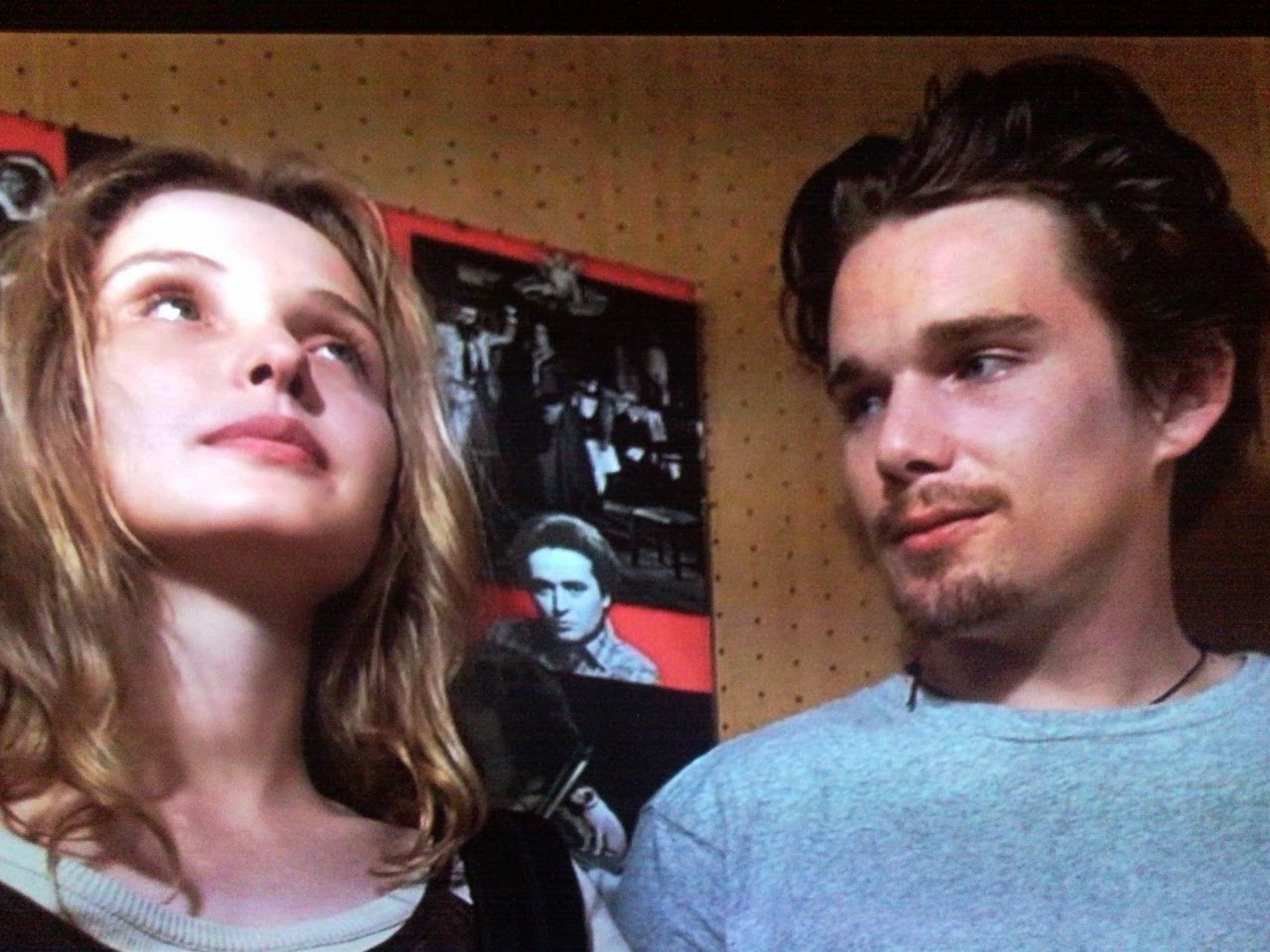
Ethan Hawke and Julie Delpy play Jesse and Celine, two young lovers of very different national backgrounds who by complete chance end up sitting together on the same train. They start talking but the train reaches Jesse's destination of Vienna (which is in Austria, not in Italy; apparently that's a common misconception). He has a flight back to America the following morning and invites Celine to come with him to see Vienna for the evening. She agrees and the rest of the movie is their interactions as they explore various parts of the city. They raise questions about what it means to be in love and try to have a great time before they have to leave each other in the morning.


Really, when you get down to it, it is the interactions between the two characters that really drives the film. Both leads deliver exceptional performances and play off of each other to great effect, which is good because Jesse and Celine are really the only major characters in the film. They encounter various other people but none of them are really anything more than a background role for the central relationship. 

There is not a single scene that goes by without at least one of them having something meaningful to say, but it never feels forced, rushed, or overly drawn out. The movie takes its time when it needs to but scenes never go on longer than necessary. In fact, if anything the way these two people play off of each other makes it all the more compelling. It's a bit like what I've suggested made My Dinner With Andre work so well: the simple interactions between two characters with very different personalities (and in this case, also from two different countries) is enough to drive the story.


Of course, the acting alone doesn't carry a film, but I can't name any specific flaws with the movie itself. The script works surprisingly well, with just the right balance of comedy and drama. There are lighter more humorous moments and other points that are more serious, and even a few in between, but it never goes too far one way or the the other.

The direction and cinematography are spot on, creating the perfect sort of atmosphere. Despite the minimalist structure the film also takes full advantage of its setting. As you can expect from a movie set in a location like Vienna, there is lots and lots of great scenery, both as backgrounds and for our two protagonists to explore.


This is definitely a movie I would recommend to anyone, even if like me you're not immediately drawn towards romance. As I'd always heard, it is so simple, but at the same time just so emotionally investing. It is a well-crafted film centered around two characters with wonderful chemistry, and almost certainly a must-see for any film buff.

I am curious to see where the sequels will go with these two characters, and whatever happens I'm looking forward to it. However, if they ever make a fourth one I can't help wondering what they'd call it. They're running out of times of day and "Before Noon" doesn't quite have the same ring to it.