Pageviews from the past week

Wednesday, 26 February 2014

A Look a Hard Science Fiction


DISCLAIMER: THERE MAY BE SPOILERS TO SEVERAL REALLY GOOD SCIENCE FICTION MOVIES HERE! CAUTION IS ADVISED!

As you may have gathered from reading this blog, I am a huge fan of science fiction, but one area in particular that I find interesting is the genre known as hard sci-fi. This is a very unique kind of brand, and one which is not commonly explored. I myself have even made a few efforts to contribute to this especially fascinating genre.

So let's look at what exactly defines hard science fiction. In short, it is a science fiction story like any other, but one which actively makes an effort to be as realistic as possible. Films of this sort attempt to incorporate actual science and when speculation is required they attempt to provide the most plausible version of how a scenario could play out.

Now one of the most famous writers of hard science fiction is Arthur C. Clarke, who wrote a variety of novels and short stories, many of which incorporated the most accurate science available when trying to envision the future. It is only fitting therefore that Clarke went on to become a technical advisor on arguably one of the best examples of hard science fiction in film: 2001: A Space Odyssey.


Speaking of sci-fi writers, it would also be worthwhile to bring up another case: Robert A. Heinlein (the original author of Starship Troopers), who also served as a technical consultant for one of the first hard science fiction films: George Pal's 1950 blockbuster Destination Moon. This was one of the first efforts to realistically envision the future of space travel. It might not be perfect, especially in light of the actual moon landings, but a lot of the basic scientific concepts still hold up surprisingly well.


This of course brings us to George Pal's other hard science fiction movie, the 1955 box office catastrophe Conquest of Space. This one also may be in no way perfect, but as an early attempt it does make a reasonable effort and may well have paved the way for later science fiction movies. I have previously analyzed this one in greater depth on its own, but here I can point out that this is one of the first to introduce the concept of a wheel-shaped space station, and idea that would later be popularized by 2001: A Space Odyssey.


To help round out the selection of films, we can look at something a bit more recent, and there are a few options to choose from. One of the best science fiction films in recent years is Carl Sagan's Contact, starring Jodie Foster. Though it deals with an age-old question (are we alone in the universe?), it is noteworthy both for providing realistic circumstances by which the discovery could be made, and also exploring the social and political consequences that realistically stem from finding solid evidence of extra-terrestrial life.


To finish off the comparison, I also have three other movies from more recently. The first of these is the recent movie Gravity, a very thoroughly-researched science fiction movie centered on astronauts trapped in orbit after their ship is destroyed. I also have Duncan Jones' 2009 film Moon, along with the more recent independent film Europa Report.


Now a full comparison is a tricky task. I can say it is very likely some of these films have had a major influence on one another, as you can see similarities upon close examination. A simple example would be to compare Moon's GERTY and 2001's HAL 9000.


You might notice a strong resemblance between both. In particular is the distinct "eye" and monotone voice. Also an interesting case in that Moon works this to its advantage. The fact that GERTY so obviously resembles HAL throws us off somewhat, especially with clues towards him having a hidden agenda. It makes it all the more surprising when GERTY turns out to be extremely helpful.

In both cases, it was a fault in programming due to human error (conflicting orders in the case of HAL combined with fear of being disconnected, and an unforseen loophole in GERTY's programming that allows him to act against his superiors), but while the outcome of one was frightening the outcome of the other was actually quite emotional.

On a related note, we can also look at how the Moon has been depicted over time across various works of hard science fiction. Destination Moon, 2001: A Space Odyssey, and Moon all aimed to present realistic visions of the lunar surface. In Destination Moon, we get an idea of what seemed like a reasonable idea of what the lunar surface might have looked like before we had actually launched anything into space. You can see some mistakes in the cracked ground and jagged mountains, however.


2001: A Space Odyssey was released only a year before the first moon landing. You'll notice its vision is far closer to the reality. Some of the jagged mountains are still present, but not as strong.


By the time we get to Moon, we have much clearer pictures of the lunar surface. The shots of a mostly smooth plane with small hills and craters is probably the closest to the photos of the actual moon.


However, far more interesting is to look at how the moon is treated in each of these films. Destination Moon was released before the moon landings, 2001: A Space Odyssey only a year early, and Moon a great deal of time afterwards.

In Destination Moon, the lunar surface is seen as an undiscovered country, the successful journey to which would be the greatest triumph of humanity (certainly the mindset during the Apollo Missions). In 2001: A Space Odyssey, we get to see a possible vision of where humanity could go after landing on the moon. The characters act as though living there is an everyday occurrence, but Kubrick still aims to impress us with the technology available in his world.

On the other hand, by the time we get to Moon, there's a very different outlook on living there. Sam Bell displays none of the excitement of sense of adventure felt by the heroes of Destination Moon. Instead, working on the moon is treated as a dull and boring job, as well as one that is excruciatingly lonely. To sum up simply: in Destination Moon, the protagonists start off on Earth and want to get to the moon. In Moon, the protagonist starts off on the moon and wants to get back to Earth.


On a related note, we could also compare similarities in plots. I have previously reviewed both Europa Report and Conquest of Space favorably, but when I was watching the former there were moments where I began to wonder if there was influence from the latter.

One area where I couldn't help finding this was a little trick used in both to create a sense of disorientation (though a little more sophisticated in Europa Report). The launch sequences of both films use an interesting series of shots to create a sense of disorientation within the weightless environment of their respective spaceships.


With these two cases, you get an interesting composition. For most of the film, the part that is usually the "bottom" relative to the camera during scenes on these ships is the back of the vehicle. This, however, creates an interesting effect when we see the "bottom" appearing to be the background, while the crew members in the foreground appear to be the right way up. 

Also, if you look closely there are details that help to indicate this (you may notice the seemingly horizontal ladder in the still from Conquest of Space, while in Europa Report you can see four of the crew sitting on what appears to be the background) 


Also interestingly, though this may be little more than coincidence, I couldn't help noticing some similarities between their endings. In both films, there is a problem with the mission that leaves the protagonists stranded at their destination for longer than originally planned (sabotage by the commander in the case of Conquest of Space, technical problems in Europa Report).

Still, what was more interesting was the efforts to get off. The outcome is very different, but the basic set-up is surprisingly similar. The climax of Conquest of Space has the heroes finally reaching a possible launch window and attempting to take off. Unfortunately, there is a sudden, really inconveniently timed Earthquake which causes the ship to tip over, with the danger of possibly falling under the ground. Fortunately, they are able to re-stabilize and take off.


Europa Report had a somewhat similar predicament in its climax. The remaining crew attempt to relaunch only to crash down onto another part of Europa, this time with much thinner ice (also an area where they already lost one member of the crew). Like Conquest of Space, there is danger in the remaining members of the crew having to figure out how to get off the moon before their ship sinks under the surface. 

The difference is that unlike the previous film, the crew fail to accomplish this. Two of them fall under the ice while trying to repair the ship outside and the third crew member presumably drowns when the ship is flooded, but in her final moments she is able to record proof of multicellular life under the surface of Europa.


On a similar level, we can also compare the climactic sequences of 2001: A Space Odyssey and Contact. Both are incredibly realistic interpretations of scientific discoveries, but there is a peculiar quality to the climax. Both films see their respective protagonists being sent on a strange journey through space by way of some form of dimensional gateway, at the end of which they experience a surreal encounter. Out of these two, Contact's is arguably the more straight forward as some explanation is offered, in contrast to the more ambiguous nature of 2001 which has baffled many a first-time viewer.


In both cases, we do get a sort of meeting with the aliens discovered in each film. However, neither one opts to actually show the aliens. Instead, both Dave Bowman and Ellie Arroway are transported to a strange world seemingly created specifically for them. Most likely this is done by the aliens to allow the human protagonists some degree of comfort in an otherwise unfamiliar environment. In Contact, Ellie is brought to a recreation of a drawing she made as a child based on her imagination of what Pensacola, Florida might look like. In 2001, it is depicted as a stylized hotel room. 

However, the actual confrontations are notably different in both films. In neither case do we see the aliens, but in 2001: A Space Odyssey, they seem to be more interested in observing Dave, while in Contact they are willing to confront Ellie directly (though appearing as a replication of her father). 


Throughout the final scene of 2001 you can hear strange ominous voices (possibly the aliens), and it appears Dave is being kept under observation. It is hard to tell precisely what is happening to him as we see him encountering increasingly older versions of himself, but in the end, as he lies dying, he finally gets a direct interaction with the aliens: he sees the monolith and it transforms into the next stage of human evolution.


This brings an interesting contrast in the motivations of the aliens despite their similar methods. Those of Contact are interested in... well... contacting humanity but wish to take it in steps. Those of 2001 are harder to explain, but while they seem to be interested in humanity, they are less willing to confront us directly so much as observe and to an extent guide our evolution from a distance.

Well, I hope you enjoyed this long-winded ramble about random facts comparing various hard science fiction films released between 1950 and 2013. Perhaps you have some hard science fiction films you've noticed some interesting things about. Maybe you'd like to compare something else about some of the films I've discussed or you've noticed something interesting about some other hard science fiction film I failed to reference. If you do you can share your thoughts in the comments.

I was hoping to find something to say about Gravity. Since I haven't been able to work that one in, here's a good picture I found from that movie. I can let you compare the film's depiction of weightlessness to several other hard science fiction films:


Tuesday, 18 February 2014

Europa Report: A Little-Seen Science Fiction Film From Last Year


2013 saw the release of a lot of great films, but when discussing science fiction films of this particular year, it is likely that the two to immediately come up will be either Elysium or Gravity. You might not immediately be aware of another science fiction film during that year, Europa Report.

I first heard of Sebastián Cordero's film Europa Report when I received a tip towards a special one-time screening. Unfortunately, the screening was only happening once and was timed so perfectly as to ensure there was no way I could make it. I subsequently vowed that one way or another I would find a way to see it. Unfortunately I was never able to find it on DVD, but after discovering it to be available on American Netflix I finally have had a chance to watch it, and it is really something.


If you've been following my blog (assuming you didn't just stumble across this article through a Google search or something), you probably know that I'm a big fan of science fiction. I've already reviewed the older, earlier attempt at hard science fiction Conquest of Space from 1955, and I've voiced my passion for Stanley Kubrick's 1968 classic 2001: A Space Odyssey and discussed Gravity in minor detail. This is the kind of film that ranks alongside those (among other hard sci-fi classics like Destination Moon, Contact, and Moon)

Much like the aforementioned movies, Europa Report is an effort to realistically envision the first mission to Jupiter's moon Europa while also exploring the long-discussed possibility of life existing under its surface. The story centers around a crew of six astronauts who are sent on this mission, but along the way they face unforeseen problems and extreme dangers that could cost them their lives.

Interestingly, though, unlike those films, Europa Report opts for a documentary-like style similar to District 9. I'm not normally a fan of "found footage" movies (if only because it's a bit cliche now) but here it is actually executed surprisingly well. The acting is fairly solid and the documentary style adds a level of authenticity to what we're seeing.

Of course the visuals and the science are incredible. The affects used to simulate weightlessness are solid and the design of the ship is also really impressive, with an appropriate sense of disorientation due to the environment. Then of course there's the shots of Jupiter and the impressive shots of Europa itself (which I dare say are on par with those of 2001: A Space Odyssey), both from orbit and the landscapes on its surface. That's not even getting into the incredible underwater scenes.


Above we have the landing sequence from Europa Report, below an actual photo of Europa.


The take-off scene of Europa Report (2013) has the two pilots appearing to be in front while the area that is usually treated as the "floor" (relatively speaking) appears in the background. Compare that to a similar trick used for the launch sequence in Conquest of Space (1955)


Europa Report is an excellent film. It is a brilliant piece of science fiction that sadly went unnoticed last year and is definitely worth your time. If you'd like a creative science fiction film with some emotional drama, incredible scientific realism, a few tense sequences, and a plot dealing with some intriguing subject matter, it is almost certainly worth checking out.

Monday, 17 February 2014

Why I Love Westerns


I've been saying a lot of negative things lately and doing a few hateful reviews, so I decided for this one to do something a bit more positive and look at something I like. As you may have already figured out I'm quite fond of the science fiction genre, but I've decided here to look at another area in which I have a certain appreciation for. That area is the Western.

It's hard to say just what it is about the Western that I enjoy. It's a genre that can be simultaneously formulaic and unpredictable. Usually you have some idea what you're getting into. You know there's probably going to be a showdown of some sort, though you can't be sure if it's going to be a one-on-one shootout between the hero and the villain (as in For a Few Dollars More, Once Upon a Time in the West, The Outlaw Josey Wales, Blazing Saddles, and Sam Raimi's The Quick and the Dead), a three-way Mexican stand-off (the famous climax of The Good, the Bad, and the Ugly, helped by the incredible music of Ennio Morricone), a survival course past numerous outlaws in order to get to the station before your train arrives (both versions of 3:10 to Yuma) a tense fight that goes on to include most if not all of the main cast (the shootout near the end of Rio Bravo), our heroes are going to be hopelessly outgunned but go out in a blaze of glory (Butch Cassidy and the Sundance Kid) or they're going to subvert your expeditions and skip any kind of showdown all together (as in No Country for Old Men and Red River, although both by very different means).

One of the most memorable showdowns in any Western.

Despite being a very formulaic genre, the Western does also seem to lend itself to a variety of memorable and lovable characters. From Clint Eastwood's "Man With No Name" to John Wayne as Chance in Rio Bravo to Bart in Blazing Saddles and his best friend Jim (most people call him... Jim) to the mysterious heroine of Raimi's The Quick and the Dead, not to mention Rooster Cogburn and Mattie Ross in both versions of True Grit.

How could we discuss Westerns without bringing up Clint Eastwood's "Man With No Name"?

John Wayne in Red River memorably shifts back and forth between hero, anti-hero, and villain.

The Dude in an eye patch. What's not to love?

It's not just the heroes either. For every good Western you need not just a great hero but also a great villain to stand in their way. There's plenty of those to go around: Lee Van Cleef as Angel Eyes in The Good, the Bad, and the Ugly, Henry Fonda as Frank in Once Upon a Time in the West (a role cast specifically to surprise audiences expecting him to play the hero), Harvey Korman as Hedy Hedley Lamarr in Blazing Saddles, and John Wayne as Tom Dunson in Red River.

The interactions between Hedley Lamarr and his right hand man Taggart are a source of comedic gold in Blazing Saddles.


I can't understand a word this guy says, but dang it his rousing speech in Authentic Frontier Gibberish is just so inspiring.

Then of course we've often got the impressive landscapes to enjoy. They vary between movies but usually in a Western you can expect to see plenty of desert, which allows for some excellent scenery. 

The very first shot of The Good, the Bad, and the Ugly we get an impressive landscape shot only for some outlaw to shove his ugly mug in front of the camera.

Even a modern Western like No Country For Old Men can't avoid the incredible desert landscapes.

Perhaps the interesting thing about Westerns is the fact that they play a significant role in film history. After all, one of the most significant early motion pictures was Edwin S. Porter's The Great Train Robbery. Contrary to popular belief, this was not the first motion picture to tell a story (that area had already been explored by Georges Méliès, most famously in A Trip to the Moon a year earlier). However, it was significant in being one of the first to explore then-revolutionary editing techniques such as crosscutting.

This scene might not look like much now, but when audiences first saw it 1903 they thought they were actually about to get shot.

Of course naturally it should hardly be a surprise that some of the biggest directors have made Westerns at some point. John Ford's name became synonymous with the Western, Howard Hawks is know to have done at least two great ones (Red River and Rio Bravo). Even one of my all-time favorite directors, Sergio Leone made a career primarily of making Spaghetti Westerns. In the present day we have people like The Coen Brothers (most memorably No Country for Old Men and True Grit, with some Western influence clearly present in The Big Lebowski). Another of my favorite directors, John Carpenter, even made his 1998 film Vampires because the script seemed to resemble a Western and you can certainly see that in the film's frequent use of desert landscapes and ghost towns.

Saturday, 15 February 2014

Alfonso Cuarón's 'Gravity': Is there a Chance that a Science Fiction Film Could Finally Win a Major Award?

Recently the Oscar Nominees are announced and unusually a science fiction movie, Alfonso Cuarón's critically acclaimed film Gravity was among the nominees for several major awards. This is an interesting development as science fiction has never been hugely popular with the Oscars. It is very rare to see a science fiction movie nominated for any Oscar, but we have yet to see one win anything higher than "Best Special Effects".

Once in a while we do see a science fiction film get nominated for one of the big Oscars such as best actor/actress, direction, or even best picture. These contenders include movies such as 2001: A Space Odyssey, A Clockwork Orange, Star WarsE.T.: The Extra-Terrestrial, StarmanAliensDistrict 9, Avatar, and Inception. So far, none of these movies have won anything higher than Best Visual Effects.

The greatest cinematic achievement of all time by one of the greatest directors of its age... not even nominated for Best Picture and lost Best Director to Oliver.


This brings us back into the present with a film like Gravity. When it was released it was a huge hit and a sensation among critics, but then again so was E.T.: The Extra-Terrestrial. 2001: A Space Odyssey is one of the greatest cinematic achievements of all time and yet only won Best Visual Effects (which, incidentally was also the only Oscar won by Stanley Kubrick, one of the greatest directors who ever lived). It's also being pitted against various other movies that have also received a great deal of praise and perhaps would be preferred by the Academy.

So what is the likelihood that perhaps this could change. Is there a chance at all that Gravity could break the cycle. Back in 2004 we did see The Lord of the Rings clean up at the Oscars, so it is possible for a genre film to win a major award, but that was fantasy and we're discussing science fiction.

One of the greatest achievements since 2001: A Space Odyssey, but can it succeed where its predecessor failed?


Though it is probably little more than optimistic thinking, I'm personally hoping that there is a chance of Gravity becoming the first science fiction film to win Best Picture. My guess is, however, that the Academy would give the award (along with Best Actress in a Leading Role and Best Director) to 12 Years a Slave or any of the other nominees first before allowing that to happen.

Wednesday, 12 February 2014

Jean-Luc Godard's Alphaville: A Lazy Incoherent Mess of a Film


I've already voiced my opinion several times on Jean-Luc Godard. If you've been following my blog you probably already know that I can't stand his works, and the only reason I still find myself watching them is because I'm studying cinema and can't seem to escape from him since no matter where I go my teachers end up subjecting me to his work sooner or later. Since I've brought it up a few times I thought maybe it would be worthwhile to do a piece specifically focusing on him.A general overview of his work would be harder for me to write, so instead I've decided to focus on a specific film of Godard's that a lot of people like but I consider an embarrassment to the science fiction genre. That movie is Alphaville.

Our hero, Lemmy Caution. Yes, that is seriously his name.


I had the misfortune of seeing Alphaville as part of an otherwise-quite-enjoyable science fiction class. For those of you who are (fortunately) unfamiliar with this film, it's supposed to be centered around a secret agent named "Lemmy Caution" (seriously) who is sent to the futuristic city of "Alphaville" to stop an evil scientist named "Dr. Von Braun" (I'm not kidding, they don't even try to make the reference subtle) who has built an evil computer that outlaws all human emotion.

I suppose I'd better start by jumping into the heart of the movie and pointing out why I consider its vision "lazy". You remember how I said that Alphaville is supposed to be "futuristic". Well, behold, Godard's incredible vision of a dystopian future:


Supposedly there's some absurd stylistic reason for this, but Godard presents us with a science fiction movie set in the future... and he makes absolutely zero effort to actually show us any kind of future. The extent to which he does so consists of characters offhandedly mentioning the word "galaxy". I'm not a huge fan of the stereotypical Jetsons-style future but even a flying car or two might have helped a little bit, especially since the way they use the word "galaxy" (i.e. "things are a lot different in this galaxy") seems to imply that intergalactic travel exists in this world and yet everything else resembles 1960's Paris. To paraphrase Inigo Montoya: "You keep using that word. I do not think it means what you think it means."

An actual galaxy: billions of stars across 100,000 light years. It makes you wonder if Jean-Luc Godard actually knew what the word means.


That there is really the biggest issue I have with the film. You can't just throw in the word "galaxy" and suddenly have a perfect vision of the future. That's not how science fiction works. Aside from his absurd depiction of the future, the plot really makes no sense, the characters aren't very interesting, and there just really isn't anything I found that I could consider a redeeming feature of any kind.

If you're a Godard fan and you disagree, fine. That's your opinion, but for everyone else, if you'd like a good dystopian science fiction film with an interesting vision of the future, you're not going to find it here. I'd advise you to instead stick to Blade Runner, Escape From New York, Twelve Monkeys, A Clockwork Orange, Metropolis, or even The Hunger Games for a film that actually makes an effort to create its own future world beyond mentioning the word "galaxy" once in a while.

Monday, 10 February 2014

The Tediously Slow Pacing of Andrei Tarkovsky's "Solaris" and Why the George Clooney Version is Better


There are some areas where I am in a small minority of people. I've discussed this sort of thing before. As you may already know I can't stand the works of Jean-Luc Goddard and saw Alphaville as nothing but an incoherent mess and a bit lazy considering the lack of any attempt to make his future world... futuristic. This is another area where I find myself in that position.

For those of you who don't know Solaris, it was originally a book by Stanislaw Lem, a famous 20th-century Polish science fiction author. It tells the story of Kris Kelvin, a psychologist trying to cope with the recent loss of his wife who takes a job investigating the strange behaviors of the crew of a space station orbiting the distant planet "Solaris". Upon arriving, he finds that the planet itself seems to be alive and encounters a replication of his wife, leading to emotional and psychological conflict both between himself and the other crew members. I have not personally read the book, but will be discussing two of the three film adaptations that have been made of it.


When the subject of the movie Solaris comes up, the discussion usually refers to either the 1972 Andrei Tarkovsky version, or the 2002 Steven Soderbergh version with George Clooney (most people don't know there was also a TV movie released in 1968). Most people will argue that the 1972 version is better, many of whom say the Clooney version "misses the point". There are a few people, myself included, who don't think the Clooney version is that bad a movie. However, I am also in an even smaller minority of people, to the point where I have yet to meet someone who shares my opinion. I am under the opinion that the Clooney version might well be better than the Tarkovsky version.

I had the misfortune of seeing the Tarkovsky version during the Christmas break, or at least part of it. This brings me to the biggest problem with the film: the pacing. Both versions are fairly slow-paced, but while the Clooney version keeps it under control, the Tarkovsky version is painfully long and far slower than it needs to be. It didn't take more than twenty minutes for Clooney to get onto the space station, but in the Tarkovsky version you have to wait literally an entire hour just to get into space. Up until that point you just have a bunch of scenes that seem to go on much longer than necessary like that one scene about 30 minutes in that is just a bunch of tracking shots in which the camera moves along various roads and nothing happens. 


In Tarkovsky's version, a large portion of the beginning is the main character watching this: a group of bearded men talking about Solaris and its effects on astronauts "Solarists". You remember that old rule of cinema, show, don't tell? Well, in the Clooney version you were actually starting to see some of it by this point.


To be totally honest it actually took me two attempts just to get to the space scenes. The first time I shut the film off right around the point we got to the unnecessary extended shots of roads and instead put on the Clooney version. The second time I shut off right around the time the first projection of Kelvin's wife started to appear.

So to recap, around the 45 minute mark in the Tarkovsky version, we were seeing a bunch of people talking about Solaris, several other scenes that went on too long, and a bunch of unneeded POV shots of an automobile driving along various roads. If you want to get to the actual plot of the movie, you have to wait about an hour before our hero gets into space. 

To provide a contrast, in the Clooney version, Chris Kelvin arrives early on. We do spend a bit of time getting some exposition but just enough to get a general idea of what's going on. By the 45 minute mark in that version, the replication of Kelvin's wife has actually shown up at least twice and the plot is starting to get somewhere, while his counterpart in the 1972 version hadn't even gotten off Earth yet.

So the pacing is my main concern with the movie. I've explained that the pacing of the Clooney version is far superior to the Tarkovsky version, so maybe the rest of the movie is okay, right?

Well, to be honest, I'd have to disagree. I didn't really see anything in the 1972 version that caught my interest. Even the visuals I felt were handled more effectively in the 2002 version. I thought the sets looked far more convincing in the Clooney version, and they seemed a bit fake in the Tarkovsky film.


Some people may think I'm crazy to think this, and indeed many are shocked to hear me make such a radical claim. I honestly feel Soderbergh did a better job with this story than Tarkovsky. Somehow I find his version was far more more memorable and compelling, while Tarkovsky's was just needlessly long and tedious.

Sunday, 9 February 2014

Why Do People Like James Bond?


Ah, James Bond. That super-awesome lovable badass super spy and all-around really great guy and excellent role model-

Hang on, what is this?

 James Bond is in a barn with his latest girl and... HE FRIGGIN' RAPES HER! Um... yeah... this guy was supposed to be the hero right? He's supposed to be the good guy that we're supposed to be rooting for and here he is sexually assaulting a young woman. Okay, you could argue that the woman does eventually consent but Bond still has to force himself onto her and she clearly tries to fight back. And the worst part? This scene is somehow supposed to be charming.

Ever since I watched Goldfinger for a class a few years ago I have found myself perplexed by this situation. The fact of the matter is that James Bond is incredibly sexist, and the worst offender is, ironically enough, Sean Connery i.e. the Bond that everyone else usually says is the greatest. Every time I hear someone (especially women) talking about how much they love Bond I always find myself thinking about scenes like this one, where Bond is, like it or not, a misogynistic jerk who seems to see women as little more than sex objects.

In the old films he'd sometimes go through four or five girls in one movie, usually moving onto one almost immediately after the last gets killed with almost no time to grieve (another example comes from a different film I'd seen before Goldfinger: You Only Live Twice, where Sean Connery's Bond spends about three quarters with one girl, only for her to get killed off and Bond to end up falling in love with some other female agent who was only present for the climax).

So why is it that Bond has such a fan base after all these years? That is hard to say, part of it may stem from the fact that more recent films have gotten a bit better about this (say what you will about Goldeneye, at least Bond didn't go through five different love interests), but many hardcore fans still defend Connery's Bond.

To bring up an analogy, let me refer to an older movie: Birth of a Nation. This was a film made long before Bond and was every bit as significant a part of film history as Bond, and possibly even more so (given most modern film making techniques came from it). The thing is, most people who aren't film historians or students tend to pretend this movie doesn't exist. Why? Because the story is incredibly racist and involves a glorification of the Klu Klux Klan.

From Birth of a Nation (1915): the heroic Klu Klux Klan has captured an evil black man and... WAIT WHAT?

I cite this example because it seems a double standard to me. Why is that most people will shun a film as blatantly racist as The Birth of A Nation and then go on to ignore the prominently sexist elements of James Bond films while talking about how awesome he supposedly is? (or might have been if he didn't treat women like crap)

As you've probably guessed from this post, I am not a fan of James Bond. Before anyone brings it up: yes, I am aware that some of the more recent incarnations have gotten better about this, at least starting with Pierce Brosnan in the 90's if not earlier. One of these days I might even work up the nerve to try watching one of Craig's Bond films. However, that does not change the fact that most fans point to Connery as the definitive James Bond. In other words, they look at a misogynistic pervert who likes to sexually assault every woman he sees and think "Wow, THIS is the guy I want saving the day."

The name's Bond. James Bond. I'm going to save the da- Wait, what do you mean I'm under arrest for multiple counts of rape?

Thursday, 6 February 2014

My Favorite Directors


As a cinema enthusiast, I often get asked a certain set of questions. One of the most common ones is "what's your favorite director?" This is a question I get asked a lot and don't really have a definitive answer to, so usually I have to start listing the directors I like. I thought it might be worthwhile to compile some of my personal favorites into a list. I was thinking about doing a "top ten"-style list but I'm not going to rank them.

Since there's a lot of directors I like it would be hard to go into all of them, so for the purposes of this list, I'm going to focus specifically on those who I feel have had the strongest impact. For each, I also think I'll include a particular favorite of that director's work. I have selected four of which to discuss. I do present a fairly diverse body of work for each, though there may be some limitations (all of them are white men and only one is not American)

Also, some of you may be surprised to find out that Alfred Hitchcock is not on this list.

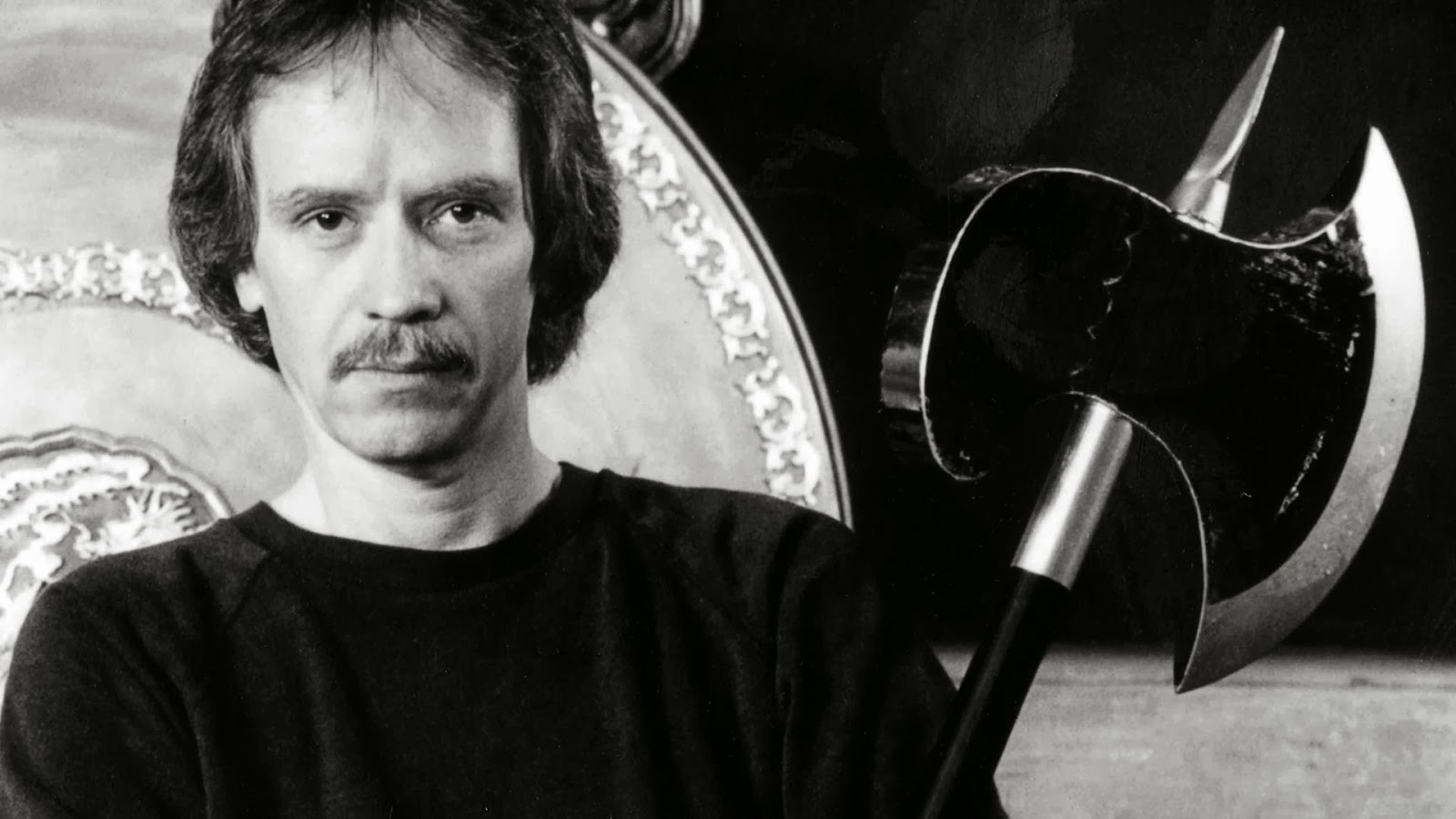
John Carpenter


 This is a character I might have been completely indifferent to if not for a specific project I did in High School examining his work. Carpenter also has a unique place on this list, as he is currently the only one of these directors I have actually had the opportunity to meet.


Carpenter is an interesting character with an extremely diverse range of work. He is often recognized as the "Master of Horror" but there is really so much more to him than that. He has done some excellent horror work (and in fact one of my favorite films of his fits into the horror genre), but he has also made some interesting action films, science fiction, comedy, and romance. In fact ironically my least favorite movie of his is Halloween, followed by The Fog (which I don't hate quite as much but still feel is weaker compared to some of Carpenter's other films), but barring those two exceptions there has never really been a film of his I can honestly say I didn't enjoy: even Ghosts of Mars and Escape From L.A.

I suppose what I like about Carpenter is his diversity. Though he is best known for his horror movies he enjoys trying out different things. 

The Thing


I like most of Carpenter's movies but The Thing has a tendency to stand out for me. It's hard to pinpoint exactly what makes this particular film work: between the solid acting with only two big stars (the others aren't completely unknown, but certainly aren't as well-known as Kurt Russell or Keith David), the brilliant special effects, the claustrophobic atmosphere, the total sense of paranoia that these men endure. It is a rare case of a remake that may actually have improved on its predecessor (The Thing From Another World is a decent movie in it's own right, but is also quite a bit different). 

Stanley Kubrick


2001: A Space Odyssey


2001: A Space Odyssey is one that often comes up when I'm talking about movies. This isn't just, in my opinion at least, Kubrick's ultimate masterpiece, but also one of my all-time favorite movies. In fact, this film may have had one of the most significant impacts on me, as it is possibly the movie that got me interested in cinema to begin with.

I could go on about everything that makes this film so great: the scientific realism, the visuals, the soundtrack. 

Sergio Leone


I'm not normally a huge fan of foreign cinema. I had to watch Fellini's  in cinema studies class and found it to be kinda frustrating and confusing. Sergio Leone, however, is an example of Italian cinema at its finest. He really only made seven movies (eight if you include his uncredited work on The Last Days of Pompeii), one of which (The Colossus of Rhodes) has more or less faded into obscurity, and all but one of the rest were spaghetti Westerns. 

What makes him interesting is how he handled his Westerns, not being confined to the formulaic structure of classical Hollywood. This gave him the opportunities to play with conventions in ways even John Ford (an earlier director known for his Westerns) could never imagine. To provide a simple example is the famous "quick-draw" move displayed by Clint Eastwood, which has been repeatedly copied in countless Westerns since (and taken to it's logical extreme in the case of Jim from Blazing Saddles). 

Even disregarding his influence, Leone's Westerns (and his one gangster film) are just so well executed. All of them feature extremely memorable characters ranging from Clint Eastwood's "Man With No Name" to the emotionally troubled demolition expert John Mallory in Duck, You Sucker! They also come with an excellent theme by Ennio Morricone, which always blends perfectly with the environment.

Once Upon a Time in the West


As great as The Good, The Bad, and the Ugly was, this was the movie that really showcased Leone's talent for Westerns. Here he took everything he learned from his previous films and created something entirely new. Of particular note is the use of sound, a trademark of Leone's, and minimal dialogue.

David Lynch


This one may sound massively hypocritical on my part. I have before voiced my disliking for Jean-Luc Goddard and lack of interest in the works of Fellini, and often refer to those films as "weird", yet I admire a man like David Lynch. As with many of these directors it is hard to pinpoint exactly what it is I like about his work. His more straight forward films are extraordinarily well-executed and have plenty of emotion (The Elephant Man and The Straight Story being two good examples). 

Perhaps it's the fact that he never tries to tie himself to one type of film and does whatever he wants. He never seemed to make the same movie twice, even if there were patterns that emerged among his work. In fact it's hard to find one particular film of his that stands out. Whereas with many of the other directors on this list, I can usually identify one particular film as their best, it is much harder to do so with Lynch. Most of his movies seem to have some element that stands out and remains in your head. 

Lost Highway


This particular movie is an interesting one and a good example of how Lynch plays with conventions and does his own thing. I personally find the whole structure interesting, how the film sets up one plot and draws us in only to abruptly change everything, introducing a new protagonist who has never been seen before and beginning a whole new plot with very few connections to the previous one (it is only at the end that both threads meet, and then things get weird).