Pageviews from the past week

Tuesday, 8 April 2014

Duck, You Sucker!... Or Maybe Don't


Sergio Leone had a very small (though influential) body of work, but there are a few films of his that tend to be overlooked. Many forget his (uncredited) directorial debut in The Last Days of Pompeii as well as the feature that followed: The Colossus of Rhodes. Those two were followed by Leone taking a job working on a cheap spaghetti western to make up for the studio's previous failure, which would become A Fistful of Dollars and which in turn would become such a success that Leone was launched to fame and given incresingly larger budgets with which to make For a Few Dollars More and The Good, the Bad, and the Ugly. He then went on to direct Once Upon a Time in the West and Once Upon a Time in America.

There is one movie I left out of that description. It is an easy one to forget of Leone's known in English by one of two different titles: Duck, You Sucker or A Fistful of Dynamite (even DVD copies tend to print both titles). If you've been to my YouTube Channel you may have heard of this film, in which case I'd imagine the first thing you'd think of is John Mallory's relentless determination to blow up Hitler for no readily apparent reason.


But what of the original movie? The parodies are hilarious but let's look at the film as Leone originally intended it. Rod Steiger plays the role of Juan Miranda: a Mexican bandit trying to provide for his family who is really only as rough as he is because it's the only way to survive.


James Coburn plays the role of John Mallory, an Irish demolitions expert who has a tendency to blow things up (though it is taken up a few notches in the parodies). He also has a dark past involving a friend who betrayed him, which becomes a major impact on his actions in the present.


Both men cross paths in the midst of the Mexican revolution, and team up to rob a bank. However, that plan soon takes an unexpected turn and Juan finds himself forced to join the Mexican rebels. Most of the movie centers around the relationship between these two characters: a sort of uneasy friendship that develops between them (though they're not above double crossing each other).


When you get down to it, the whole movie is really about deconstructing the concept of a "revolution". The Mexican revolution provides a backdrop, but at its core it's really about the ethics of revolutions in general. Revolutions are violent and ultimately never justified. Even if the people conducting the revolution have noble intentions, thousands of people will die for nothing, and ultimately the rebels seem no better than the oppressive government they are fighting against. There's even a really good scene where Juan pretty much sums up the whole theme of the movie:


There's no doubt the movie can be pretty disturbing at times, especially in the second half when we really start to see the darker side of revolutions. It does take a strong stomach to sit through the scenes of mass executions by firing squad.


From a technical standpoint, Duck, You Sucker! is also a pretty well-done movie. Coburn and Steiger do play well off of each other, the action scenes are appropriately tense, and the darker scenes can get pretty emotional. As you might expect from a Sergio Leone film, we also get a great soundtrack by Ennio Morricone, some very interesting ways to utilize sound to different effects, and plenty of great landscapes. It is definitely an underrated film of his, and one worth checking out, so don't duck, you sucker, or you might miss it!

Monday, 7 April 2014

A Tribute to Mickey Rooney


I found out this morning that legendary actor Mickey Rooney died at the age of 93. I'll confess that I mainly knew him by name, and had only seen the man himself in a handful of movies, but I respected his talent. There was no doubt he could act, and he did have a variety of characters.

The film I've often found myself identifying him with is Breakfast at Tiffany's, where he plays a character that would probably be considered a racist stereotype by modern standards. Even with the glasses and buck teeth, however, I always find that every time I see the film I still enjoy his performance and can't help but laugh at his slapstick antics, not to mention he plays really well off of Audrey Hepburn.


There is no doubt Mickey Rooney was good at humor. It's a Mad, Mad, Mad, Mad World saw him play a very different sort of character who gets into equally hilarious situations, especially after he gets stuck at the controls of the plane while the pilot is passed out drunk in the back.


I can't find much to say about Mickey Rooney as an actor or as a person. What I can say is he was a great actor with a lot of talent that was put to excellent use. According to IMDB he was even still acting before he died, playing a part in a still-upcoming adaptation of The Strange Case of Dr. Jekyll and Mr. Hyde, which is quite impressive given the span of his career.

Sunday, 6 April 2014

The War of the Worlds: The Old and the New


I remember I was in Grade 5 when I first read a (abridged) version of H.G. Wells' incredible novel The War of the Worlds. I was quickly hooked in and fascinated by the whole idea. When I heard there was a movie based on it I was keen to see it, and I've seen it quite a few times since. Even more exciting was finding out Steven Spielberg was making another version. I didn't get a chance to see that one until last fall.

Now to be fair I have been somewhat critical of the fact that both George Pal and Steven Spielberg's adaptations modernized the story and placed it in America. In fact one of my dream projects if I were to ever become a director is a rendition that actually uses the original book's setting of Victorian England. Still, both the 1953 film and the original H.G. Wells novel captured my imagination. 

More recently, I recall being really excited when I heard the Nostalgia Critic was planning to do an "Old vs. New" of War of the Worlds. As I later found out, that never happened, largely because according to him he couldn't get enough material to make a decision which film won. To be fair there are things I liked about both but they also had their flaws. I'm not going to make any statements about which one is better, but I am interested in discussing and comparing both films.

Now it's been a while since I've read the book in full, but neither George Pal or Steven Spielberg stick strictly to Wells' narrative. You can definitely see its influence on both, but they are quite a bit different. Pal's film uses a similar setup and employs several moments reminiscent of the original book. 

For instance, the original novel had a segment where the narrator was stranded in an abandoned house after one of the Martians' cylinders crashes into it, and he has to keep quiet without being noticed. A similar sequence is in the movie, but it happens shortly after the Martians begin their invasion (whereas in the book they had completely decimated England and this happened towards the end). 


Similarly, the Spielberg version also preserved certain details from the book, but also took the story in a few new directions. One thing worth noting is that the central character is an ordinary man caught up in the chaos that ensues from the war, which is actually much closer to the book (which was told from the point of view of an unnamed journalist). 


In both cases, there are strong deviations, some of which work, others not so much. I remember in Spielberg's version being pleasantly surprised to see the inclusion of the red weed, a detail omitted from the 1953 movie.


However, that's not to say the Spielberg version was any closer to the book than the George Pal version. While there may have been more obvious parallels, there were some drastic changes. For instance, the setup is quite a bit different here. In the book (and Pal's version), the Martians first arrive in a large capsule. There's actually a fair bit of time spent detailing the curiosity experienced by the characters over this encounter as they try to figure out what is going on, before seeing a door beginning to unscrew itself. The "lid" finally comes off and we encounter the Martians' chief weapon, the heat ray. There is still some time between the initial appearance of the heat ray and the first encounter with any of the machines.


Spielberg's version happens much more quickly. The aliens (which aren't explicitly stated to be from Mars, probably because we know a lot more about the planet now than Wells did in the Victorion period) instead arrive in some sort of beaming device that looks like bolts of lightning, followed by one of the fighting machines suddenly coming up from the ground and attacking everyone present.


Another change, one which really pissed me off, about the Spielberg version was he omitted one of the most important parts of the book, and I felt like his justification was incredibly weak. Quite simply, the book had an important catalyst in the role of a warship called the Thunder Child. When Wells wrote his book, this was the most powerful technology the military had to offer, and it is a crucial part of the story (although the narrator himself isn't actually present when it happens, but simply relates his brother's account of those events).

The point of that scene was that the most powerful weaponry available ultimately fails to do more than stall the Martian invaders, which marks the point where mankind seemingly loses all hope of defeating them. Granted, the Thunder Child does not actually appear in the 1953 version either, but has a rough equivalent in the form of the atomic bomb, which essentially serves the same purpose as the last hope for mankind that ultimately proves futile.


Spielberg's film has all the setup, with crowds of panicked people pushing and shoving to get on boats to escape, and the Martians cut them off, but no Thunder Child. According to IMDB, this was because the Thunder Child was a British warship. That seems like a lame excuse, since last I checked America had a pretty solid navy, and I don't see why they couldn't just have an American warship with the same name. Even if they wanted to restrict the perspective to the central character they could have at least shown part of it, since he was in a position to glimpse such a conflict, even if the actual outcome was only revealed later.


The George Pal version also had some major changes from the original book. The most obvious would be that the fighting machines are shown flying instead of walking on tripods like the book and the Spielberg version (although this was allegedly for practical reasons, mainly because Pal wasn't sure how to animate the legs, and it is alluded to briefly with three beam-like things being visible under one of the machines in one shot).


The other major change is in the nature of the protagonist. The book described the military's efforts to combat the Martians, but it was also told from the perspective of a journalist who spends most of the story just trying to survive. Any information he gave of the army were either instances where he was present to witness it or him relating other people's accounts of those events. Pal's film changes this slightly, having the protagonist being a scientist who works with the military. He never actually manages to find a solution to stop the Martians, but he does make an effort.


It is interesting that, with all the changes, both versions still preserve the ending of the original book. In the Wells novel, all of mankind's greatest weapons have failed, and the Martians have taken over the Earth. The narrator is left to a mostly abandoned England, populated only by extremely sparse groups of survivors. Eventually, he becomes depressed and finds himself willing to allow himself to be killed by the Martians, but as he arrives, he finds that they're all dead. After everything humanity could do has failed, the Martians were finally killed by bacteria, which we have grown accustomed to but which the their bodies couldn't handle.


Now let's stop talking about the book for now and just discuss the two films on their own merits. George Pal's version may have some dated effects (though I'd say the models still look pretty good), but I've always found it did have a sort of strange charm. It also has a certain amount of significance as one of the films to play a role in launching the "alien invasion" subgenre of science fiction, which would become insanely popular during the 50's and still carry on to the present day. Spielberg's version manages to do a reasonable job of capturing the general chaos of the book, but I still feel the Pal version wins over. I'm not entirely sure why.

Saturday, 5 April 2014

Raging Bull: A Miserable Mess of a Film


I like Scorsese as a director. He's done some great films: Taxi Driver, Goodfellas, The Aviator, Shutter Island, and Hugo were all excellent movies made under his direction. Scorese and Robert De Niro go together like Clint Eastwood and Sondra Locke, John Carpenter and Kurt Russell, or David Lynch and Jack Nance. Put the two of them together and you can get some really good movies... most of the time anyway.


During my short-lived stint in college, I was enrolled in a film studies course that had a frustrating way of working. Every week, our teacher would have a new movie for us to look at, but she only once ever screened a movie in full, and that was in preparation for the exam (we were expected to write a short essay comparing Out of the Past to one of two possible movies, one of which was Breathless; having to watch that film was my first real exposure to Jean-Luc Godard). Instead, she gave us a syllabus that labelled each week, and gave us a movie she expected us to watch on our own time.

Even more irritating was the fact that the majority of the movies on the syllabus were obscure and/or foreign movies. She expected us to somehow, in the period of a week, acquire some obscure movie from the other side of the movie on DVD and watch it. Once in a while we got something a bit more plausible (though I still ended up seeing North By Northwest a week late), but as you can imagine I quickly fell behind.

When I saw Raging Bull on the list, I got excited, since it just so happened I'd obtained a file of that movie, which wasn't the most ethical way of watching it but still allowed me to see it in time. I thought I could finally start catching up and things would get easier.


I didn't get more than thirty minutes in before I shut it off in frustration from not being able to understand it. I eventually had to sit down and watch it in full, frequently referring back to a plot synopsis to keep track of what was happening, but that was an extremely painful experience. This was really an Oscar winner? If you ask me this film stole an Oscar that rightfully belonged to the other black and white historical drama nominated that year: David Lynch's The Elephant Man.


So what's my problem with the film? Well, for starters there isn't much of a plot to it. Supposedly it's about a boxer who has a bad temper but it took a plot synopsis off IMDB to understand that. The movie really seemed to keep jumping all over the place without ever really developing anything. There were a lot of scenes of Robert De Niro in the boxing ring and occasionally his interactions with other characters. The way it does that is exceptionally jarring, and doesn't really draw you into the world of the story. I also never really found myself connecting with De Niro's protagonist.

If you want a good boxing drama, you'd be better off with something like Million Dollar Baby. That movie actually makes sense and has a point, and deserved the Oscars it won much more than Raging Bull ever did.


Thursday, 3 April 2014

The Non-Existence of Female Astronauts in Older Science Fiction


It's an interesting experience watching older, perhaps somewhat dated science fiction movies, as well as reading old stories. As long as you can remind yourself that the people behind those films lacked the information available to us now, it is still possible to enjoy old stories of space exploration.

Of course from a technological standpoint, the claims of some can be jarring. We're still waiting on those interstellar-travelling flying saucers Forbidden Planet promised we'd have by 2002 and any story claiming Venus is capable of supporting intelligent life seems outright insane now that we know that planet is a blazing inferno with an unbreathable atmosphere and temperatures supposedly hot enough to melt lead. You just have to remember that the filmmakers did not have access to the same information we have now. Conquest of Space had some notable errors in its vision of the Martian surface, but back then they didn't have any of the photographs of Mars that we do now and certainly hadn't sent probes there. In fact, given how little they had to go on it was impressive they came as close as they did.


Now, technology of the future isn't the only thing that older science fiction movies occasionally tend to make mistakes about. Another area that also can make the experience of watching an older science fiction movie, especially one from the 1950's, to seem particularly jarring is the failure to predict certain changes in society.

Recently, we had the success of Gravity, a tense, critically acclaimed science fiction thriller centered almost entirely around a female astronaut. These days, most astronaut movies, barring historical films like The Right Stuff or Apollo 13, usually tend to have a reasonably co-ed crew aside from a few rare exceptions such as Moon.


The idea of an astronaut being stranded by themselves in space had been used before, but was usually done with a man, as is the case of Sam Bell in Moon or the earlier example of David Bowman in 2001: A Space Odyssey.


Before Gravity, the closest examples I can think of involving a woman in this scenario are Ellen Ripley in Alien (which was only for the final act) and Eleanor Arroway in Contact (where the isolation is not given as much focus, and again, it's only for the final act, even if it's the most memorable part of the movie)


However, things were a bit different back in the 1950's, and if you look at older stories of space exploration, you see very different casts in many cases. To bring up an icon of the genre from that time, Forbidden Planet opens with a narrator hastily explaining mankind's achievements, talking about how men and women would land on the moon in the 90's (which oddly enough, might be seen as slightly ahead of us, since even today we've never actually put a woman on the moon) and begin travelling through interstellar space by 2002. 

They do say men and women, so that all seems well and good, like there's some reasonable gender equality in the future. Then we see the group of characters who will serve as our protagonists: a massive expedition crew that happens to be made up entirely of white American men. My guess is that I may have misunderstood what they meant by "men and women" going into space, and what they probably meant was women going into space colonies established by the men to get married, likely acting as a woman would have been expected to in the 1950's, as opposed to men and women both going out to explore space together.


Indeed, a lot of old science fiction stories tended to have all-male expedition crews. You can see this very clearly in a ton of Ray Bradbury's older short stories (The Illustrated Man is an anthology that contains several examples of this), along with movies like Forbidden Planet. Now, female astronauts weren't completely unheard of. They did pop up from time to time in films like The Angry Red Planet or Rocketship X-M.


However, let's take a look at some of the better remembered science fiction of the period. Rocketship X-M does have a certain fanbase but we can't forget it was hastily put together to compete with the blockbuster Destination Moon, which also happens to be one of the first science fiction films to attempt to be as realistic as possible. Naturally, this resulted in having the narrative center around four men.


Later on, George Pal made the 1955 film Conquest of Space which talked about "men" building the Wheel. We naturally see an all-male crew, along with a massive number of people aboard the Wheel and no women among them. In short, according to this film, along with Destination Moon, Forbidden Planet, and various short stories of the early 20th century, female astronauts don't exist.


2001: A Space Odyssey was slightly more lenient, having been made while the women's rights movements were really taking off. It was also released only a few years after Valentina Tereshkova became the first woman in space, disproving the earlier depictions of all-male crews (though America didn't launch its first female astronaut until 1983). As a result, female astronauts do exist in Kubrick's world. In fact, we see Dr. Floyd have a short conversation with a group of four astronauts, only one of whom is a man.


However, even then it's still a very masculine vision Kubrick has of the future. Outside of the scene where Floyd talks to these three women (who curiously enough, happen to be Russian, perhaps something to do with the nationality of the first woman to go into space), there are women among the extras in the briefing scene at Clavius.


However, the rest of the women we see are in more stereotypically feminine professions. The most obvious would be the stewardesses seen on the shuttles to the space station and the moon, but we also see women working as secretaries aboard the station and the first line of dialogue in the film is spoken by a female lift operator.


While there are women visible in the briefing scene at Clavius, it is still the men who do all the talking. Later on when Floyd is taken on an expedition to see the greatest find of modern science, he is also in a group made up entirely of men.


This in turn brings us to Discovery, wherein the active crew consists of two men with another three in hibernation. At this point the only woman to appear is Frank's mother in a transmission. Now even today with a crew of that size it's not inconceivable that a mission like this could still consist entirely of men (although it would be less due to any prejudice of the time and more just a case of it being a small group of people and all the individuals who best fit the strict requirements for the crew just happened to be men), but it is still worth noting that there is no obvious indication of any women being involved. To be fair, though, the less popular sequel 2010 does have a strong female lead among the crew, and the Arthur C. Clarke novel it was based on actually had several major female characters.


Natalie Rae Wass in the role of David Bowman for the stage version of 2001: A Space Odyssey. Yes, apparently that exists. You can read about it here.


Even Carpenter's 1974 film Dark Star opted for an all-male cast, though again it is small enough that it isn't too far-fetched even today. However, the opening crawl does use the term "men" in reference to the crews of ships like Dark Star.


If I were to make any sort of guess, I would say the movie that finally changed it all would be Alien. The women's rights movements were finally getting somewhere in the 1970's and Ripley just happened to be a very good, strong female lead for the time period. Much like the Hawksian woman, Ripley was just one of the guys, but this time she didn't get a central romance, and of course she ultimately had to defeat the alien single-handedly after it killed everyone else in the crew.


Thanks to Ripley, most modern science fiction, barring rare exceptions like Moon (where Sam Bell was the only crew member) usually tends to have much more gender diversity in its cast. Stories of space exploration are no longer about "men" journeying to other worlds, but about "men and women" venturing outwards to explore the solar system and beyond.


Wednesday, 2 April 2014

The Unusually Progressive Women of Howard Hawks


In my cinema studies classes I've had to watch a lot of movies. There's been some really great ones, and other times ones that aren't so great. I've frequently found myself forced to watch popular movies that I really can't stand (I really did not like Raging Bull, even though I don't have anything in particular against Scorsese, and feel that The Elephant Man should have won those Oscars). On the other hand, with all the bad stuff, there is usually some good to be found, and one such opportunity came up recently. This same class forced me to watch Playtime and Tout Va Bien; but I also got exposed to some great movies like A Man Escaped. I've decided here to look at one of my more positive experiences of the class, which was to examine the work of a specific auteur. The man in question was Howard Hawks.


I was certainly no stranger to Howard Hawks before I took this class. In fact I'd somewhat accidentally built up a small collection of his movies (by "accidentally", I mean I obtained them either as gifts or for other reasons and only afterwards realized they were by the same guy): The Thing From Another World (which I'd mainly purchased because I'm a huge fan of Carpenter's The Thing), Bringing Up Baby, Red River, (both of which I received as gifts from family), The Big Sleep (the result of a short-lived attempt to explore the realm of film noir), and Rio Bravo (because I caught a small portion on TV once and really wanted to see the rest of it). I'd also previously seen the film His Girl Friday for another class. Naturally, I'd developed some respect for this guy already, but examining him in my class did allow me to understand him a little better.

The three movies of his we saw in the class were His Girl Friday, Bringing Up Baby, and Rio Bravo, all great movies that I had some familiarity with. There definitely were some patterns I could see in those films alone, many of which extended into the other films I'd also seen, including The Thing From Another World (of which he is only credited as the producer, though there's some dispute over how much influence he and the credited director Christian Nyby actually had over the movie)

One thing that's always fascinated me about Howard Hawks is his female characters, which were remarkably progressive given he was working primarily in Hollywood while the Studio System was still in place. A trademark in his female characters is that they have a tendency to "intrude" upon what would normally be an all-male group, but eventually work their way to being "one of the guys". In other words, Hawks women were usually equal to the men.

The first time I saw His Girl Friday I was a little bothered by Hildy Johnson's attitude of wanting to settle down and be "a woman", since given the time period and her current position that basically entailed giving up her rights. It was only later on I realized that the idea of a strong, sharp-witted, and intelligent woman running a newspaper, being their best reporter, and being treated as 100% equal by her (male) colleagues was pretty impressive for a movie released in 1940. Even better is that the movie seems to know this, with a minor running joke in the men placing bets on how long it's going to take before Hildy returns to the paper and the fact that she ultimately sticks to her career as an ace reporter. (although on the condition of re-marrying her boss and getting a proper honeymoon this time)


There is actually this interesting sort of dynamic that often emerges with the female leads in Hawks' movies. They almost always have a romantic relationship with the protagonist, but its not exactly love at first sight... at least not entirely. You see, women in Hawks' movies are hardly submissive. Hildy Johnson is a good example of one of Hawks' smart and sharp-witted female leads, as is Nikki Nicholson in The Thing From Another World, Feathers in Rio Bravo, and to a lesser extent Susan in Bringing Up Baby. In every case there is a sense of mutual attraction early on, but at the same time both the man and woman actually have to earn each other.

We can see this sort of dynamic play out throughout many, if not in fact, all of his movies. However, to bring out a straight forward example, this is definitely present in Bringing Up Baby. Katherine Hepburn's character of Susan is a lot of fun, and it is clear there is some attraction between her and Cary Grant (even if he's reluctant to admit it), but they have to go through a lot before they can be together. Susan herself is also a very intelligent (if extremely clumsy) young woman who has a tendency to constantly improvise her way out of trouble (and frequently distract the local sheriff from his job by way of casual chatter), and Cary Grant's character of David also has to adapt to keep up behind her every step of the way despite his very reclusive and bookish personality.


Nikki in The Thing From Another World is an interesting case as well. Like most of Hawks' female characters, she is already one of the guys right from the start, even wearing pants for most of the film. There is a sense of mutual attraction between her and the protagonist Captain Pat Hendry, but as usual they have to earn it. The part that I find especially interesting (even if the poster may suggest otherwise) is that she always manages to stay calm, never simply expecting Hendry to save her (she even gets a moment near the end of the film to help everyone when she is able to notice something crucial because she wasn't involved with an argument between some of the men). The one time she does raise her voice, it's at the very end and because she's trying to alert Hendry to a serious problem that threatens everyone present (which is also resolved pretty quickly).


I remember the first time I saw Rio Bravo, I half-expected Feathers to show up with a rifle in the middle of the final showdown (especially after the unlikely arrival of Stumpy and Carlos, Colorado even jokes about it). She didn't, and she only once ended up being taken (and even then was never really rescued so much as released when Chance complied with the demands of her captors), and in fact even managed to save Sheriff Chance's life by throwing a flower pot through a window (the noise providing enough of a distraction to allow Colorado to throw Chance his rifle).


Given Hawks was working largely in the era of the Studio System and within the confines of Hollywood, it is impressive that he found such a unique image for the time period (this character type even became known as the "Hawksian woman"). Whether he was doing this consciously or not I cannot say. All I can comment on is how progressive his films could be.

The Misleading Poster of "Tyrannosaur"


I've spent a lot of time on IMDB, and naturally it's a good way to keep up to date with the latest releases. The front page usually has a few trailers of upcoming films. Usually I only see a few of the ones that really catch my attention, but this was how I came upon the 2011 independent movie Tyrannosaur. I never actually saw it, so I can't make any comments about the movie itself, just the way it was advertised. Still, I do have a bit of a beef with that, and judging by the comments in the IMDB boards I'm not the only one. Some agreed with me, others thought we were being whiny and immature and failing to understand something about a great film.

So let me get to the heart of the situation. The movie itself is called Tyrannosaur, and of course most people who hear a word like that would associate it with the famous species of dinosaur. Now a few people have defended the title as being a metaphor and maybe it makes more sense in the actual film, I can't say for sure. That's all fair enough, but then we have the poster. Take a look at this image:


A number of people, myself included, were initially misled by this poster. It seems to convey the right sort of atmosphere, but there's still a giant dinosaur skeleton. When I first saw this image on the IMDB front page I was curious, as my initial assumption was that this was some sort of drama about the discovery of the first Tyrannosaurus rex skeleton, and thought that maybe that could be interesting. When I checked out the page it turned out a lot of people had slightly different impressions, mainly that it would be a Jurassic Park-style thriller with lots of dinosaurs (one user even claimed to have taken their kid to see the movie under that assumption). In actuality, it's a drama about abusive relationships and the "tyrannosaur" is apparently supposed to be metaphorical.

Again, I can't say anything about the movie itself. Maybe the "tyrannosaur" thing makes perfect sense in its context, but I do feel like they could have done better with advertising it. Even if the title of "Tyrannosaur" makes sense in context did they really have to mislead people by putting a giant skeleton on the cover?

Tuesday, 1 April 2014

The Coen Brothers' Movies All Have the Same Plot


I've discussed before some of the directors I admire. I love Kubrick and Lynch, but here I'm going to look at a pair of more recent directors. You may have heard of Joel and Ethan Coen, the directors of several great movies like The Hudsucker ProxyFargo, The Big Lebowski, O Brother, Where Art Thou?; No Country for Old Men, and True Grit. They've had their falling out now and then (I'll confess I didn't get much out of Burn After Reading) but they're still a great pair of directors of contemporary cinema.


So with all the great stuff the Coen Brothers have done, it is surprising what you can find when you look closely at their work. The thing is, while at first they may appear to have a widely diverse range of films, at their core, almost all of them follow more or less the exact same plot. The basic structure of a Coen brothers movie goes something like this: someone (exactly who varies, sometimes it's the main character, other times its an antagonist or supporting role) commits something that could be considered a crime.  Usually it's something that seems simple in theory but when put into practice quickly spirals out of control and has a bunch of unforeseen consequences. Usually the characters get into a lot of trouble and end up way in over their heads as a result.

With Fargo, we have the botched kidnapping. Incompetent businessman Jerry Lundegaard devises an elaborate scheme to have his wife kidnapped and held for ransom so that he can use the money for his own ends. In theory this sounds simple enough, but things quickly get out of control and several people end up dead.


In The Hudsucker Proxy, the plot gets going by way of an elaborate scheme by a major corporation to let an idiot take over and then buy back all their stocks once they start to lose value. The trouble of course is that the "idiot" they hire turns out to be a lot smarter than they thought and actually manages to run the company fairly well.


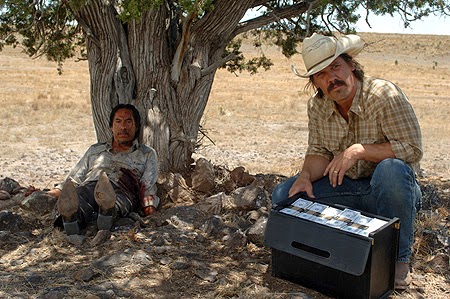
In No Country For Old Men, the crime is Moss taking a satchel full of money from the scene of a drug deal gone wrong rather than turning it over to the police. In theory it should be simple enough, but he didn't count on a psychopath being sent after the money or there being a transponder in the satchel that could be used to track him down. Naturally, this seemingly simple act (and returning to the crime scene later) result in Moss being chased by the aforementioned psychopath, along with several people (including Moss himself) getting killed.


It is a bit harder to place exactly what the crime is in The Big Lebowski, since in this case the person in over his head is the Dude, who is more or less an outsider who gets caught up in several different actions. The most likely catalyst is the pseudo-kidnapping, which we eventually find out Jeffrey Lebowski had used as an excuse to take some money out of a joint account with his daughter and then hired the Dude expecting him to fail to deliver the money (which he was never given to begin with) as well as a scapegoat for the "kidnappers" to pursue.

The whole thing causes a massive amount of trouble for the Dude. On the other hand, the reason the Dude was there was because of the guys who peed on his rug mistaking him for Jeffrey Lebowski, as well as the fact that the Dude got caught up with Maude because he stole her rug. In that sense, it's actually several crimes coming together which all pile up on the Dude and send everyone after him.