Pageviews from the past week

Showing posts with label Abridged Essays. Show all posts

Tuesday, 21 July 2015

Alienation of Female Sexuality


Female sexuality has always been a controversial topic to depict on film. Some feminists, such as Bonnie Sherr Klein and Catherine A. MacKinnon, have accused pornography of “objectifying” women, and argue that any form of sex depicted involving women is produced exclusively for a “male gaze”. Jonathan Glazer’s Under the Skin provides a strong rebuttal to this notion in an unusual way—offering an outsider’s perspective. By casting the sexually curious female as an alien from another planet—literally alienating both her and, by extension, the viewer—Glazer allows us to step out of our own social constraints and look at the picture as a whole.


Under the Skin centers around an extra-terrestrial played by Scarlett Johansson; unnamed in the film but given the name of Isserly in the original book. She arrives in Scotland, her true form concealed inside the body of an attractive young woman. Under the employment of a mysterious man on a motorcycle (played by Grand Prix champion Jeremy McWilliams), Isserly is tasked with seducing men who are then lured into an old house where they are drowned in a black fluid that breaks down their bodies. As Isserley spends time living among humans on Earth, she begins to question her own purpose and, growing comfortable in her new skin, tries to become human. However, despite her efforts, the film constantly reminds us that she is not of this world, and questions just what it means to be “human”.

Throughout the film, Isserley is constantly, and literally, alienated from the world around her. To the average viewer, Scarlett Johansson stands out as she is the only recognizable name to appear (though motorcycle enthusiasts may be more familiar with Jeremy McWilliams). The rest of the cast consists of a mix of unknown actors and random people on the street with whom she interacts in character, unaware that they are in a film or talking to a world-renowned actress. A recurring motif throughout the film is her walking against the crowd, always facing the opposite direction of the movie’s extras and thus displaying a lack of conformity, making her constantly stand out.

By both literally and figuratively alienating the central character, the film also alienates the viewer and places them in a position to experience an alien perspective on the world around her, and in particular the idea of sex. The protagonist experiments in various ways of seducing men, but does it less out of pleasure and more in a machine-like routine way. She lures men to their doom not because of any actively malicious intent, but simply because that is her job (presumably overseen by the motorcyclist).

The first time the heroine finds herself experiencing any real pleasure is when she encounters a deformed man suffering from Neurofibromatosis (Adam Pearson). Upon encountering this man, she finds herself drawn to him and, upon finding out that he has no friends, invites him to touch her body. During this scene, Isserley challenges the claims of MacKinnon and Klein that sex on film is purely intended for a male gaze by seducing a man with a visible deformity, an act which causes the audience feel uncomfortable, making it clear that this is not for anyone's exclusive pleasure.


The idea of pleasure in sex is something Isserley sees as completely alien and struggles to comprehend, as is notable when she finally experiences real sex after being taken in by a friendly young man. During this scene, the protagonist appears to act indifferent while her friend experiences pleasure, though she herself does appear to eventually start to feel something during their intimate moment. When the man removes Isserley’s pants, while she tries to help him, displaying a sense of confusion as though the entire process is new to her. The man then climbs on top of her, seemingly in control. Isserly’s expression seems to suggest that she is feeling something, but is unsure what. In another close-up on the man’s hand, he begins to remove more of her clothes.

As the two embrace, the protagonist's expression starts to suggest that she is experiencing pleasure, but finds herself confused. She pushes aside the man, moves toward the edge of the bed, and shines a lamp into her vagina, apparently checking to see if something has happened. The man stares at her in confusion and says “you don’t like it?” She simply throws aside the lamp, apparently having seen no change in her genitals. Both she and the man are confused about what has just happened. Isserly is confused about having found pleasure in sex, while the man is puzzled by her being unsure about liking it.

In her documentary film, Not a Love Story: A Film About Pornography, director Bonnie Sherr Klein takes the stance that pornography in general is anti-feminist, allegedly because it “objectifies” women for a purely male gaze. Other feminists such as Gayle Rubin argue that the “anti-porn” movements are in fact detrimental to feminism. In reality, pornography is being used as a scapegoat for contemporary social problems, and the real solution is to provide better recognition for female sex workers and encourage more women in the porn industry to move behind the camera and produce films for female audiences.

Rubin's suggestion is not even considered in Not a Love Story: A Film About Pornography, in which Klein only offers information that furthers her own argument. She cites one specific type of pornography, in which torture is staged, and uses it to argue that all pornographic films are therefore movies are equivalent to snuff films depicting actual abuse of women. No reference is made, for instance, to the work of Barbara Hammer, a lesbian filmmaker who produced pornographic films intended for lesbian audiences as early as 1973, or feminist porn stars like Annie Sprinkle. Though the arguments of both sides are aimed at pornography, their ideas extend beyond a single genre and are relevant to film in general.

The mysterious protagonist of Under the Skin has a child-like attitude toward sex and finds herself curious about it, which draws some parallels to the similar character of Lena (Lena Nyman) in Vilgot Sjöman’s 1967 art film I Am Curious (Yellow). Similar to the tragic heroine of Under the Skin, Lena is a young woman curious about and trying to understand sex. She experiments with it through her encounters with various men, and in many of them she is the one responsible for initiating the experience. Lena is a sexually active young woman who challenges the ideas of MacKinnon and Klein by engaging in what they might consider “pornography” and displaying pride in doing so. Under the Skin uses a different approach, by treating sex as something literally alien. By making the protagonist herself an alien struggling to understand it, Jonathan Glazer is able to criticize common attitudes about how sex is often depicted.


I Am Curious (Yellow) provides an early example of a film challenging the ideas of anti-porn activists by presenting a sexually active female lead who “experiments”, fully embracing her sexual encounters and displaying pleasure within them. What distinguishes Under the Skin from I Am Curious (Yellow) is in how it challenges the ideas of Klein and MacKinnon. Instead of simply presenting an attractive woman gaining pleasure from sex, it uses the alien approach to criticize the lack of understanding towards female sexuality.

Unlike Lena, who is precisely the opposite of MacKinnon or Klein’s views on female sexuality, the protagonist of Under the Skin is at first an embodiment of their ideas. She interacts exclusively with men and, at least at first, it is only the men who experience true pleasure during her encounters. Her emotions seem almost forced. When she smiles there is a sense that she is only doing it because she understands she is supposed to, a feeling which constantly reminds the viewer they are not seeing her real face. Every time Isserly lures a man into her house, she puts herself on display for his pleasure, carefully stripping her clothes in a machine-like way. This is precisely in line with how MacKinnon and Klein have interpreted pornography. It starts off resembling the anti-porn claims regarding sex, but gradually shifts to be more in line with opinions expressed by Gayle Rubin.

By having the protagonist represent the ideas of pornography as “objectifying” women for the pleasure of men, Jonathan Glazer is able to demonstrate how confusing this same notion is when she finds herself experiencing sexual pleasure. However, these ideas emerge in a distorted and twisted form, with the female in control and using it to manipulate men. As her quest to become human progresses, she begins to question who she really is—and by extension whether she is capable of enjoying sex. This leads to something of a “sexual awakening” that forces her to question what she sees as “normal”, or—more accurately—MacKinnon and Klein’s distorted ideas of sex in contrast to the reality proposed by Gayle Rubin.

MacKinnon and Klein are convinced that any depiction of sex on film is detrimental to feminism, and that filmmakers are incapable of anything more than displaying women’s bodies for the pleasures of men. Rubin has argued precisely the opposite, suggesting that while there are cases of women being abused in the porn industry, the correct solution to the problem is to promote better treatment of women and produce pornographic films for female audiences, which has happened with filmmakers like Barbara Hammer. By showing both sides through the eyes of an alien, Jonathan Glazer is able to examine their respective views and criticize them through a new perspective.

Wednesday, 3 June 2015

A Discussion of Fear From Within the Mouth of Madness


In his essay An Introduction to the American Horror Film, film scholar Robin Wood argues that the horror genre is defined by the presence of a "monster". This does not have to be a literal monster, but it serves a specific role which he identifies as the central formula of horror films: “Reality is threatened by the monster”. Similarly, in his essay Why Horror? Noel Carroll raises the question of why viewers are attracted to a genre that by its very nature is meant to scare them. His solution to this “Paradox of Horror” is that the monster is an anomaly that challenges the viewer’s understanding of the world around them and arouses their curiosity. John Carpenter’s 1994 horror film In the Mouth of Madness plays on the ideas of both authors and brings them into question.

The most common form of the human monster is the mad scientist, as depicted by characters such as Elsa in Splice or Dr. Pretorius in The Bride of Frankenstein, as well as Dr. Victor Henry Frankenstein himself, to an extent. A similar idea is explored by In the Mouth of Madness, but with the mad scientist replaced by a mad artist. Through this choice, In the Mouth of Madness distorts and twists the ideas of Carroll and Wood. It forces the viewer to constantly question their ideas of what defines the monster, what can be considered an anomaly, what is normal, and what it is that is being challenged.

Throughout the movie, the idea of what is normal begins to change, and with it the identity of the monster and the nature of the reality its presence challenges. The viewer’s idea of what distinguishes normality, the anomaly, and the monster is constantly challenged as the narrative progresses. Instead of one monster, the film suggests that anyone could be a monster under the right circumstances, and ultimately leaves the viewer to question who is really the monster. Cane himself is by his very nature a human monster. It is through his books that the abjection between fiction and reality is created. In the context of the film, Cane is the original monster, and possibly the most powerful, though it is suggested that even he may not have complete control over everything.

He disrupts what is seen as real by exposing the real world to be a work of fiction; all created from his imagination. At one point Cane even displays a literally monstrous side with a growth on his back—a cue to the audience of his role in the story. Cane disrupts and challenges the normal ideas of reality by revealing the world to be nothing more than an illusion. The characters who read his book In the Mouth of Madness—his agent, Trent’s partner Linda Styles (Julie Carmen), and eventually Trent himself, all find their ideas of what is normal challenged, and in the process become monsters themselves.

Cane might not be the only monster, but he is the driving force behind the film. The other monsters to appear are extensions of his character. With the possible exception of the unseen “Old Ones” that Cane says inspired his writing; even the few instances of literal monsters are constructs of his mind and therefore extensions of his character. This idea is set up early on, when Trent and Styles arrive at the Pickman Hotel, and Styles comments on how the greenhouse is empty but used to be “filled with strange growing things”, and how one night the townspeople saw something moving inside.

Trent immediately recognizes her description as being from the plot of Cane’s novel The Hobbs End Horror (itself a reference to Lovecraft's story The Dunwich Horror). Later, Trent encounters this monster in the form of Mrs. Pickman (Frances Bay), who experiences a grotesque transformation and is seen in the greenhouse. At first, this sub-plot does not seem to contribute directly to the overall narrative, but it marks the point in the story where Trent, Styles, and many of the supporting cast begin to show their status as monsters.

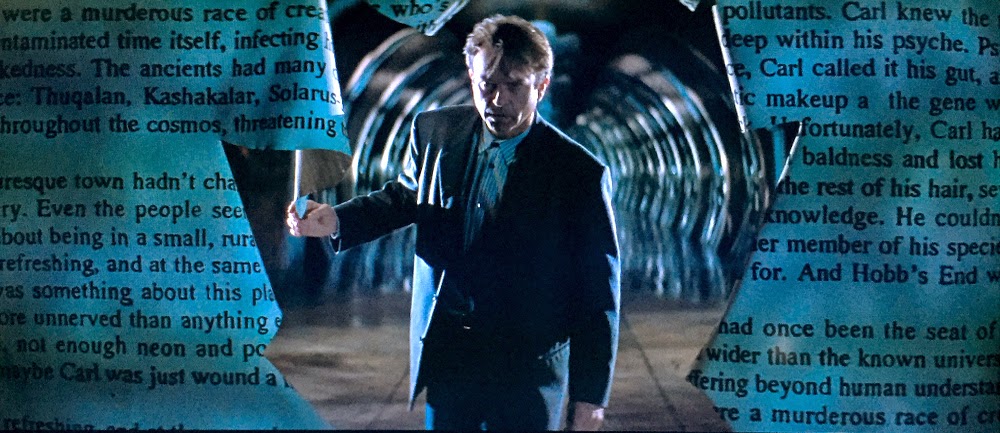
One of the few scenes to clearly show literal monsters occurs when Cane finishes his book. The scene begins with Cane showing that he is capable of warping reality when Trent suddenly finds himself in the former’s writing room. Cane finishes typing the book and declares it “all done” before entrusting Trent to return it to the world. Cane explains that “you are what I write” and states that nothing within this world existed before the story began. Cane continues to emphasize the idea of the world being fiction when he embeds his fingers in his face and tears it apart like a sheet of paper, exposing a black, empty void. The camera looks back at Trent from inside the void. From this side, the door that was behind Cane is replaced by a page from a book. Though the hole prevents the page from being read clearly, the text that is visible refers to Hobb’s End, suggesting that the viewer is literally looking into a page from one of Cane’s books. As Trent approaches the hole, Styles begins reading part of the manuscript, which describes in detail precisely what is happening.


The presence of Cane as the writer allows the film to further create this disruption through the use of abjection, an idea proposed by Julia Kristeva which suggests that horror resides in the middle of established social boundaries such as the living and the dead, human and animal, and male and female, or in this case between reality and fiction. The horror of In The Mouth of Madness comes not from Cane himself or from the Lovecraftian "Old Ones" he claims have influenced his work, but from the idea that everyone within this world, including Trent, is a fictional construct whose every action is dictated by the author and who only exist to serve the needs of the story.

Moments of abjection between reality and fiction recur throughout the film, beginning with Trent and Styles encountering a town that should not exist—later in the film it vanishes entirely, along with Styles who was literally written out of existence by Cane. The confusion is further emphasized when Trent finds himself reading one of Cane’s books while exploring the town, and comments that “I’m reading this thing like it’s a guidebook.” This idea of the abjection between reality and fiction reaches its peak in the film’s final moments. Trent sits down in a movie theater with popcorn and watches the film adaptation of the Sutter Cane story In the Mouth of Madness. A brief montage reveals that the film adaptation of the book is literally the film the audience has just finished watching. Reality as the viewer understands it is being disrupted by the idea that their reality is fiction. Trent constantly finds himself trying to rationalize his encounters, but upon seeing himself in his own movie, he is forced to finally realize the truth that none of his world is real.


This idea of monstering goes further. While Cane can be seen as the monster, the film also plays with Carroll’s idea of the anomaly to turn the rest of the cast into monsters themselves. Trent sets this idea up early in the film when he describes the experience of reading Cane’s books. “Pulp horror fiction, they all seem to have the same plot,” he says. “Slimey things in the dark. People go mad. They turn into monsters.” This is precisely what happens later in the film. Cane himself is an anomaly in In the Mouth of Madness, but in keeping with Wood’s ideas of what defines the monster, the anomaly shifts over the course of the film.

In a conversation between Trent and Styles, the latter justifies her love for Cane’s writing by suggesting that “Right now reality shares your point of view. What frightens me is what would happen if reality shared Cane’s point of view”. She goes on to suggest that “sane and insane could easily switch places if the insane were to become the majority”. This discussion sums up Wood’s idea of the monster challenging "normality", a term he uses in a loose sense meaning simply “conformity to the dominant social norms.”

Normality changes over the course of the film, initially with the characters believing that what they are experiencing is reality until Sutter Cane exposes them to the repressed truth. As the narrative progresses, more people become aware and are infected by it in ways that a man like Trent would view as insane. This challenging of Trent’s understanding of sanity is first experienced when he is faced by a man he later describes as a “lunatic with an ax”. The man in question steps out of a bookshop, crosses the street in broad daylight holding an ax, walks toward the diner where Trent is eating with his employer, smashes the glass and then asks Trent “do you read Sutter Cane.” This man is killed by the police, and naturally his actions are dismissed as being the product of mental illness.


Later on, it is revealed that this man was actually Cane’s agent. He was also the one person who read In the Mouth of Madness and as a result was not only aware of his fictional status, but also of the role Trent would eventually play in the narrative. It is now brought into question whether the actions of Cane’s agent were insane. At first, the agent can be seen as a monster, but when his perspective is revealed, it suggests that Trent may in fact be the real monster. In addition to reality and fiction, the abject also occurs between sanity and insanity, and the viewer is left to question their definitions of both.

Freud’s original concept of “madness” was that it was connected to a person’s own past, but in In the Mouth of Madness it is suggested that insanity is simply a label for any behavior that violates what the majority of the population see as normal. Trent’s own sanity is brought into question, ironically, by his very efforts to rationalize his experiences while everyone around him is turning into what he would consider monsters. This development in Trent’s character ties back to Styles’ comment earlier in the film: that which the viewer would consider insane has started to become the majority, and a character like Trent whom the viewer might ordinarily view as sane appears to be insane by the sheer nature of failing to conform to what has become normal.

The idea that Cane transforms people into monsters is explored more literally through the character of Styles. From her introduction, Styles is a horror fan who attempts to address Carrol’s very question of why viewers are attracted to horror films, as raised by Trent. As a Sutter Cane reader, she finds herself more open to the possibility that his books are real, an idea she begins to develop soon after entering Hobb’s End. When they first arrive at the hotel from Cane’s book The Hobb’s End Horror, Styles displays an uncanny ability to point out minor details about it without looking. She is also the second character to have her reality challenged, after Cane’s agent, when she is forced to read In the Mouth of Madness.

After this scene, Styles becomes a more explicit puppet of Cane’s, having sex with him oblivious to a monstrous outgrowth on his back, experiencing peculiar transformations, and displaying abrupt shifts in personality. With no build up she begins attempting to seduce Trent, much to his shock and confusion. She has herself become a monster, challenging what Trent would see as normal. Styles behaves in ways that he would deem insane, such as swallowing the keys to Trent’s car. She even briefly becomes a literal monster when her body is shown contorting into a quadruped form, walking on both her hands and feet with the sounds of bones cracking heard as she moves.

In the Mouth of Madness is one large distortion of the theories presented by Wood and Carroll. It plays on the idea of the monster disrupting what is normal and challenging the viewer’s understanding of reality by forcing the viewer to question their ideas of reality and what is normal. By leaving the viewer unsure of what they can call normal, the film also brings into question precisely what it means to be a monster or an anomaly. In the end, Cane can be seen as a monster, but he is also a tool used by the filmmakers to explore the question of just what makes someone a monster, and it is through him that the ideas of Wood and Carroll are tested.

Sunday, 15 March 2015

A Reflection on the Motion Picture Production Code

The Motion Picture Production Code, now commonly known as the "Hays Code", was first created in response to a public outcry regarding the “controversial” material of films made during the Silent Era. During this time, when there were no rules in play, many filmmakers experimented with different ideas, sometimes touching on sexual or violent themes. In the late twenties the Motion Picture Producers and Distributors Association, led by William Hays, was hired to create a list of regulations. He started with a vague list suggesting what filmmakers should and should not do in their movies. When this list went ignored by filmmakers, the studios retaliated with the Production Code, enforced by an associate of Hayes, Joseph Breen, beginning in 1934 and continuing through the following two decades before finally a series of legal cases in the 1950's led to its dissolution and eventual lifting in the 1960's.


The Production Code was a strictly enforced series of rules that prohibited several topics and contained restrictions about others. For instance, the Code lists several regulations about how crime pictures were to be made. Movies dealing with illegal activity were required to minimize the use of firearms to those essential to the plot and crimes could not be shown in detail. It also says that criminals cannot be treated in a sympathetic light, that any depiction of drug trafficking is forbidden, and that alcohol cannot be shown unless it is important to story or characterization. While the Production Code is more lenient towards depictions of violence provided that the films avoid romanticizing crime, depicting certain types of criminal activity, and showing it in detail, it prohibits any sexual themes. Hays’ justification for this decision is his claim that “Pictures shall not infer that low forms of sex relationship are the accepted or common thing”. In other words, sex could not in any way be depicted visually or verbally.

In addition to prohibiting any explicit depictions of sexual intercourse, Hays also prohibits showing adultery (unless it is essential to the plot, and even then cannot be explicit or justified), “scenes of passion”, “sexual perversion”, interracial relationships, children’s sexual organs, and childbirth. Filmmakers were generally barred from depicting any form of sexual activity. The few that did manage to get under the censors, such as James Whale’s The Bride of Frankenstein or Stanley Kubrick’s Lolita, were unable to address their sexual themes directly. The former incorporated homoerotic undertones through the interactions of the characters, particularly in the intimate relationship between the two scientists. The latter, centered on a pedophilic relationship, refrains from showing any sexual activity between Hubert Humbert and the titular Lolita.

Ironically, many of the “controversial” movies the Production Code was made in response to seem tame by today’s standards, especially with regards to sex and violence. A major component of the public outcry was the violence of crime films made before the Production Code. Gangster films like Howard Hawks' Scarface, depict criminal activity and in some ways glorify it (though they often came with a "crime doesn't pay" message, usually by ending with the gangster's death), but compared to the work of modern directors like Quentin Tarantino, these films seem surprisingly tame.

Really? This is what people were upset about?

Films like The Divorcee imply sexual activity to occur, but refrain from showing it. It is mostly suggested through innuendos in the conversations between the characters. The story concerns both a husband and wife committing adultery against each other, but all sex between them happens off-screen. While this was controversial for 1930, many more recent films, such as those of David Lynch or Stanley Kubrick, are far more explicit.

One restriction I find especially curious is the Production Code’s reference to “sexual perversion”. Precisely what Hays intended by this remark is unclear, as he fails to define or provide examples of what he considers to be “sexual perversion”. It appears that this particular category comprises anything other than a “traditional” heterosexual marriage, likely including homosexuality. While the Code does not specifically name homosexuality as something that should not be depicted, it was responsible for preventing any images of same-sex relationships from being shown on screen during the Studio Era.

Because of the Code, the production of A Streetcar Named Desire encountered difficulties when the filmmakers were pressured to change a scene in which Vivien Leigh reveals that her husband (who is never seen) was homosexual. The original play was already vague about his sexuality, but the film required what little references were present in the script to be taken out. Prior to the Code, there were very few films that did attempt to positively address the issues of homosexuality outside of a few exceptions such as Géza von Radványi’s Mädchen in Uniform (which featured a sympathetic lesbian protagonist). Though it is a very recent development, more filmmakers are making efforts to depict sympathetic gay couples.


Contemporary movies such as Mulholland Drive, Brokeback Mountain, and Blue is the Warmest Colour all attempt to present homosexual love stories with complex leading characters. Several of these films have also been made and released through mainstream Hollywood, and even Blue is the Warmest Colour (made in France) managed to gain international attention. Both Mulholland Drive and Brokeback Mountain were nominated for Best Director at the Academy Awards (the latter actually winning), while Blue is the Warmest Colour was nominated for Best Foreign Language Film at the Golden Globes.

While the Production Code was at its height during the 1930’s, the 1940’s saw the beginning of its decline. With America’s entry into World War II, the code was relaxed to allow the production of movies addressing the conflict. The intended result was the introduction of the combat film, but the relaxing of the Code also had the unexpected side effect of allowing directors to explore areas they could not previously. In particular, this relaxation of the Production Code, combined with a need to conserve resources and influence from the German Expressionist movement, resulted in a technique that would later become known as film noir. Movies that fit the style of film noir would explore more controversial themes, including more violent narratives and sexual undertones. In the 1960’s, the American government began to conduct a series of inquiries about the Code, eventually forcing it to be officially lifted.

The introduction of the Production Code may have in fact had the reverse effect of its intended purpose. Before it was published, movies explored sexual themes but rarely did it in an explicit way. With restrictions preventing even the use of innuendos and implied sex, Hays forced directors into the position of trying to find ways around his rules. This led to films attempting to find creative ways to show sex or related subjects that would go under the censors, such as disguising a sexual relationship as the humorous bantering and eventual marriage between a man and a woman (which is how the screwball comedy was first developed) or incorporating homoerotic undertones that would not have been noticed at the time (as in The Bride of Frankenstein). By examining the output of films made since the production code, I can see that many of them are far more explicit in their images of sex than the “controversial” films of the 1920’s.

There is definitely no homoerotic subtext in this scene.

Wednesday, 10 December 2014

Sarah Connor and the Development of an Action Heroine


The iconic character of Sarah Connor, originally played by Linda Hamilton, was first introduced through James Cameron’s 1984 film The Terminator and its 1991 sequel Terminator 2: Judgement Day. The story of The Terminator centered on Sarah being relentlessly pursued by a human-looking machine known as the T-800 (the titular “Terminator", played by Arnold Schwarzenegger) that has been sent back in time to kill her. Seven years later, a sequel, Terminator 2: Judgement Day was released, also directed by Cameron, which took the story into several new directions.

In the sequel, audiences were taken by surprise when the Terminator that had been such an effective antagonist in the first film was re-introduced as one of the heroes. Instead, a new, far more dangerous terminator, the T-1000 (Robert Patrick) appears as the villain, this time sent to kill Sarah’s son John Connor (Edward Furlong). In order to survive and protect the future, Sarah must undergo a huge transformation in character. She begins the first movie as a young college student making a living as a waitress and evolves into a self-reliant musclebound hardbodied heroine by the end of the sequel.

At first Sarah Connor is a friendly individual who lives with her college roommate Ginger. She has no immediate aspirations in her life and is struggling to find some form of meaning. Her helplessness is made clear when she encounters what she believes to be a stalker (actually Kyle Reese, played by Michael Biehn, who has been sent from the future to protect her from the Terminator) and immediately calls the police. When she first encounters the T-800 at the nightclub Technoir, she can only stare helplessly as it aims its laser-sighted pistol towards her forehead.


Sarah only survives this encounter due to Kyle’s interference. Much of the rest of the movie centers on the two of them running away from the T-800, and Sarah is constantly looking for protection. During this time, Sarah is forced to become more self-reliant as everybody she depends on is killed. Even after she stops, faces, and destroys the Terminator, she is still shown to be in a panicked state of mind. While Sarah may be unsettled by her experiences with the Terminator, this final confrontation begins a major shift in her personality which is developed much further in Terminator 2: Judgement Day.

In the second film, Sarah becomes something more closely resembling a middle-ground between the wise-guy action heroes of the 90’s, such John McClane in Die Hard, and the hardbodied action heroes of the 80's such as Sylvester Stallone in Rambo: First Blood Part II. This becomes evident during the climax in which Sarah is shot in the leg and later impaled through the shoulder. Much like the wise-guy heroes of the 90’s she does manage to show pain. She cries out as the T-1000 slowly runs a massive rod through her shoulder and she is visibly limping afterwards (she had also been shot shortly before that).


What puts her on a level with the hardbodied heroes is that the despite the obvious agony of her wounds, she keeps getting up and fighting. Even during that scene where she is impaled, Sarah never gives into the T-1000's simple demand: "Call John". Linda Hamilton’s co-star Arnold Schwarzenegger, known for playing hardbodied heroes and in this case a literal example, actually endures far more physical harm than Sarah. She gets hurt, but The T-800 gets an arm ripped off, loses an eye, and is temporarily shut down before finally being lowered into a vat of molten steel. This makes Sarah Connor more of a hardbodied hero than the literal hardbodied hero.

In Terminator 2 Sarah’s body is used as a far greater spectacle than that of the T-800. One notable aspect of the hardbodied action heroes of the 1980’s was their muscular display. Stallone made this image famous with the Rambo films and Schwarzenegger himself has done this numerous times in his earlier action films like Commando.  It's a trademark of the genre for the lead male actor to have few clothes on by the end in order to allow them to display their impressive muscular body, but that is not quite what happens in Terminator 2.

Instead, Schwarzenegger spends most of the film with shirts and jackets and much of the bodily spectacle focuses on the abuse he takes rather than on his muscles. By contrast, the majority of Sarah’s wardrobe throughout the film wholly exposes her muscles and puts them on display for the viewer. This also deviates from her wardrobe in The Terminator, where the more conservatively dressed Sarah Connor was less exposed. Muscular display has traditionally been associated with men, which makes Sarah’s character appear more visually striking.

In a similar vain to the hardbodied action films of the 80’s and even the urban vigilante films of the 70’s such as Dirty Harry, weapons are heavily romanticized in both Terminator films. In The Terminator, numerous characters are equipped with large guns, particularly the T-800 and Kyle Reese, whose weapons become an extension of their character. At the same time, Sarah never holds onto a gun until the final scene in The Terminator, where her handling a revolver is used as a visual indication of her growth as a character. By the start of Terminator 2: Judgement Day, Sarah is far more comfortable around firearms, to the point where she has an entire cache containing a huge array of weapons. This leads to a development where Sarah herself starts to become more like the Terminator she had previously fled.

The parallels between Sarah and the T-800 as seen in the first film become especially clear in one scene of Terminator 2: Judgement Day. This scene happens right after Sarah has learned of the work of Miles Dyson (Joe Morton), whose programs later ultimately led to the creation of Skynet and, though indirectly, both the T-800 and T-1000. She decides to kill him in an effort to prevent the apocalyptic future from being realized. The scene begins with Miles in his home working on a program when a red dot appears on his back, quickly calling to mind the T-800 aiming its laser-sighted pistol at Sarah Connor’s forehead in The Terminator.

Unlike Sarah, Dyson is not aware of her presence nor is there anyone to save him. A close-up reveals Sarah outside the house, coldly looking through the scope of an assault rifle, and her finger wrapping around the trigger. In another close-up, Miles bends down after his son accidentally drives a remote-controlled monster truck into his foot, just as Sarah fires. The next close-up shows Miles sitting up in shock and staring out his window. Miles’ reaction is followed by another close-up of Sarah, but this time with the camera almost facing her directly—literally staring down the barrel of her gun. When she begins firing she only stops once, in order to reload, before she runs out of ammunition.


When she is finally forced to discard her weapon, Sarah proceeds to draw a pistol and walk just as coldly towards the house. Miles stands, and she immediately begins to fire on him. She shoots three rounds before finally hitting him in the shoulder. What distinguishes her from the T-800 is that she still shows her humanity when she breaks down after confronting him directly, creating a parallel to the way in which the previously emotionless T-800 is now being humanized. This scene shows her full capability, but also emphasizes that she is not completely transformed by her experiences.

Having men attempt to protect Sarah is crucial to emphasizing the transition in her growth as a character. All three of the men who attempt to protect Sarah Connor (Kyle and two police officers) die over the course of the first movie. The establishment of law enforcement’s futility against the T-800 eliminates its status as a source of protection leaving Sarah Connor with no one to turn to except Kyle. The transition continues as Kyle is wounded while escaping from the Terminator. This forces Sarah to take on a more active role. Finally, Kyle’s death puts Sarah into a position where she has to rely exclusively on herself to survive by seizing an opportunity to crush the Terminator with a hydraulic press.

A similar situation also occurs in Terminator 2: Judgement Day. During the climax, the T-800 is temporarily disabled by the T-1000, putting Sarah into a position where she is unable to rely on its assistance. When the T-1000 threatens her son, Sarah is able to save John’s life. Similar to how Kyle saved her in The Terminator, Sarah manages to stall the T-1000 by shooting it multiple times with a shotgun. This fails to kill the T-1000, but does save her son’s life and puts the T-1000 into a vulnerable position. While it is not Sarah herself who ultimately destroys the T-1000, this particular action manages to buy time for the T-800 to reactivate and take the other terminator by surprise.

Sarah Connor goes through a very clear shift in personality over the course of both The Terminator and Terminator 2: Judgement Day, going from a passive woman with everyday problems to an action heroine determined to avert the potential end of humanity. This is emphasized by a wide range of elements including her treatment of guns, her general appearance, her attitudes, and the role of the male characters. Across both films, Sarah develops into a more “masculine” figure reminiscent of the types of heroes traditionally played by men. While The Terminator and Terminator 2: Judgement Day were not the only action films of the period to introduce a strong-willed heroine in a leading role (The The Terminator was released between Alien and Aliens, the latter also by Cameron) they helped to popularize it and create a path for later action heroines.


Friday, 17 October 2014

How Spectacle Conveys Narrative


There has always been a delicate relationship between narrative and spectacle on film. Many Hollywood movies struggle to balance a compelling story with special effects to create a spectacle. Some of the earliest films, such as those of Méliès, were made as almost pure spectacle. Later films would prefer to focus on telling a story. Sometimes, as is shown with the famous “biplane scene” in Alfred Hitchcock’s North By Northwest, the spectacle is used as a driving force for the narrative.


While this scene is clearly meant to be a visual spectacle, it is created in such a way as to stand out in the mind of the viewer because it is an extremely pivotal moment in the story. The scene marks the beginning of several drastic changes, including the general tone of the narrative and in the character of Roger himself. This is set up through the scene’s deviation from the film’s previously established patterns.

This famous scene happens roughly at the mid-point in the film. The build up is simple enough: Roger is led to an isolated crossroads in the middle of open mid-western farmland. He has been told at this location he will be able to meet the man he has been confused with, George Kaplan, whom the audience already knows does not exist.

Instead of finding the agent, he is attacked by an unseen pilot in a biplane. A chase ensues in which Roger desperately tries to evade his attackers. The plane attempts to shoot him, run him down, and pour crop-dust all over him. Finally, Thornhill sees a passing gas truck, stands in front, and falls under it as soon as it stops. The plane crashes into the back of the truck and explodes, creating a spectacle of destruction.

This scene is a very famous cinematic moment that no doubt served as an influence on later action films such as Clint Eastwood’s The Gauntlet. Even the helicopter chase scene in From Russia With Love clearly took a few cues from this iconic sequence. Why is it such a great scene? Why did Alfred Hitchcock make the choices he did when putting this sequence of events together? That's what we will be discussing in this article.


As far as narrative goes, there is only one obvious function filled by this scene—giving Roger a reason to suspect he cannot trust Eve, the woman who sent him to this location. This end could have been accomplished by a much shorter scene. For instance, instead of a plane, Roger could have encountered a man he thinks is Kaplan who ties to kill him. A simple chase scene would have sufficed The scene as it was presented could have ended with Roger simply evading the plane instead of causing it to explode.

Simpler alternatives would have served the same narrative function and advanced the story but not have had the same impact on Roger’s character. Up until this point, Roger has been doing little more than attempting to run away from the villains, hoping to eventually find the man he is being confused for. After this scene, Roger starts to gain control over his situation, pursuing the antagonists himself and setting in motion the events that ultimately allow him to become Kaplan.

As a result, Roger becomes much more daring in the second half of the film. While in the first half, he simply runs away from the villains, the biplane scene marks the point where he realizes he must take more drastic measures to survive such as standing on a road in front of a moving truck and falling under it. The fact that the plane explodes shows how much of a risk he was taking. He could have easily been injured or even killed by the blast.

This scene is just the first of many creative and unusual methods Roger uses to get out of dangerous situations; he no longer simply runs away. The biplane scene marks the point in which Roger decides he is no longer going to tolerate the antagonists pursuing him and instead of simply trying to evade them instead decides to stand up for himself. As the film progresses, Roger goes on to do even more dangerous stunts, culminating in the climactic scene of him and Eve climbing down Mt. Rushmore’s face.

If the biplane scene had ended with him simply evading his attackers instead of outwitting them, Roger’s personality would not have changed from the first half of the film. His later actions would confuse the viewer. If Hitchcock had ended the biplane scene with Roger simply hitching a ride with a passing motorist and getting away from the airplane, he would simply be running away again, instead of taking a stand as is set up by this sequence. This change in character is vital to concluding the narrative. Without this particular scene the shift from an urban mystery to an espionage thriller would have been completely unexplained.

There is a very good reason Hitchcock would have wanted his scene to be a spectacle. Most of the film is extremely chaotic. Even before Thornhill is abducted, people are running around, pushing and shoving each other. One of the few calm moments of the film happens when Roger sneaks onto a train and meets Eve. Because this scene is so calm, it puts the viewer into a false sense of security. It seems as though Roger is safe from any danger. Him being attacked in such an unusual manner compared to earlier in the film is Hitchcock’s way of reminding the viewer that he is in fact still in trouble.

In addition, this scene also marks a very drastic change in tone to the overall narrative. The biplane scene marks a specific change in the tone of the story. The first half sees Roger trying to run from the antagonists, while the middle transitions the viewer into the events set off by this scene. The scene with the biplane marks the beginning of the second half, in which the narrative changes from being a chase film to more closely resembling an espionage thriller. This scene begins the transition and in turn leads directly into the final episode where Roger actually becomes a spy.

Another aspect that is worth noting is the jarring change of environment. The exotic locations used in older Hollywood films have often been used as a source of spectacle, but in this case Hitchcock opts for exactly the opposite. Instead of utilizing an impressive landscape, he chooses mid-western monotonous, flat, open fields . The spectacle is instead in the chase between Roger and the plane itself. The reason Hitchcock does not opt to include a more attractive environment is because he wants the viewers to focus purely on the central action.


Up until this point, the action has been set in populated urban environments. Roger has been pursued on foot through city streets, but here he is alone in the middle of open farmland. There are fewer places to hide, and almost no other people beyond the occasional passing motorist. The choice to use a biplane adds a layer of tension. The confrontation is obviously an unfair fight, thus alerting the viewer that Roger could be killed and creating a great sense of relief when he escapes.

Like the rest of the film, Hitchcock avoids crosscutting between Roger and the pilot chasing him, allowing the sudden arrival of the plane to startle the viewer. However, this remains the only scene in the movie where the antagonists are kept anonymous as they are never clearly visible inside the plane. This scene also marks the only point in the movie where Roger is directly responsible for anyone dying (you could argue that Mr. Townsend might not have had a knife in his back had Roger not tried to talk to him, but even that wasn't entirely his fault). By not allowing him or the audience to see the pilots, it eliminates the emotional repercussions that would otherwise come from him killing one, possibly two people.


North by Northwest has many memorable scenes, but Hitchcock has specifically crafted this particular moment so that it burns itself into the mind of the viewer. This scene is a pivotal moment in the film that marks a drastic shift in narrative tone and the main character’s role in the overall story. By creating this particular scene as a visual spectacle, Hitchcock forces the viewer to recognize these changes as they happen.

Sunday, 1 June 2014

Sergio Leone as an Auteur


Sergio Leone was one of the most influential and iconic directors of the 20th century. He was an Italian director best known for his “Spaghetti Westerns”: westerns that are produced by European companies (often but not always Italy), and filmed in Europe (often Southern Spain). Contrary to popular belief, Leone did not create the Spaghetti Western, but he is responsible for making it internationally popular. Leone was naturally an auteur director as over the course of his career, during which he directed a total of seven films, he created his own unique impressions of the genre and often tried to play with conventions.

Leone often put a notable emphasis on sound effects. This is most notable in Once Upon a Time in the West, where a large portion of the audio was Foley art, especially at the beginning. The very first scene is three armed men waiting for a train. Aside from the station master asking them for tickets, there is not a single word of dialogue spoken by any of the characters present. Instead, the audio is based entirely around sounds made by various objects present, most notably the windmill, which is heard creaking repeatedly throughout the scene. There is also emphasis on the sounds of water droplets landing on a man’s hat, and a fly crawling on another man’s face.


The scene immediately after the train station has another clever use of sound editing. The scene takes place on a farm, occupied by a family who is preparing for the arrival of the main character, Jill McBain. Suddenly the background sounds of crickets stop abruptly, catching the attention of the viewer, but then start up again, putting them into a false sense of security. The sound stops again shortly after, resulting in a short period of silence with only a few scattered birds being heard, at which point a gun is suddenly fired and one by one the family is killed.

Duck, You Sucker also utilized a clever editing technique known as a “sound bridge”.  The flashbacks would largely be silent aside from background music and specific noises, such as the gunshots when John shoots his best friend. However, on some occasions, the flashback ends and a sound that would be audible in the scene is heard when the film cuts to the present. For example, in one scene when John watches a firing squad killing revolutionaries, and sees that their leader provided the soldiers with information, he recalls a similar incident when his best friend told the authorities about him. The younger John is seen aiming a gun towards his friend, and pulls the trigger, with the scene immediately cutting to the prisoners being shot by the firing squad.

All of Leone’s films contained various scores composed by Ennio Morricone. Among the soundtracks composed by Morricone, he always created a specific piece as the “theme’ which would be played throughout the film (the most famous of these is probably the theme to The Good, the Bad, and the Ugly). The music itself was used to achieve various purposes in different films. For example, The Good, the Bad, and the Ugly had a score which played when Tuco and Blondie are led into the Union prison camp, which gave the scene a sad tone and a feeling of pointless brutality. However, later on in the movie, during the showdown between Blondie, Tuco, and Angel Eyes, a different score is used to build up tension as the camera cuts between the three of them waiting to draw.


In addition to clever use of sound, another thing that helped Leone to stand out among other directors was his casting choices. He would often have a cast with diverse nationalities (many of them were Italian, but there were actors from other European countries as well). When they were shooting the film, each of the actors would speak in their own language, and certain lines would be dubbed in post-production depending on the version of the film. For example, in the English version of The Good, the Bad, and the Ugly, the original lines spoken by Clint Eastwood, Lee Van Cleef, and Eli Wallach remain intact, and the lines of the Italian cast are subsequently dubbed. Meanwhile, in the Italian version of the film, the Italian lines would be left intact, but a voice actor would dub the lines spoken by Clint Eastwood, Lee Van Cleef, and Eli Wallach.

Leone seemed to get closer to America and further from Italy with each of his films considering the cast. A Fistful of Dollars was mostly a European cast aside from a then-unknown Clint Eastwood. Sergio had wanted to work with Henry Fonda in For a Few Dollars More, but as he had not yet established himself as a director, he was unable to get him and instead hired another American, Lee Van Cleef. The Good, the Bad, and the Ugly reunited Eastwood and Cleef, and also brought in another American, Eli Wallach as Tuco, also known as “the Ugly”, with Italian actors portraying various supporting characters they meet over the course of the film.

Once Upon a Time in the West had a cast made up of American actors Henry Fonda, Jason Robards, and Charles Bronson, alongside Italian actress Claudia Cardinale. Duck, You Sucker was focused almost entirely on the relationship between Rod Steiger and James Coburn’s characters (interestingly enough, both were American actors playing a Mexican bandit and a former Irish terrorist, respectively), and only brought in an Italian supporting cast when it was necessary to the film. Finally, when making Once Upon a Time in America, Leone abandoned his usual style of casting actors of mixed nationalities, instead opting to have a cast made up entirely of American actors.


Despite the fact that each of his films was completely different, Leone did have a number of characterizations that he frequently used. One of the most common as the “mysterious stranger”, a character whose true identity either remains unknown or whose background is only partially shown. The most famous example of such a character in a Sergio Leone film is Clint Eastwood as “the Man With No Name” in the Dollars Trilogy. His real name is never mentioned (he is only referred to by a nickname in each of the films), and almost none of his back-story is even mentioned.


Harmonica serves a similar role in Once Upon a Time in the West. Like the Man With No Name, very little is explained of whom he is, but in this instance it is clear from the start that he is after the villain Frank, and he intends to kill him. A series of flashbacks reveal that Frank had murdered his brother and that he is seeking revenge.


To a lesser extent, John Mallory in Duck, You Sucker could also be considered an example of this concept. Unlike the Man with No Name and Harmonica, he does have a clear back story: that he was involved with a revolution in Ireland and had killed his best friend. Nonetheless, many of the details are left unclear, such as the fact that the identity of the woman in the flashbacks is never revealed.

Another character which can be traced through all of his films is the use of remorseless killer as the villain. A Fistful of Dollars featured Ramon, a ruthless outlaw who is strongly skilled with a rifle. For a Few Dollars More once again brought Gian Maria Volonté back as the main antagonist, El Indio, the leader of a ruthless gang of bandits. The Good, the Bad, and the Ugly also featured a ruthless bounty hunter (ironically played by Lee Van Cleef, who had previously appeared in For a Few Dollars More as one of the heroes) as the titular “bad”. Once Upon a Time in the West featured Henry Fonda playing against his usual type as a ruthless gunslinger who is willing to massacre an innocent family and even murder children.


In Duck, You Sucker, the main villain is Colonel Günther Reza, an officer in the Mexican army. Unlike Ramon, El Indio, Angel Eyes, or Frank, Reza was not a gunslinger himself, but an authoritative figure working for an oppressive government, whilst the main characters are in fact technically outlaws. Nonetheless, while he had soldiers doing the actual killing, Reza seemed to feel no remorse for the off-screen massacre of most of the revolutionaries (including Juan’s whole family), nor did he object to sentencing the remaining prisoners to face firing squads.


In an interesting case of playing with conventions, Sergio’s cast often included a bandit as an anti-hero. In a traditional “classic” western, bandits would usually play the roles of villains, who would have to be brought to justice by the hero. While this tradition was maintained in For a Few Dollars More, many of his later films would take this basic character and turn it around, showing them as a complex character whom the audience can relate to.

This started with The Good, the Bad, and the Ugly, in which the titular “Ugly” is a Mexican bandit named Tuco. Tuco is a ruthless bandit who is more than willing to murder his double-crossing partner by forcing him to walk through the desert, and only saves him because he knows where to find a stash of buried gold. Nonetheless, there is a short scene where Tuco meets his brother, who is now a priest, where he shows a more emotional side, and it is hinted that he became a bandit because of a life of poverty.


Cheyenne in Once Upon a Time in the West is an interesting variant of the traditional bandit. He first appears after an off-screen gunfight, and initially seems like a typical outlaw with his drinking habits and an attempt to convince Harmonica to fight him. However, as the story moves on, it becomes clear that he actually has strong morals, and makes a point of not shooting women or priests. Even more interesting is that he is framed for the murder of Jill McBain’s family by Frank, and much of his story is simply his effort to clear his name and find the real killer.

Juan Miranda is much more ruthless than Cheyenne, but he also has the same sense of likeability. Juan’s “gang” is made up of his family, including his children. They are all living in a capitalist society run by an oppressive government and torn apart by revolution. Juan genuinely cares for his family, and he is simply an ordinary man trying to provide for them by whatever means he can.


Once Upon a Time in America is centered entirely on the story of a gangster’s rise to power. Noodles and his friends grew up in a poor community, and like Juan, they were merely trying to provide for themselves. Unfortunately, this started to lead to a life of crime, and eventually violence as well.

One of the most common aspects among Sergio Leone’s characters was the concept of a dark past which they regret, often influencing the choices they make in the present. Usually these stories are shown in a series of flashbacks. The first case of a character driven by a past event was in For a Few Dollars More, in which a series of flashbacks are seen showing the villain, El Indio, breaking into a house and entering a room occupied by a young couple. The man is quickly shot, and he begins raping the woman, who is eventually revealed to have shot herself. At the end of the film, it is implied that the woman was in fact Colonel Mortimer’s sister, and that he wanted to kill Indio in an act of revenge.

Once Upon a Time in the West utilized a similar story with Harmonica. For most of the film, very little information is given on who he is or why he is after Frank. A few flashbacks show a blurred figure walking towards the foreground, with the image slowly getting clearer each time it is shown. During the final showdown, when Harmonica and Frank meet face-to-face, it is finally revealed that Frank gave Harmonica his distinctive instrument after he cruelly hung his brother from a bell, and left him standing on Harmonica’s shoulders. Like Mortimer, Harmonica was after revenge.


However, Duck, You Sucker takes a slightly different approach. The flashbacks focus on John Mallory, an Irish explosives expert. They provide an interesting contrast to the scenes dealing with the present day, as they show the Irish countryside in contrast with the Mexican desert in which the film is set. John is clearly much younger, as he is clean-shaven in these scenes. The flashbacks seem to show that John was involved with an Irish revolution, and reveal that he had killed his best friend after he had been forced to reveal information to the government.

The final flashback showing John’s betrayal of his friend take place while he is alone in a steam engine with a rebel leader who had been forced to provide information. The leader initially expects John to kill him in revenge, but it is soon clear that he is in fact guilty of his actions, and tries to convince the man to save himself when the engine (loaded with dynamite)  is about to hit an oncoming train.


Another theme which can be traced through most of Sergio Leone’s work is the idea of a lawless society. A Fistful of Dollars deals with a gunslinger arriving in a town that is run by two gangs who are tormenting the inhabitants. The Good, the Bad, and the Ugly shows how the United States was destroyed by the Civil War. Once Upon a Time in the West deals with a series of violent events that take place in a growing town. Duck, You Sucker illustrates how society is destroyed by a violent revolution. Once Upon a Time in America focuses on the rise to power of a group of gangsters and their violent careers during the 1930’s.


Unlike many other directors, Sergio Leone’s personal life is not reflected in his work. However, it is clear that his experiences as a director may have influenced him with each film he made. In each movie, he uses techniques he learned from his previous work and applies them to something completely different, and each time tried to explore a new idea. A Fistful of Dollars is a simple story based on the earlier film Yojimbo (only now located to the American Wild West). The story is somewhat flawed, and its characters are not fully developed. For a Few Dollars More is an original story centered around a re-imagined version of Clint Eastwood’s character from A Fistful of Dollars, now focusing on a complex relationship between two men as they attempt to outsmart and eventually bring to justice a dangerous Western outlaw.

The Good, the Bad, and the Ugly contains arguably the most famous score of Leone’s films. The story now focuses on the relationship between three men, but this time it is a lot more brutal, with high tension between the titular “Good” (Clint Eastwood) and the “Ugly” (Eli Wallach), who are both trying to avoid being double-crossed by the other. At the same time the titular “Bad” is constantly in pursuit of them both, and will do whatever he feels necessary to learn where the gold is buried and to claim it for himself. Leone took this a step further by placing the story during the Civil War, meaning that over the course of the journey, both the audience and Blondie (the “Good”) are able to observe just how the war destroyed the United States.

Leone made Once Upon a Time in the West due to popular demand, and wanted to make something completely different from his previous three Westerns. The result was an elaborate epic telling the story of the tragic events which led a young woman to becoming the founder of a new town, and which drove a mysterious stranger’s quest for revenge. Leone experimented with sound and music in this film, and ultimately, it was through diagetic sound, various scores by Ennio Morricone, and elaborate visuals that the story was told, while dialogue was minimal.

Duck, You Sucker allowed Sergio Leone to look at a different kind of Western, known as a “Zapata Western”, set during the Mexican Revolution. Much like how The Good, the Bad, and the Ugly explored the effects of the Civil War on America, Duck, You Sucker  is an examination of the concept of “revolution” in general, as the story is shown from the perspective of a peasant who gets drawn into it through an Irish explosives expert.

Finally, Once Upon a Time in America was the only film Leone made where he was able to try something different. Instead of a Western, the story was now about gangsters, and explored how they rose to power and become who they were. The movie is almost four hours long, and now takes place over a period of 20 years. Along with Once Upon a Time in the west, it is often considered to be Leone’s masterpiece.

The idea of “auteur theory” applies to any director who has shown three major qualities: that they have an excellent technical ability, they have a unique style of filmmaking, and that their own experiences are reflected in their work. Sergio Leone clearly has his own unique style, and has explored with numerous forms of editing (especially relating to sound), and he clearly used the skills he learned while making his movies in later projects. Because of this, it is clear that Sergio Leone is an “auteur”. 


Saturday, 31 May 2014

War Is a Drug: Analyzing Themes in The Hurt Locker


Kathryn Bigelow’s award-winning film, The Hurt Locker, is a story about a man, Sgt. William James, who loses himself in war. War is compared to a drug, something so compelling that once one is caught in it they cannot stop. It is addictive. From the start, James is shown to be aggressive, headstrong and reckless unlike the more cautious Sgt. Thomson. In James’ first scene, there is a loud heavy metal soundtrack playing, presumably non-diegetic, before James suddenly turns off a radio, showing off his aggressive character.
He then begins to remove the plywood from the windows despite Sanborn pointing out that they were put there to block mortar shells.

This serves to foreshadow many of the reckless choices James makes later in the film: approaching a bomb without first investigating with the robot, removing his bomb suit and headset while defusing a car bomb, forcing a merchant at gunpoint to take him to the home of a kid he believes was murdered, and leading his squad to locate a possible bomber rather than wait for backup (which results in Eldridge getting shot). He is extremely confident in himself, almost considering himself to be invincible, and that the war cannot touch him. He is also ignorant of the consequences for his actions, which includes the near death of one of his own men and nearly being killed himself.

The camera is set up as such to invoke feelings of unease on the audience. Throughout the film, the camera shakes slightly as if it were handheld in order to create a sense of authenticity. When the action starts, the camera gets up close to the protagonists, the shots cut together more quickly, and the shaking becomes more intense in order to unsettle the viewer, who realizes that the bombs can go off rather easily, and James is often taking extensive risks without thinking.

This intensity also serves to help build up not only suspense, but also a feeling of adrenaline- allowing the viewer to get a glimpse into the thrill James feels while disarming bombs. This sort of feeling is first set up in the opening scene, when Thomson is unable to escape from an explosive in time and is subsequently killed, showing how this line of work can easily go wrong. The explosion itself happens in slow motion, emphasizing the destruction that ensues.


The first ten minutes of the film set up the danger that James endures every time he goes to defuse a bomb. It is worth noting that Guy Pearce, who plays James’ predecessor Sgt. Thomson, is a fairly well-established actor in contrast to the then-unknown Jeremy Renner, and at first the story is set up to look as though he is the main character. This creates a shocking reveal when Thomson is suddenly killed in the opening scene making way for the real protagonist.

The fact that a well-known actor is killed off so early in the film helps to emphasize the fact that in war, anyone can die by creating a false expectation (that Thomson is the main character) which is suddenly shattered. It is also interesting that Thomson is killed as early as he is despite following protocol, while James works against regulations and survives, but nearly kills one of his own men.

The moment in the opening scene where Thomson is caught in a blast also parallels a later moment in the film when James is unable to remove the vest of a man forced to wear a suicide bomb. In both cases, the characters realize too late the danger they are in and attempt to make a run for it, only to be caught in the blast. However, while Thomson continues to run in an attempt to survive and is killed, James turns and faces the blast head on expecting to die, but survives.


The explosives themselves are a major motif in the film. With a few exceptions, the majority of the explosives which appear on screen are of very similar, familiar shape- large grey cylinders. In actuality, improvised explosives are likely to come in many different shapes and sizes. The reason Kathryn Bigelow may have opted for this approach was to create a sense of familiarity in the bombs- that both the audience and James will immediately recognize. Eventually, the constant finding of bombs becomes an everyday occurrence for James, to the point where both he and the audience give it very little thought.


The antagonists of the film are for the most part unseen and unidentified. On some level this makes them even scarier. In the scene with the British contractors, the three protagonists, along with five other people, get ambushed by snipers, but neither they nor the audience knows for sure where the shots are coming from. In fact, when one of the contractors jumps into the Humvee, he seems to be firing at nothing, as he is unable to see the target, and is quickly dispatched by the snipers. This is further affected by the fact that visible heat waves are present when the characters look through the scope of the sniper rifle, blurring the image greatly and making it harder to see the enemy targets.

This element is also established in the opening scene, when the bomb that kills Thompson is detonated by a man with a cell phone who is entirely unseen before Eldridge spots him. The fact that the enemy is never truly identified also makes them seem less human, meaning that neither the characters nor the audience feels much sympathy for them. This eliminates the ethical implications of killing another man, causing the characters’ casual attitude towards their everyday routine to make more sense.

In the end, when James gets home he finds his life to be very plain and empty – something as simple as choosing cereal seems unbelievably overwhelming and meaningless to him. The only thing he can do is go back to Iraq and continue fighting.


Through a combination of editing and cinematography, the audience is able to get a feel for the adrenaline rush James starts to become addicted to during his experiences in the face of danger, drawing their attention toward his constantly taking greater risks in order to keep the adrenaline going. The sense of paranoia created by the fact that the antagonists are never truly identified adds to the suspense as well as making them less human. This allows the viewer to experience the same thrill as James does throughout. All these elements combine together to carry the message that war is a highly addictive drug.