Pageviews from the past week

Showing posts with label Horror. Show all posts

Wednesday, 1 October 2025

Deadliest Alien Parasites, Ranked


One of the greatest examples of nature's cruelty you can find is the existence of parasites. Parasitism is a relationship between two species in which one benefits by harming the other. The one that is being harmed is usually referred to as the host. This is distinct from predation, wherein one species eats another as a food source. A predator will consume what it needs to and then moves on. A parasite will remain tied to its host as long as possible in order to exploit them.

Parasitic organisms can be found in all four biological kingdoms and live in every conceivable biome. They come in many different forms. There are parasitic birds, perhaps most famously the cuckoo, that sneak their eggs into other nests. The Last of Us was inspired by the real-life Cordyceps, a fungus that zombifies insects. Mistletoe survives by stealing nutrients from trees. Anglerfish developed a form of parasitic reproduction where males are permanently fused into the female's body. 

A male anglerfish is permanently infused to a female's body, acting as a parasite by stealing nutrients from anything she eats.
Original photo by Edith A. Widdler


The abundance of parasites has even created its own ecological niche. Several species of fish effectively exploit the existence of parasites by acting as a sort of "cleaning service" that eats them off of other creatures' bodies. 
 
The worst part is it's not even their fault. Parasites don't act maliciously or out of love for causing pain. They do it because natural selection has forced them onto an evolutionary path where they can't survive unless they parasitize. Because parasitism can, unfortunately, be a very effective survival strategy. So if there is alien life somewhere out there in the universe, whether intelligent or not, why shouldn't we expect to see examples of parasitism on other worlds and  in alien ecosystems? 

In honor of spooky season, we're going to dive into the disturbing world of alien parasites. I've collected the grossest, most terrifying parasites I could find from across film, TV, video games, and comics. And we are going to scientifically determine the deadliest parasite science fiction has to offer.

Note: This article was inspired by a piece I previously published on Game Rant. While some of the information from that article was reused, I have rewritten each entry to avoid self-plagiarism (that's apparently a thing) and tried to expand on the original concept, as well as provide updated information when available.

The Imposter- (Among Us)


While Among Us doesn't take itself particularly seriously, it does present a pretty unnerving setup. The cartoon aesthetic, silly cosmetics, and memes might take the edge off your fear, but how would you feel being trapped on a ship with the knowledge that one of the people around you isn't who they claimed to be? 

The Imposter operates by infiltrating spaceships, consuming a crew member, and then assuming their identity. This gives them the ability to blend in, forcing the crew to use deductive reasoning to find them. When played effectively, the imposter can sabotage critical systems and eliminate crew members without drawing suspicion. A particularly crafty imposter can even divert suspicion onto other players, increasing the odds of an innocent person being thrown out the airlock.

Devastating as it is, however, the imposter only works at a small scale, and lacks the spreadability of many parasites. It can eliminate crew members but cannot infect anyone outside of its initial host. This makes it pretty tame in the grand scheme of things.

Fib- (Veggie Tales)


The Fib, also known by the scientific name Fibrilius Minimus, is a parasitic alien that takes a rather unconventional approach to its hosts. Instead of physically infecting them, it feeds off of dishonesty. When it lands in a heavily populated area, Fibrilius Minimus will scout the population in search of an individual who is in some sort of trouble, usually someone who has made a mistake or performed an immoral act and fears the consequences. This person will become their unwitting host. Children are an ideal target, due to their lack of critical thinking skills and ability to come up with lies that easily fall apart under scrutiny.

Upon making contact, the Fib will act as a friend while playing into their host's worries, convincing them it is better to lie about their misdeed than to admit fault. With each lie, Fibrilius Minimus is able to grow larger. Their growth rate accelerates with increased lies, so they will encourage the host to dig themselves deeper by continuing to lie even after being called out. In a matter of hours, Fibrilius Minimus can grow from a tiny ball-shaped alien to a godzilla-sized monster, at which point it will turn on and eat its host. 

Admittedly, we don't have a full picture of the Fib's life cycle, so it's hard to say for sure how easily it spreads. However, individual instances don't seem to be contagious. They tend to focus on a single host and conveniently "disappear" in the presence of witnesses. That said, the final stage does make them capable of destroying a city, so we shouldn't underestimate them. 

However, Fibrilius Minimus's method is also its greatest weakness. Just as it thrives on dishonesty, honesty can bring it down. The only known way to weaken or even kill it is for the original host to come clean about their lies. This is a pretty simplistic solution next to some on the list.

The primary method of travel used by Fibrilius Minimus appears to be via asteroids. The likely way it works is riding on asteroids until they enter the atmosphere of a habitable planet, then ejecting themselves into a populated area. While effective, it is not the most efficient means of spreading as it lacks any control of where it ends up.

Headcrabs (Half-Life)


Anyone familiar with the Half-Life games will be familiar with the infamous headcrabs, a parasitic organism that encases the head of its host. They've faced off against them and witnessed the horrific fates of their victims. The infamous cry of a headcrab zombie betrays the anguish experienced by those unfortunate enough to be hit by one. 

Headcrabs have a simple way of functioning. Once they find a host, they jump up and encase their head (hence the name). They then embed their arms into the host's shoulders and seize control of their nervous system. The process results in the body being contorted and mutated, all while the victim is still alive and fully conscious. The only hope for release is death. It's a cruel fate, one weaponized by the Combine, who love to deal with suspected dissidents by launching a rocket full of headcrabs at them.

However, the very fact that they can be weaponized betrays a much darker truth. As horrific as they may be, headcrabs are actually on the weaker end as far as parasites go. Their only method of infection is to physically secure themself on the host's body, and it is possible (if difficult) to kill one before this happens. With sufficient precautions, they can be handled without issue. The Combine were able to use them easily, vortigaunts are able to consume them as food, and Kleiner even kept one as a pet simply by debeaking it. 

While the results are nightmarish, Headcrabs ultimately lack the spreadability of many others, making them seem tame in comparison to others.

Seed Pods (Invasion of the Body Snatchers)


Seed Pods specialize in infiltration, which isn't unusual for a parasite, but they have one thing others don't- they don't have to physically infect their hosts. All that's needed is for a potential host to be in proximity to a seed pod. The pod produces a copy of the host. When the host falls asleep, they die and get replaced with the copy. That copy will then assume the host's identity while helping to continue spreading seed pods to infect more hosts.

What makes seed pods particularly dangerous is their discretion. They start small and gradually work their way out, carefully blending into the population and diverting any questions or investigation. Often it works so subtly that early signs are easily ignored. They come in the form of things like a kid saying there's something off about his mother, something easily disregarded by others. By the time they make themselves known, they're too late to stop.

Technically it is possible to spot a host- a general lack of emotion is a dead giveaway. However, by the time anyone can start identifying them they will have already spread to a point where they are really hard, if not impossible to avoid. The seed pods themselves can get so widespread that even the most resourceful survivors can be infected purely by chance. It was a total fluke of luck that any government response could be made to them, and that was the ending Don Siegel was forced to put in. His original vision was to end with the protagonist realizing how far it's spread and trying in vain to warn others (and the viewer) about what's coming.

The one limitation the seed pods have is they lack a means of self-spreading. While they can reproduce in alarmingly large numbers, actually spreading requires making use of their hosts and existing technology. Just covering the immediate area requires seed pods to actively be carried or loaded into vehicles to spread. Although this limitation does show them to be resourceful and adaptable to their environment, it does slow them down compared to others.

Genestealers (Warhammer 40k)


Tyranids usually function as predators, rather than parasites. However, there is one exception in one of their more... nefarious strategies. Genestealers are a special kind of Tyranid. They sneak aboard ships to get into worlds populated by other races. Once in place, they begin building up a cult, usually by seeking out outcasts and marginalized groups and slowly working their way into positions of power and influence. Over a few generations, their DNA will also start to infect the local population, producing hybrids. This makes them both a social and a biological parasite.

Left unchecked, a genestealer cult can gain enough power to dismantle a planet's defenses and destroy government infrastructures. Which is exactly the point. The goal, ultimately, is to leave the world vulnerable to a full-on tyranid invasion, essentially using parasitism to aid a predator. They can spread across an entire world without being noticed until it's too late.

The one silver lining, if it can be called that, is that genestealers are usually confined to a single planet. Once the final stage is complete, the genestealer and all its hybrid offspring are consumed as biomass along with everything else, rendering them incapable of spreading further. 


Xenomorphs (Alien)


The titular aliens from Alien function as both parasites and predators. As predators, they are apex hunters. A single fully-grown xenomorph can decimate a group of humans in a matter of hours. A whole colony can be too much even for a group of heavily armed colonial marines. Xenomorphs are great at using their environments to ambush their prey. It doesn't help that they're intelligent and fully capable of strategizing. 

As parasites, on the other hand, they have a messy reproductive cycle involving the infamous and aptly named facehugger and chestburster. The facehugger attaches itself to the host's head and shoves a tube down their throat through which it places the chestburster. Once that's fully grown, the chestburster will violently tear its way out of the host's body, killing them in the process.

As if that weren't bad enough, the facehugger has a cruel trick. It exploits the empathy of others to deter any effort at removal. It tightens its grip on the host's neck if any attempt its made at pulling it off. And the highly corrosive blood prevents it from being cut off without risking grievous harm to the host, the cutter, and any bystanders. Facehuggers can also burn through glass, so wearing a space suit won't offer any protection.

The good news is the facehugger alone isn't contagious. A single facehugger will attach itself to one host and die upon successfully implanting the embryo, so anyone around the host is unlikely to be infected. At least, that's if there's only one of them. While removing the facehugger is a huge gamble at best, it is at least theoretically possible to remove the chestburster via surgery if it is spotted early enough. 

To really get going, xenomorphs need to mass produce eggs... which is exactly what they do. The crew of Nostromo found hundreds of eggs, but were fortunate enough to only see one actually hatch. The settlers at LV-426, fifty-seven years later, weren't so lucky. However, this requires the establishment of a queen and a sufficient supply of potential hosts. While effective, this does take time and requires xenomorphs to jump through a few hoops before they can reach the level of other parasites. 

Zerg (Starcraft)


The Zerg are driven by an endless quest to achieve genetic perfection. To that end, they have an unusual biological quirk- an ability to consume other organisms and absorb their genes. This ability makes them highly adaptable to different environments, including outer space. By taking traits from other species, Zerg can produce a variety of different units for different tasks. There are even zerg who have evolved to act as living spaceships, facilitating interstellar travel. 

Naturally, they spread very easily and can consume entire worlds given the opportunity. While it is possible to resist them, this is easier said than done. They are extremely durable and resistant to most conventional weapons, and their sheer numbers can be overwhelming. There's a reason they are often referred to as a swarm.

Luckily, there is one thing that's stopped them from consuming the galaxy outright. They are pragmatic and can be reasoned with. Under the right circumstances, they can form alliances and make an uneasy truce with other races. And even uphold that truce. They were even open-minded enough to make a human their queen. While certainly not an easy thing to broker, it is more than can be said for a lot of parasites.

Mnggall-Mnggal (Star Wars)

Note: This may or may not be an actual image of Mngall-Mnggnal. It's been alternately labelled as Mgnall-Mnggal and a DND monster named Jubilex, and I have been unable to find the picture's original source, so I can't confirm which it is.

What I said earlier about parasites not being to blame for their actions? Yeah, that all goes out the window with Mnggal-Mnggal- a parasitic creature so twisted and evil, you could probably be forgiven for thinking this was Warhammer 40k's answer to the Thing instead of something out of Star Wars. What makes mnggall-mnggal particularly sick is its malevolence. It doesn't just parasitize to survive; it revels in it. It loves tormenting its hosts and using them to play mind games.

Mnggal-mnggal is essentially a sentient fluid, which makes it easy to infect a potential host. It commonly appears as a seemingly inert pool of black goo, waiting for a potential host. When one appears, it will splash the unfortunate victim, quickly sliding into any opening it can find in the body. A single drop will be more than enough to be lethal. mnggal-mnggalwill begin eating the host's body from the inside out, breaking down organs, tissue, and bone, until only the outer flesh remains. It will then continue to puppet its host until their body inevitably decays. 

This does make mnggal-mnggal easy to spot if one knows where to look. Zombified hosts have several obvious signs. However, what makes mnggal-mnggal dangerous is it's intelligence and desire for cruelty. It won't just infect anything in sight, it will actively communicate with them. mnggal-mnggal will offer lost secrets and forbidden knowledge that it may or may not actually have. One of its favorite tactics is to possess children and then sic their zombified remains on their parents. Some go as far as to suggest it doesn't even need to feed on its hosts and acts purely for fun. It even collects trophies in the form of shipwrecks orbiting its apparent homeworld of Mugg Fallow.

Judging by the state of their homeworld, which is completely taken over with mnggal-mnggal having destroyed just about everything, it can easily take over an entire planet. And has probably done this across several worlds. It also has a very simple mechanism for spreading. Once a host is taken, their remains can easily be used as a vector for spreading the goo to others. Gnall-Gnall can also use its hosts to pilot ships, so spreading to other worlds isn't a problem either. 

An important detail to keep in mind is the mnggal-mnggal isn't a species in the traditional sense. It's actually more like a single organism. Every instance ultimately connects to the same hive mind, making it great at co-ordination to the point where zombified hosts will often act in unison. 

Luckily, it is possible, if difficult, to quarantine mnggal-mnggal. It's bad enough that the Chiss are willing to pay handsomely for anyone open to purging an infected world. Full eradication is possible in theory, but nobody's come up with a plan for how to safely approach Mugg Fallow and destroy it at the source. And even then it's hard to say if that would be enough to destroy mnggal-mnggal for good.

The Thing (The Thing)


The titular monster of John Carpenter's 1982 sci-fi horror classic The Thing was described as "the ultimate in alien terror" for a reason. Xenomorph infections are bad enough, but at least their victims can be identified with some level of reliability. Actually, dealing with the infection is another matter, but usually the presence of a facehugger makes it easy to tell who was infected. Not so much the case for The Thing. 

The Thing is an alien that not only infects and consumes its hosts, but also replaces their bodies with an identical copy. There are a few ways it can do this, but ultimately, its greatest strength is discretion. The ability to perfectly copy its host allows the Thing to easily blend into any environment and spread unnoticed. 

Once it gets going, the Thing is really hard to eradicate, because all it needs is a single cell. While an individual instance of the Thing can be defeated by a flamethrower or explosives, it remains a threat so long as any cellular activity remains. And even when one instance is dealt with, its rapid spread and built-in survival instincts make it easy for smaller pieces to break off and escape. 

But what makes the Thing especially dangerous is its intelligence. It doesn't just spread to whoever's nearby; it studies its targets and strategically decides who to infect. This intelligence can be used to exploit the inevitable paranoia of its victims and manipulate them against one another. It even has the knowledge to build its own transportation using whatever bits and pieces of machinery are available.

Left unchecked, the Thing could easily assimilate every organic lifeform on Earth in a few days at the most, and that's just the latest in what is probably a long chain of planets. Given sufficient means of travel, the Thing could spread across the galaxy and maybe even further. 

X Parasite (Metroid)


Metroid's X Parasite is a gelatinous organism that consumes its hosts and replaces them with an identical copy, similar to the Thing. In their base form, X Parasites look like large blobs, usually yellow though variations in other colors exist. In this state, they are really hard to kill, simply because it's hard to actually do any meaningful damage. But it gets worse when they actually infect a host. 

As a gelatinous lifeform, the X Parasite can easily squirm into the cracks of any armor and absorb itself into the host's body. They seize control of the host's nervous system and then begin reproducing. Each copy of the X Parasite begins taking over more and more of the victim's body, absorbing their DNA. When the process is finished, the host is replaced with a nearly identical copy. It will look like the original host, while also inheriting all their skills and memories. Just about everything short of emotions. 

Unsurprisingly, the X Parasite can spread really fast, especially if it gets the right host. The entire infection process only takes a few seconds. For the Chozo, it got so bad that they had to genetically engineer a predatory organism to keep it at bay- this is literally the entire reason Metroids exist. And even they couldn't completely wipe it out. 

Voidworms (Stellaris)


If some of the parasites above seem frightening, how about one that consumes entire planets? While many of the previous entries, like the Thing or Seed Pods, and the Genestealers, could easily take over a planet given the chance, they still have to infect on an individual level. That usually means gradually infecting hosts one at a time. World domination doesn't happen straight away, and there is at least theoretically time to identify and stop them. That all goes out the window for voidworms. 

These space leeches travel across the galaxy looking for planets occupied by biological life forms. When they find a suitable world, they bombard it with spores, quickly overwhelming and easily infecting any living organisms on the surface, whose bodies become incubators for the worm's young. Eventually, they emerge from their hosts as nymphs and leave the planet, continuing the cycle.

While they don't appear to have the intelligence of other species, their ability to mass infect an entire planet gives them a firm reproductive advantage. It is possible to develop a cure to the infection and even an immunity, but this takes time- easily enough for the infection to spread before a cure can get anywhere near completion.

Another thing that makes voidworms especially dangerous- they can travel through the vacuum of space. Keep in mind that other examples, like the Thing or even mnggal-mnggal, still need to either build their own transport or exploit their host's technology. Voidworms can travel through space unimpeded and, while not indestructible, become formidable opponents when allowed to grow to their full size.  

The Flood (Halo)


The parasitic menace known as the Flood is basically responsible for setting the entirety of Halo into motion. This parasite mainly transmits itself through airborne spores, which are then breathed in by other species, allowing their bodies to be taken over and mutated. There are several different forms that mutation can take, but they all serve the same basic purpose of spreading the infection by whatever means available. The use of spores make it easy to spread and infect multiple hosts at a time. 

That alone would be bad enough, but it gets worse. The flood considers intelligent species a primary target because it can learn from each host's mind. When a host is infected, the flood gets access to their mind. It can read their memories and access everything they know. The more intelligent hosts consumed, the more it learns. This allows the flood to become a lot more organized and strategic. Once it starts forming a gravemind, the Flood can start using advanced battle tactics and even play conflicting sides against one another for its own ends. 

This already happened once before. The flood became so widespread that the Forerunners had to turn to an extreme solution. The only way to stop it was to use the Halo Arrays, a collection of superweapons powerful enough to wipe out all life in the galaxy. While Chief is able to prevent that happening a second time, they come pretty close.

Brethren Moons (Dead Space)


The Brethren Moons are massive aliens, similar in size to the Jovian moons, who have built their entire existence around exploiting the evolutionary patterns of other species. Their method relies on what could be described as a galactic trojan horse, known as the marker. It's like a cruel inversion of the monolith from 2001: A Space Odyssey. Where the monolith acts to further the evolution of other species into an intelligent spacefaring civilization, the marker presents itself to an established spacefaring species and engineers their downfall.

The whole system relies on a common evolutionary pitfall. Each species encounters a problem when it exhausts their homeworld's resources and must travel into space to sustain itself. The Brethren moons offer the marker as an apparent solution- a free and infinite power source, and who's going to say no to that? Even better, they're designed to be easily studied and reproduced. The host species, seeing a perfect solution to their energy problems, will begin making more markers and dispersing them across every planet they've settled. All while failing to realize this is only step one of a bigger, much darker plan.

By becoming an integral part of the host species' society, the markers are able to secretly begin manipulating people around them with electromagnetic frequencies. This begins discreetly, with the marker causing people in proximity to begin experiencing hallucinations. This is used to create chaos which then leaves bodies that can be reanimated as necromorphs, corpses modified into durable killing machines that further the infection. The final stage is a convergence event where all the leftover biomass is brought together and forms into a new Moon.

The biggest advantage the moons have is their ability to mass infect on a level unseen in most parasites, without even touching their hosts. While they are certainly capable of surviving in a vacuum, they don't even need to travel. The use of markers allows them to quickly infect multiple worlds simultaneously, while also taking their host species by surprise. It's already known that they previously destroyed thousands, if not millions, of other civilizations through this process. And each cycle only produces a new moon, adding to their numbers and making them increasingly powerful. 

The only limitation the moons have appears to be a technological one. They can launch markers around the galaxy, but lack the means to actually build them, instead relying on their host species to replicate and spread them across any given civilization. But being as immensely powerful as they are, this is a pretty minor drawback.

Starro (DC Comics)


Now, admittedly, when it comes to this one, the available data can be wildly inconsistent, thanks to DC's tendency to constantly rewrite its own canon. Is he a single entity or part of a larger species? What exactly is the full range of his powers? Is he even truly a villain or more of an anti-hero? It all depends on exactly which version we're looking at across a huge range of comics from different eras, plus movie and TV versions.

That said, Starro is usually portrayed as a ruthless tyrant seeking power and control. To that end, he relies on a seemingly infinite supply of parasitic starfish that can be launched at will. These will attach themselves to a host's face and override their nervous system. The host's free will is suppressed, and their body effectively becomes a drone for Starro's bidding. 

Whether the host can survive this process depends on the version, but Starro can launch thousands of stars at once, and co-ordinate hosts across massive distances unthinkable to most parasites. At his most powerful, Starro has been able to infect and control hosts across nine galaxies. And he has even shown a capability to infect superheroes, having used his mind-control stars on several Justice League members on multiple occasions. 

The Hiss (Control)


The Hiss are an extra-dimensional entity that even managed to overwhelm an entire US government agency dedicated to protecting extra-dimensional threats. The Hiss can infect and assimilate its hosts in an instant, transforming them into tools that further its spread. There are a few different ways hosts can be used, but they all serve the same function. At best, hosts get turned into transmission vectors who constantly perform a mysterious incantation that seems to facilitate their spread. At worst, hosts can turned into weapons, their skills turned on their former allies. Or even worse, the hiss can modify their hosts on a molecular level, twisting and contorting their bodies to whatever serves their purpose.

Some of this might not sound that unusual, but how many parasites can travel across dimensions and spread by literally breaking reality? The Hiss are powerful enough to easily overwhelm and confuse an entire government wing dedicated to dealing with extra-dimensional threats, taking the majority of its personnel almost immediately. Just Containing the hiss was only made possible by intervention from another equally powerful entity, and even that took massive foresight and extensive research from their head scientist.  If not for Polaris, the Hiss would easily have overtaken the world and probably continued spreading, maybe even destroying the universe as they have in other realities.

No other entity on this list has the power to deal the amount of damage the Hiss can do when allowed to run wild. This easily makes them the deadliest parasite there is.

Wednesday, 3 June 2015

A Discussion of Fear From Within the Mouth of Madness


In his essay An Introduction to the American Horror Film, film scholar Robin Wood argues that the horror genre is defined by the presence of a "monster". This does not have to be a literal monster, but it serves a specific role which he identifies as the central formula of horror films: “Reality is threatened by the monster”. Similarly, in his essay Why Horror? Noel Carroll raises the question of why viewers are attracted to a genre that by its very nature is meant to scare them. His solution to this “Paradox of Horror” is that the monster is an anomaly that challenges the viewer’s understanding of the world around them and arouses their curiosity. John Carpenter’s 1994 horror film In the Mouth of Madness plays on the ideas of both authors and brings them into question.

The most common form of the human monster is the mad scientist, as depicted by characters such as Elsa in Splice or Dr. Pretorius in The Bride of Frankenstein, as well as Dr. Victor Henry Frankenstein himself, to an extent. A similar idea is explored by In the Mouth of Madness, but with the mad scientist replaced by a mad artist. Through this choice, In the Mouth of Madness distorts and twists the ideas of Carroll and Wood. It forces the viewer to constantly question their ideas of what defines the monster, what can be considered an anomaly, what is normal, and what it is that is being challenged.

Throughout the movie, the idea of what is normal begins to change, and with it the identity of the monster and the nature of the reality its presence challenges. The viewer’s idea of what distinguishes normality, the anomaly, and the monster is constantly challenged as the narrative progresses. Instead of one monster, the film suggests that anyone could be a monster under the right circumstances, and ultimately leaves the viewer to question who is really the monster. Cane himself is by his very nature a human monster. It is through his books that the abjection between fiction and reality is created. In the context of the film, Cane is the original monster, and possibly the most powerful, though it is suggested that even he may not have complete control over everything.

He disrupts what is seen as real by exposing the real world to be a work of fiction; all created from his imagination. At one point Cane even displays a literally monstrous side with a growth on his back—a cue to the audience of his role in the story. Cane disrupts and challenges the normal ideas of reality by revealing the world to be nothing more than an illusion. The characters who read his book In the Mouth of Madness—his agent, Trent’s partner Linda Styles (Julie Carmen), and eventually Trent himself, all find their ideas of what is normal challenged, and in the process become monsters themselves.

Cane might not be the only monster, but he is the driving force behind the film. The other monsters to appear are extensions of his character. With the possible exception of the unseen “Old Ones” that Cane says inspired his writing; even the few instances of literal monsters are constructs of his mind and therefore extensions of his character. This idea is set up early on, when Trent and Styles arrive at the Pickman Hotel, and Styles comments on how the greenhouse is empty but used to be “filled with strange growing things”, and how one night the townspeople saw something moving inside.

Trent immediately recognizes her description as being from the plot of Cane’s novel The Hobbs End Horror (itself a reference to Lovecraft's story The Dunwich Horror). Later, Trent encounters this monster in the form of Mrs. Pickman (Frances Bay), who experiences a grotesque transformation and is seen in the greenhouse. At first, this sub-plot does not seem to contribute directly to the overall narrative, but it marks the point in the story where Trent, Styles, and many of the supporting cast begin to show their status as monsters.

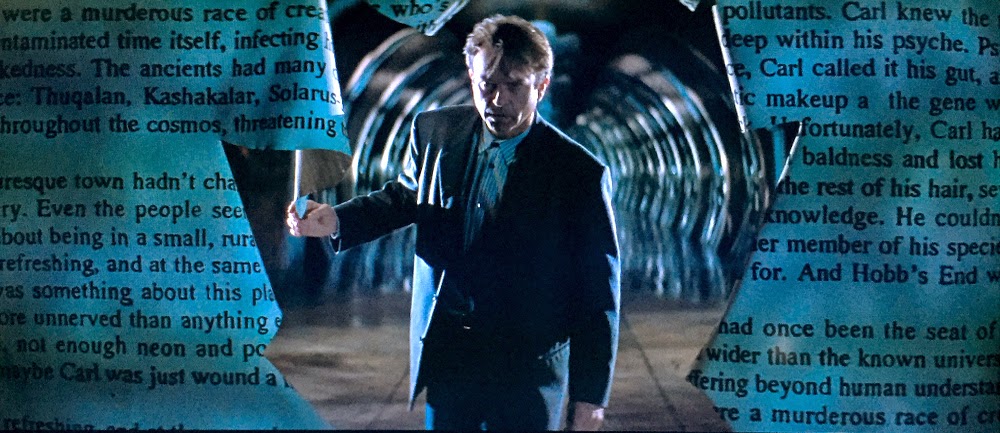
One of the few scenes to clearly show literal monsters occurs when Cane finishes his book. The scene begins with Cane showing that he is capable of warping reality when Trent suddenly finds himself in the former’s writing room. Cane finishes typing the book and declares it “all done” before entrusting Trent to return it to the world. Cane explains that “you are what I write” and states that nothing within this world existed before the story began. Cane continues to emphasize the idea of the world being fiction when he embeds his fingers in his face and tears it apart like a sheet of paper, exposing a black, empty void. The camera looks back at Trent from inside the void. From this side, the door that was behind Cane is replaced by a page from a book. Though the hole prevents the page from being read clearly, the text that is visible refers to Hobb’s End, suggesting that the viewer is literally looking into a page from one of Cane’s books. As Trent approaches the hole, Styles begins reading part of the manuscript, which describes in detail precisely what is happening.


The presence of Cane as the writer allows the film to further create this disruption through the use of abjection, an idea proposed by Julia Kristeva which suggests that horror resides in the middle of established social boundaries such as the living and the dead, human and animal, and male and female, or in this case between reality and fiction. The horror of In The Mouth of Madness comes not from Cane himself or from the Lovecraftian "Old Ones" he claims have influenced his work, but from the idea that everyone within this world, including Trent, is a fictional construct whose every action is dictated by the author and who only exist to serve the needs of the story.

Moments of abjection between reality and fiction recur throughout the film, beginning with Trent and Styles encountering a town that should not exist—later in the film it vanishes entirely, along with Styles who was literally written out of existence by Cane. The confusion is further emphasized when Trent finds himself reading one of Cane’s books while exploring the town, and comments that “I’m reading this thing like it’s a guidebook.” This idea of the abjection between reality and fiction reaches its peak in the film’s final moments. Trent sits down in a movie theater with popcorn and watches the film adaptation of the Sutter Cane story In the Mouth of Madness. A brief montage reveals that the film adaptation of the book is literally the film the audience has just finished watching. Reality as the viewer understands it is being disrupted by the idea that their reality is fiction. Trent constantly finds himself trying to rationalize his encounters, but upon seeing himself in his own movie, he is forced to finally realize the truth that none of his world is real.


This idea of monstering goes further. While Cane can be seen as the monster, the film also plays with Carroll’s idea of the anomaly to turn the rest of the cast into monsters themselves. Trent sets this idea up early in the film when he describes the experience of reading Cane’s books. “Pulp horror fiction, they all seem to have the same plot,” he says. “Slimey things in the dark. People go mad. They turn into monsters.” This is precisely what happens later in the film. Cane himself is an anomaly in In the Mouth of Madness, but in keeping with Wood’s ideas of what defines the monster, the anomaly shifts over the course of the film.

In a conversation between Trent and Styles, the latter justifies her love for Cane’s writing by suggesting that “Right now reality shares your point of view. What frightens me is what would happen if reality shared Cane’s point of view”. She goes on to suggest that “sane and insane could easily switch places if the insane were to become the majority”. This discussion sums up Wood’s idea of the monster challenging "normality", a term he uses in a loose sense meaning simply “conformity to the dominant social norms.”

Normality changes over the course of the film, initially with the characters believing that what they are experiencing is reality until Sutter Cane exposes them to the repressed truth. As the narrative progresses, more people become aware and are infected by it in ways that a man like Trent would view as insane. This challenging of Trent’s understanding of sanity is first experienced when he is faced by a man he later describes as a “lunatic with an ax”. The man in question steps out of a bookshop, crosses the street in broad daylight holding an ax, walks toward the diner where Trent is eating with his employer, smashes the glass and then asks Trent “do you read Sutter Cane.” This man is killed by the police, and naturally his actions are dismissed as being the product of mental illness.


Later on, it is revealed that this man was actually Cane’s agent. He was also the one person who read In the Mouth of Madness and as a result was not only aware of his fictional status, but also of the role Trent would eventually play in the narrative. It is now brought into question whether the actions of Cane’s agent were insane. At first, the agent can be seen as a monster, but when his perspective is revealed, it suggests that Trent may in fact be the real monster. In addition to reality and fiction, the abject also occurs between sanity and insanity, and the viewer is left to question their definitions of both.

Freud’s original concept of “madness” was that it was connected to a person’s own past, but in In the Mouth of Madness it is suggested that insanity is simply a label for any behavior that violates what the majority of the population see as normal. Trent’s own sanity is brought into question, ironically, by his very efforts to rationalize his experiences while everyone around him is turning into what he would consider monsters. This development in Trent’s character ties back to Styles’ comment earlier in the film: that which the viewer would consider insane has started to become the majority, and a character like Trent whom the viewer might ordinarily view as sane appears to be insane by the sheer nature of failing to conform to what has become normal.

The idea that Cane transforms people into monsters is explored more literally through the character of Styles. From her introduction, Styles is a horror fan who attempts to address Carrol’s very question of why viewers are attracted to horror films, as raised by Trent. As a Sutter Cane reader, she finds herself more open to the possibility that his books are real, an idea she begins to develop soon after entering Hobb’s End. When they first arrive at the hotel from Cane’s book The Hobb’s End Horror, Styles displays an uncanny ability to point out minor details about it without looking. She is also the second character to have her reality challenged, after Cane’s agent, when she is forced to read In the Mouth of Madness.

After this scene, Styles becomes a more explicit puppet of Cane’s, having sex with him oblivious to a monstrous outgrowth on his back, experiencing peculiar transformations, and displaying abrupt shifts in personality. With no build up she begins attempting to seduce Trent, much to his shock and confusion. She has herself become a monster, challenging what Trent would see as normal. Styles behaves in ways that he would deem insane, such as swallowing the keys to Trent’s car. She even briefly becomes a literal monster when her body is shown contorting into a quadruped form, walking on both her hands and feet with the sounds of bones cracking heard as she moves.

In the Mouth of Madness is one large distortion of the theories presented by Wood and Carroll. It plays on the idea of the monster disrupting what is normal and challenging the viewer’s understanding of reality by forcing the viewer to question their ideas of reality and what is normal. By leaving the viewer unsure of what they can call normal, the film also brings into question precisely what it means to be a monster or an anomaly. In the end, Cane can be seen as a monster, but he is also a tool used by the filmmakers to explore the question of just what makes someone a monster, and it is through him that the ideas of Wood and Carroll are tested.

Tuesday, 26 May 2015

Why Are Found Footage Films So Successful?


We've been seeing a lot of these "found footage" films over the last few years, but what exactly defines a "found footage" movie? There is some dispute on the matter but generally the "found footage" label refers to any film which uses, as the name implies, the approach of being presented as found footage. These films are fictional stories shot in a documentary-like way to look like people actually filming the events as they happen. The "found footage" genre is most commonly associated with horror, but it can (and perhaps should more often) be applied to other genres as is the case with movies like Europa Report (science fiction) and End of Watch (police procedural).

The found footage film has a long and complicated history. A likely precursor (and perhaps also a source of the genre's association with horror) is early gothic literature. Among the best examples of this would be the stories of H.P. Lovecraft, which were often presented as "found manuscripts". Many of his longer, more science fiction-based stories such as At the Mountains of Madness, The Whisperer in Darkness, and The Shadow Out of Time were written in the form of scientific reports describing what the protagonist experienced. His earlier stories The Hound and Dagon were both presented as suicide notes written by an unidentified narrator.

One of the most likely candidates to be an early precursor to the found footage horror film is Lovecraft's The Call of Cthulhu. The story is structured in the form of a "found manuscript" written by "the late Francis-Waylon Thurston, of Boston" (as a note at the beginning informs the reader). Already, the basic setup is reminiscent of the structure of many found footage horror films, where the protagonist's fate is known from the beginning and the story is presented as his record of the events leading up to his demise, similar to The Blair Witch Project or Paranormal Activity.


The Call of Cthulhu even has the narrator using his manuscript to provide a detailed account of his investigation into a series of ancient legends, with the ominous implication at the end that he meets his end at the hands of the Cthulhu Cult that has been referred to throughout.  A similar structure can also be found in Lovecraft's earlier story The Temple, which is presented as a message in a bottle chronicling the final days of a German U-Boat crew. Lovecraft was also heavily influenced by Edgar Allen Poe, who used a similar structure for his story Ms. Found in a Bottle, which is precisely what its title implies. The idea of "found footage" is basically a modern update on the "found manuscript" model from early horror literature, with the main difference being that the protagonist is using a video camera to record what happens instead of writing it in a journal.

As a style of film, found footage goes back a long way. The 1913 short The Evidence of the Film centered around a crime being solved when the footage from a camera that was recording nearby is revealed to have captured the face of the culprit. One of the earliest films to use the modern idea of a found footage structure is the 1980 exploitation film Cannibal Holocaust, which centered around a group of characters watching footage recorded by a documentary crew who disappeared and are later found dead. However, the film that is responsible for popularizing the found footage horror film is the 1999 film The Blair Witch Project.


This was a film made with almost no budget, featuring a group of unknown actors acting under their own names. It even lacked a script; instead favoring an outline of the basic plot while allowing the actors to improvise. The "story" was basically that the viewer was seeing the recorded footage (presumably recovered sometime after) of three amateur filmmakers who disappeared while trying to shoot a documentary investigating a local urban legend, similar to The Call of Cthulhu's structure as a manuscript written by a man who died as a result of investigating an ancient legend.

To the surprise of the filmmakers, it proved to be a huge hit at the box office. The film's reputation for instill fear spread quickly, and naturally it was not long before the big studios in Hollywood started to take notice. This led to a short-lived series of attempts to replicate the success of The Blair Witch Project, most of which were unsuccessful. There was even an attempt to cash in by way of a big-budget sequel, Blair Witch 2: Book of Shadows, which was a critical and commercial failure. These efforts died down for a time, until by total chance something similar happened in 2007.

Like The Blair Witch Project, Paranormal Activity was a found footage horror film made with next to no budget and unknown actors. It was also presented in a similar way, with the film being presented as footage recorded by a man living with his girlfriend while both are being haunted by an unidentified but apparently supernatural entity. At first, it was a spectacular failure, until a copy ended up in the hands of Steven Spielberg. The initial plan was to remake the entire film with a larger budget and recognizable stars, but in the end a test screening of the original version was arranged, and proved to be a remarkable success with its audience.


Suddenly, there was a revitalized interest in the found footage genre, and since then there has been a wave of different titles: Cloverfield, Apollo 18, and Chronicle being notable examples. Many of these fit the same template as first established by The Blair Witch Project, with low budgets and unknown actors. They also used the same structure of being presented as footage recorded by the characters, typically building up to their inevitable or at least implied doom at the end. Because of this structure, likely borrowing from The Call of Cthulhu and similar short stories, the found footage genre is often associated with horror.

However, this is not always the case. They may not be as common, but there are found footage films in other genres. In fact, a lot of the best found footage films are the ones that try to work in other genres such as Europa Report (science fiction) and End of Watch (police proceedural). There are a few different reasons to take this approach. From an aesthetic standpoint, the found footage film structure can allow for a documentary or home video-like feel that adds a layer of authenticity. End of Watch uses the structure of a cop recording his everyday life to create the feeling of following two real cops on their everyday adventures. Europa Report is literally structured as a documentary, even incorporating interviews in addition to footage from the mission, making it feel like an actual step forward for the space program instead of a simple science fiction narrative.

There is also a very simple reason why studios continue to produce found footage films: they are almost guaranteed to be a success. Found footage films are often made with low budgets and, outside of a few rare exceptions such as End of Watch and Europa Report, unknown actors. From a purely financial standpoint, unknown actors can be paid less than stars (though from an ethical perspective one might argue otherwise). The format also means less money goes into equipment and reduces the number of personnel who need to be hired, and more of what little expenses are present can go into the minimal effects. This in turn ties into the idea of Return on Investment (ROI).


The ROI is a formula which serves a simple function: creating a percentage of a product's income relative to the expenses that went into its production. In the case of cinema, a movie that is considered financially successful would be one that makes more money at the box office than its original budget. The found footage format is practically designed to allow for low budgets that are easily surpassed by the numbers at the box office. This is the main reason for the recent wave of found footage horror films: they make money.

Sunday, 1 February 2015

Night of the Living Dead: Why the Remake is Better.


When I decided on watching George A. Romero's Night of the Living Dead for my Blindspot Challenge, I did so knowing a few things. I will have to make that confession that due to a prior class several years ago, I already knew about the ending and the significance of the fact that it was Ben alone who made it to the end. I also knew that it had some issues with regards to how it treated Barbara, who at the time I was led to believe was the only female character (which is not in fact the case). Say what you will about the original 1968 film, but it did have its problems. While it was remarkable on some fronts, the story had its flaws with the extremely contrived situations and underdeveloped supporting characters.

Naturally, when I finally had to watch Night of the Living Dead in its entirety for another class (forcing me to change up the order of my list), I found myself curious about the 1990 remake. I had been told that it addresses a lot of the problems of the original 1968 film. Remakes in general have a reputation for being inferior to the original, especially in horror. In some cases that is indeed the case, such as with Jan De Bont's remake of The Haunting, or at the very most, the remake is entertaining but not as good as the original. However, once in a while you get a remake that actually matches or on a rare occasion even surpasses the quality of its predecessor such as David Cronenberg's The Fly, Zack Snyder's Dawn of the Dead, or John Carpenter's The Thing. Tom Savini's remake of Night of the Living Dead is one of those rare accomplishments.

Plot-wise, the movie is more or less the same, at least in terms of its setup. Barbara (Patricia Tallman) and her brother Johnnie (Bill Moseley) are have just arrived a cemetery to place new flowers on their mother's grave when suddenly zombies show up. Johnnie gets killed and Barbara just barely escapes. She arrives at a seemingly abandoned farmhouse where she eventually encounters Ben (Tony Todd), and the two of them try to work together to survive against the zombies. Later on a few other people turn out to be hiding in the basement, which includes Harry "I Want to Lock Myself in the Cellar" Cooper (Tom Towles) who refuses to cooperate and causes a lot of trouble. However, there are a few new twists and turns to be found this time round, ranging from minor details (making Harry's infected daughter a teenager instead of a little girl) to drastic changes in character.

The most notable change is the revision of Barbara's character. In the original George A. Romero film, Barbara spends the majority of its running time sitting on a couch in a traumatized and semi-delirious state of mind only to end up getting killed when she tries to do something useful. At first it looks like her counterpart in the remake is going through something similar, except she actually manages to pull her weight despite the obvious trauma she has been through. She does cry and scream several times in the early scenes, but she goes on to begin learning to protect herself and, along with Ben, taking on a leadership role. This is precisely how the relationship between them should have played out in the original film.


There are some changes in the rest of the cast as well. They actually have personalities now which is a nice change. Harry, or Crazy Cellar Guy as I like to call him, is far worse than his 1968 counterpart. In the older film, he was just annoyingly stubborn and had difficulty listening to people. Here he really is a horrible person who treats everyone like crap, including his own wife who he even hits at one point. Said wife (McKee Anderson) actually gets a personality this time, and while her 1968 counterpart did speak out against her husband's actions, this time she actually gets to stand up to him. Judy is a bit more panicked than in Romero's film, but she does manage to be useful and gets an actual motive for joining Tom in trying to get Ben's truck refueled instead of charging into a hoard of zombies for no other reason than because of her love.

As far as the characters are concerned, it is definitely an improvement over the original. Ben is still a strong character who remains true to what made him such a crucial part of the original while also addressing its questionable treatment of women. The rest of the film also flows a lot better. For example in the original, Tom and Judy's deaths seemed very contrived and the circumstances leading to the gasoline disaster that kills them are not very well explained (for some reason they try to pour the gasoline before putting the nozzle into the truck's tank) and Judy dies because her jacket gets caught. In the remake, there is actually a far more straight forward explanation for how the fire starts and there's no more of that "my jacket's stuck" nonsense.


While George A. Romero's Night of the Living Dead holds a cultural significance as the movie that popularized the modern image of zombies, Tom Savini's remake is a far better film on every possible level. All of the problems with Romero's film are addressed and fixed here, which allows for a few new changes that help to improve the narrative such as Barbara's far more interesting characterization and even a very different ending (which I won't give away). It is a great film and definitely worth checking out, perhaps far more so than the original. This time around, the remake is definitely an improvement.

Tuesday, 20 January 2015

IT'S ALIVE... AND IT'S GAY!


1818 saw the publication of the novel Frankenstein by Mary Shelley and with it the origin of one of the horror genre's most iconic characters, simply known as "The Monster". The story was based on the idea that just because science can do something does not mean it should, in this case through the questionable process of reanimating corpses. The title character of Dr. Frankenstein is a scientist who creates a man by combining bits and pieces from dead bodies and figures out how to bring it to life. Unfortunately, upon doing so he is horrified by his creation and disowns it. The Monster (it is never given a real name) is confused and has a child-like mindset as he is released upon the world. All he really wants is a friend, but he is feared by everyone he encounters leading driving it to violence.

Since the publication of Shelley's book, the character of Frankenstein's Monster has become an icon of the horror genre. He has been the subject of countless movies, not all of them adaptations of the book. Many have spoofed the character in various ways, ranging from H.P. Lovecraft's Herbert West: Re-Animator to Mel Brooks' Young Frankenstein, or in some way paid homage. Several adaptations of Frankenstein have been made, but the most iconic is arguably the 1931 film of the same name directed by James Whale.

Whale's film was such a success that Universal Studios decided a sequel had to happen. James Whale was initially reluctant but eventually agreed to take on the project which would provide a "continuation" of the 1931 film, the result being the strange 1935 horror film The Bride of Frankenstein. In order to justify continuing the story, the movie was framed in the form of Mary Shelley herself relating what happens next to her friend Lord Byron and her husband Percy. This whole setup makes one wonder if the creators of the film actually read her original novel, to which a sequel of this sort would be extremely unlikely.

In the book, Victor Frankenstein (who for some reason had his first name changed to Henry in the films) spends the final act of the book travelling the world in pursuit of the monster, only to get sick and die a few days after being found by the crew of a sailing ship in the Arctic (these last few days of his life also serve as a framing device). The Monster follows not long after, deciding to burn himself. Most of the supporting characters have also died by this point, so there is not really any way Mary Shelley herself could have continued the story if she wanted to, at least not with the same characters. The only way the story could really go on is if another scientist figured out Victor's formula and tried to build on it, and even then she would have to find a creative angle to take or else it would just be the first book all over again.


Obviously, this framing device is a somewhat misused, as The Bride of Frankenstein is a sequel to the 1931 film rather than to the book. If anything, the only real contribution it serves story-wise is to provide a recap of everything that happened in the previous film. Mary Shelley begins telling the story but this scene is never revisited. No voice-over narration is incorporated, nor does the film ever return to these three. Mary Shelley claims that her story did not end where it did (which raises the question of why she ended it there) and it reveals that the Monster somehow survived being burned alive in the previous film, with Victor Henry Frankenstein also being found alive but injured.

What is especially strange about this movie is that for a film called The Bride of Frankenstein, she is barely in the movie. There is less Bride of Frankenstein in The Bride of Frankenstein than there was a towering inferno in The Towering Inferno. Most of the movie instead focuses on Henry Frankenstein encountering a mad scientist named Dr. Pretorius who forces him to into a collaboration to create another reanimated corpse. This leads to the idea being proposed to use a female body this time, and to create a "mate" for the monster. A similar idea actually appears in the original book, in which Victor Frankenstein is convinced by the monster to make a woman like him (though he panics and destroys the female monster before she can be reanimated), but in this case, the "bride" only appears right at the very end, and even then for only a few minutes and having no dialogue.

Even James Whale did not initially want to work on a sequel to Frankenstein, so why did he eventually agree to do it? Studio pressure had a hand in it, since his previous film was such a huge success. However, even if Whale turned it down, Universal Studios still had the rights to his film and could have hired another director to get the sequel made. It was actually because Whale was a homosexual working under the Motion Picture Production Code formed by William Hays, something which contained a very strict list of what filmmakers were not allowed to show in their movies.

The code included opposition to a lot of things and can easily come off as offensive today. It contains prohibitions on such things as adultery (unless it is essential to the plot and treated as immoral, and even then cannot be explicit) and interracial relationships. While the code does not specifically name homosexuality as something unacceptable to depict, it does refer to "sexual perversion" which I can only assume was meant to include any depiction of gay sex, among other things. In any case, homosexuality was generally frowned upon, and filmmakers were not allowed to acknowledge its existence. Whale took on the project because it provided a venue to present themes of homosexuality that could go unnoticed by the censors. It worked, and it was not until years, possibly decades later, that scholars and critics began to notice the unsubtle undertones.

These elements form in large part through the interactions between the three central characters: Frankenstein, Pretorius, and the monster. The relationship between the two scientists does in some ways play like a romantic couple. Pretorious essentially "seduces" F. rankenstein into taking part in his experiments. He also has a tendency to visit Frankenstein at night, and invite him over to his place. When they are working together in the lab, there are plenty of scenes in which both of the men are placed very close together in a way that makes them seem intimately connected.

The Monster also displays similar tendencies, with one of the best examples being when he first encounters Pretorius. This is one of The Bride of Frankenstein's weirder moments, set in an old crypt filled with corpses. Pretorius finds the skeleton of a young girl who died as a teenager and for some reason decides this is perfect material for his experiment. He then sends his two assistants out before revealing his brought his own dinner. By that I don't just mean he brought a sandwich, I mean he actually sets up a fancy candlelight dinner, complete with a bottle of wine, and sets it all up using the coffin as a table with the bones he just exhumed placed right next to his food. During the same scene, the Monster encounters Pretorius and is invited to join him. Pretorius shares the wine and they have an intimate conversation. The underlying implication here is actually quite simple: Pretorius has invited the Monster on a date.


At first glance, this actually seems remarkably progressive for a movie made in 1935. The fact that a homosexual not only managed to lead a successful Hollywood career but also managed to make a film criticizing homophobia and get away with it is remarkable in itself. At least, that might be how it appears at first. Unfortunately, there is a darker side to it. The movie might not be as progressive as it initially seems. In fact some might argue that it is outright misogynistic, but more closely focusing on the homoerotic undertones, there is a catch that suggest some... strange worldviews. 

James Whale was a homosexual and littered The Bride of Frankenstein with homoerotic undertones just to see how much he could get under the censors. One could argue that there is a pro-gay message (though one presented in an extremely roundabout way)... for men. Throughout the movie there are homoerotic undertones with regards to the interactions between the male leads, but there is no reference to lesbianism. Not a single woman in the movie ever behaves with the same sort of implications as the men. None of the female interactions display the same homoerotic components, as though James Whale didn't know that there are also plenty of gay women.

Of all the women who do appear, there are only two the viewer needs to concern themselves with, the "Monster's Mate" herself, and Frankenstein's wife Elizabeth. Both serve very little purpose in the story beyond a motivation for the men. Elizabeth is simply there to be captured so Frankenstein will work with Pretrorius (though she later somehow manages to escape, it isn't explained how she manages to get to the lab in the climax) while the "bride", who is barely in the movie, gets no dialogue and rejects the Monster as her "mate". These two women never even interact (ironic, considering they both appear in the same scene), let alone engage in the same sort of undertones that have been driving the men throughout the film.

Funnily enough, the closest thing the film has to a strong female character is Mary Shelley herself, who only appears in the opening scene during which she is praised as a talented writer by the two men in the room. As with the later moments, this interaction between the men allows for more not-so-subtle interactions. Whale seems to envision the "ideal family" as two gay men and a sympathetic woman. Once again, Mary Shelley is kept from partaking in these interactions, as though Whale could not conceive of the possibility that she too could in turn be gay.

The Bride of Frankenstein therefore becomes a strange film indeed. As a horror film, it is campy and not particularly effective especially during the more bizarre moments (it's a bit hard to take the film seriously when we see two guys going on a date that involves a candlelight dinner on a coffin). It becomes more interesting when you strip away the silliness and the obvious disregard for Mary Shelley's own writing despite the opening scene claiming that this is her continuation of the story. Underneath that, there are some bizarre sexual innuendos that make it hard to tell if the film is progressive or offensive.


Thursday, 8 January 2015

Torture and Terrified Women


In many ways film is about spectacle, and in no area is that clearer than in its many ways of treating the human body.  The history of putting a body on display for the viewer goes back a long way, long before cinema. It goes at least as far back as the "strong man" acts of 19th century circus shows, which would feature a large musclebound man performing "unusual" feats of strength to amaze the viewers. The earliest cinematic example I have found is one of Edison's Kinetoscope films, Sandow the Strong Man. The display of a muscular body (usually male, though female examples are becoming more common) would become an important element of the action film, and the same basic principle is still present in many contemporary works (Taylor Lautner in the Twilight series, for instance).

However, there are other ways to create a spectacle using a human body of either gender. On one end, there is the display of an impressive muscular build, and the display of the body in motion. On the other, there is precisely the opposite, something much darker and more disturbing. Instead of contriving situations to show off the body, situations are instead developed to show its destruction. The appropriately-named The Wizard Of Gore emphasized this very idea. The titular character, Montage the Magnificient, would create "illusions of illusions".

In one scene he performs an inversion of the classic "sawing a lady in half trick" wherein he actually saws a female audience member in half (with a chainsaw) but makes it appear to be an illusion. In the same scene, Montag delivers a speech in which he explains that "terror and torture have always fascinated mankind". He likens it to the pleasure experienced by spectators of Gladiatorial shows in Ancient Rome, which while perhaps not as violent as often depicted in the movies (the fights weren't always to the death) was still based around people harming each other to entertain others.


Indeed, there does seem to be a sort of sick, twisted pleasure to be found in observing the abuse inflicted on another person's body. This makes up an entire sub-genre of horror commonly known as "body horror". The idea behind it is simple, to frighten the viewer by mutilating or distorting the image of the human body. When done right it can be a very effective tool for horror, but in a strange sort of way it also serves precisely the opposite. The abuse or distortion of the body becomes less a mere source of fear and becomes itself a source of spectacle.

The Wizard of Gore gives the viewer a unique view compared to the fictional audience within the film, in that we get to see the violence in its excruciating detail, while we also see the perspective of the film's audience (that watches oblivious to what is really happening). When the viewer watches a body (often female, for some reason) being mutilated in this fashion, it creates a bodily response of sorts, much like watching a martial arts movie.

When watching a movie like Enter the Dragon, there is a feeling that the viewer experiences. When they watch Bruce Lee beating up one of the antagonists, there is a feeling of tension that excites them. It makes the viewer feel as though he or she is part of the action, right in there next to Bruce taking out the bad guys. This concept is known as "muscular sympathy", and has a major role in the popularity of action films featuring martial arts, though it does appear in other forms of action movies as well.


Just as martial arts films rely on the spectacle of bodies in motion, the horror genre relies on the spectacle of bodily abuse. The same basic principal of muscular sympathy applies to the horror genre as well, if in a different form. In a similar vein, the viewer is excited by a tense feeling (which I shall refer to as "muscular repulsion") that makes them feel like they are experiencing what is on screen. The difference is in precisely how the viewer feels. Instead of feeling like they are right next to Bruce Lee beating people up, it becomes more as though they are the ones taking a beating at his hands. More accurately, the viewer feels as though they are experiencing the pain of whatever horror is being inflicted.

A perfect example would be David Cronenberg's The Fly, in which Jeff Goldblum's character, Seth Brundle, accidentally has his DNA merged with that of a fly. What makes this particular film so terrifying is watching him slowly transform into something that seems less human. We see the process over several weeks, perhaps months, as he slowly transforms into a disturbing hybrid. As he does, his body becomes distorted, and it becomes increasingly harder to tell where he ends and the fly begins. When watching The Fly, the viewer experiences a sense of pain, because they feel as though they are experiencing the transformation as well. It seems as though the viewer knows what it feels like to be transformed in this way.

This feeling is also especially prominent towards the end, when the final stages of the transformation are taking place. First there is a spectacle of the harm inflicted on a supporting character, Stathis Borans (John Getz), who loses his hand to the titular monster. In this moment, the viewer feels as though they too are experiencing the same pain (and of an especially excruciating sort, seeing as his hand appears to be slowly corroded off his arm). Later on, when Brundle (or "Brundlefly" as he is often known at this point) is merged with the teleporter itself, he crawls out in excruciating agony. The viewer once again gets a sense of the horrendous pain that comes from his final transformation. Just like in the martial arts film, it feels as though they are part of the action.


Muscular repulsion is certainly a major part of the experience in watching a horror film of any sort, especially one with large amounts of gore. Just muscular sympathy makes the viewer feel like they are fighting alongside the hero, muscular repulsion makes the viewer feel as though they are on the wrong end of the action.  It is a major part of most horror films, especially ones that feature large amounts of gore. In a similar vein, The Thing features the same experience of muscular repulsion in specific moments. 

The outdoor scenes make the viewer feel as though they are in the freezing wasteland of Antarctica, while indoors they get the same sense of paranoia, but it is in a few select moments when moments of true muscular repulsion happens. These include scenes such as the infamous scene where Copper (Richard Dysart) attempts to use a defibrillator on his fallen colleague Norris (Charles Hallahan), only to discover the man in question was infected. Nobody (including the viewer) realizes this until Norris's chest opens and slices Copper's arms off, leaving him to die presumably from a combination of shock, blood loss, and smoke inhalation. 


Like in The Fly, the viewer is excited by a bodily response in that they seem to feel the same pain as Copper. They experience a sense of shock and experience muscular repulsion in that they feel as though they have just been through the same experience. This is one of the best examples, but muscular repulsion is present at numerous other moments, such as when Bennings (Pater Maloney) is assimilated, and Windows (Thomas G. Waites) is killed by the Palmer-thing. The simplest case arguably happens just prior to the blood test scene, when Clark (Richard Masur) is shot in the head by MacReady (Kurt Russell), when the viewer feels as though they too are on the wrong end of revolver he is holding at the time.

The Thing also provides another method of using bodily abuse as a spectacle, in the form of distorting and transforming the body. In this case, it happens when the characters who have been infected are exposed. With each one, they begin to transform, usually still somewhat resembling the victims but in a mutilated form. During the scene where MacReady performs the blood test, Palmer (David Clennon) is exposed as a Thing and immediately his body begins contorting. His face becomes elongated, his skin shrivels, and turns into a sickly reddish-brown color that almost looks as though he is decomposing. Once the Palmer-Thing breaks loose of its restraints, its head splits in half and turns into a mouth.


Similar approaches happen with the other cast members that are exposed as well. Norris opens his chest like a mouth full of sharp teeth and then proceeds to disconnect his own head (which then drags itself along the floor with an elongated tongue before growing legs and a separate pair of eyes), while the body grows a new one out of the torso (that resembles Norris with fangs). When the Blair-Thing transforms in the film's climax, only half of his face still remains visible (attached to the back of a sideways head filled with sharp teeth). Even Bennings, who is infected much earlier in the film, is shown first in the process of assimilation (his body is coated in a sickly red and wrapped in tentacles), and then partially assimilated just enough that the viewer can recognize him while also seeing clearly that he is no longer human.

At its core, the principle is basically the same as in the action movie. Much the hardbodied heroes of the 1980's or even Sandow the Strongman, the human body is displayed as a spectacle for the viewer to admire. The difference is in how. Much like how a film such as Predator impresses the viewer by displaying the extremely muscular bodies of its actors, movies like The Wizard of Gore, The Thing, and The Fly attempt to impress the viewer by doing the exact opposite. Instead of displaying a muscular build, they display the body being destroyed, mutilated, distorted, or in some other way being abused. This in turn becomes a major part of what makes a lot of horror films work, and how they affect their viewers.