Pageviews from the past week

Sunday, 27 November 2016

Twelve Wars to Christmas


Introduction


So last year, I decided to run War Movie Week, which turned out to be a huge hit! The idea was basically that each day was broken into different eras, and I would randomly choose a film each day based on an overarching theme (World War I, World War II, Vietnam, Modern Warfare, Future Warfare). Because it was such a hit last time, I naturally thought it could be worth exploring again, and I started experimenting with ideas for new categories to explore, and what better way to take a step further than inviting other bloggers to join in.

Yes, I'm making this a mini blogathon! The idea is straight forward enough: the week is broken up so that each day focuses on a different topic related to an overarching theme. In this case, the theme is war, and each day focuses on a different conflict. For added effect, why not make this into a sort of advent calendar counting down the days until Christmas?

Before I can get into any details, I should probably take the time to note that I can't take full credit for this idea. I mean, yes, it was my idea to put this thing together and set it into motion, but recently I seem to have found myself turning a lot towards Wendell Ottley of Dell on Movies for advice. I'd just like to thank him for assisting me in coming up with the different topics.

Instructions

No prior registration is required and you are under no obligation to post every day within the timeframe, so if you're only reading this on the 23, you still have time to enter. As long as you submit something on the appropriate day, it counts.

If you would like to join in, this is all you need to do...

  1. For each day that you wish to participate, choose a war film based on the designated era. See below for a full schedule.
  2. Watch your chosen war film and try to write something. It doesn't really matter what you write. You could just review a movie or provide a detailed analysis, or you could just write down some things you found interesting. As long as you have something, it is valid.
  3. Post what you wrote on the appropriate day, and send me a link. I'll include it at the end of my post.


And that's it. Once I've got my post together for each day, I can add in links to other participants. Feel free to comment on each other's posts or exchange recommendations. I'd be happy to hear any recommendations you have for films to look into, though I can't promise I'll be able to watch them for this particular event.

Schedule


To set things in motion, and to set a tone for what will be coming over the month, I thought it made sense to go back to the beginning, to the first war ever fought by humanity. It is hard to verify exactly what the first war was, mainly because historical records do not go back to the birth of humanity, and it is hard to gain that type of information from fossils. Fortunately, I managed to get a camera crew and a time machine, so we went back and filmed the entire thing. Here is the official, definitive, irrefutable documentation of humanity's first war...


Now, here is the official schedule. It was difficult to come up with a good selection of choices, and I looked at several different versions of how to do this. I even considered doing this over the course of a month (which turned out not to be as feasible as I'd hoped). I talked to both my mom and Wendell about this and we came up with a bunch of different categories that didn't make the final list. Among other things, we talked about films dealing with different aspects of war, different branches of the military, and even a few different aspects of World War II. The final version I think is the cleanest, given the overlap that would have come with the original list, but here are the honorable mentions that didn't make the cut...

  • Spies
  • On the Homefront (war films not about combat, suggested by Wendell)
  • Foreign Warfare
  • Navy SEALs
  • United States Marine Corps
  • Snipers
  • In the Navy
  • Air Force
  • Black Ops
  • Counter Terrorism
  • World War II- Espionage
  • World War II- Pacific Theater
  • World War II- Atlantic Theater
  • World War II- the Resistance
  • Korean War (suggested by Wendell)

There was also a bunch of different time periods that were considered but ultimately abandoned due to a shortage of movies on the topic, mostly because of difficulty in finding appropriate movies on them, or at least movies I knew for sure I could get. These included the Hundred Years War, The English Civil War, the Renaissance (lots of dramas, not a lot of war films), the Seven Years War, the American Revolution, the War of 1812, the Crimean War, the Troubles in Northern Ireland, and the October Crisis. I also originally had the last two categories as "Advanced Warfare" and "Infinite Warfare" (both names referencing Call of Duty) but I figured it would be too confusing so I merged them into one. 

Still, I think I came up with a good final selection. It wasn't easy to cut everything down and a lot of this was based on practicality, but here is the official list for December 13-24. If you'd like to recommend any good movies for these categories, I am open to suggestion though I can't make any promises.

December 13: Ancient Warfare


December 14: Colonialism


December 15: Napoleonic Era


December 16: American Civil War


December 17: American Indian War


December 18: British Imperialism 


December 19: World War I


December 20: World War II


December 21: Cold War


December 22: Vietnam


December 23: Modern Warfare


December 24: Future Warfare

For reference, I have taken the liberty of putting together some lists of films dealing with some of the above themes. I should make it clear you are under no obligation to stick to these lists. I am merely including them as a possible source of inspiration. I currently have lists for Ancient WarfareAmerican Civil War, British ImperialismWorld War IWorld War II, Cold WarVietnam, Modern Warfare, and Future Warfare.

Monday, 21 November 2016

8 Video Game Supporting Characters Who Deserve Their Own Game


So I find that in the video games I play, I usually love a good story, and with a good story I also like good characters. That said, I occasionally run into the situation where I find I enjoy the supporting cast more than the actual protagonist. Even when there is a great protagonist (or protagonists, in some cases) that doesn't occasionally stop me from being interested in the storylines of supporting cast members. So I thought I'd make a list of ten supporting characters I have encountered in video games who I would want to see take a starring role.

Now admittedly, my knowledge of gaming is not without its limits. I can only go on games I've actually played, which makes it harder to decide. I've also never been good at ranking, so I decided instead to sort these roles alphabetically. So here are ten video game supporting characters I'd be open to seeing take a starring role in their own game.

Claudia Auditore (Assassin's Creed: Brotherhood)


The Assassin's Creed games have generally had a very diverse array of female characters, even if most of them only filled supporting roles. The series has even managed to have two female protagonists so far, the first of which was also black (and possibly lesbian or bisexual, given the subtext between her and Élise). However, special mention goes to Claudia, whose story ended at a point where it was getting really interesting. She proves herself to be a strong woman throughout Brotherhood, first running a small town, later taking charge of a brothel, single-handedly killing several guards, and finally becoming an assassin in her own right.

That last part, however, only occurs at the very end of the game. We see her acceptance into the Assassin Brotherhood, but I'd love to see more of her actual career as an assassin. If Ubisoft ever wanted to revisit the setting of Renaissance-era Italy, a spin-off featuring Claudia as the star would be a really good idea. We could get to know her on a more personal level, perhaps getting a better sense of her psychology and her methods.

Chloe Frazer (Uncharted)


Okay, let's face it, Chloe was probably the best character in the entire Uncharted series. She's strong, witty, can handle herself in a fight, but also human. I'd be lying if I said I never had moments where I played Uncharted 2 wishing I could be her instead of the actual protagonist (Nate's fun, but I personally found Chloe a more interesting character). Sure, Elena's okay, but Chloe is so much cooler. I loved her role in Uncharted 2: Among Thieves and was so excited when she returned for Uncharted 3: Drake's Deception (then disappointing when she left abruptly partway through). A lot of the best parts of the Uncharted games were the ones where you're working with Chloe.

So if why not give Chloe a spin-off game of her own. After all, getting her point of view would probably allow a chance to explore the character on a level not possible when her whole story is seen through Nate. We could get a much deeper look into her psychology and personal life, as well as her career as a thief (everyone always talks about how she is "the best driver in the business," something that generally goes unseen).

Father Mathias (Tomb Raider)


Okay, this was totally Lara Croft's story and she was an amazing character in the game, but that doesn't mean there wasn't a worthwhile supporting cast as well. Most of them could have their stories explored in future Tomb Raider games, but one story that is only hinted at is that of its main antagonist, Father Mathias. Not much is revealed about him in the game, beyond that he was also a castaway stranded some time before Lara's arrival, and his desperation to leave has led him to the conclusion that he must revive the Sun Queen and started a secret brotherhood that murders outsiders. It could be interesting to explore what happened to Mathias and to get a more detailed look into his mental processes. I could see him being a tragic figure, initially a well-intentioned man who got stuck on the island and gradually turning into the fanatic Lara encounters as he grows more desperate to return home.

Janey Springs (Borderlands: The Pre-Sequel)


It's hard not to enjoy Janey's appearance in Borderlands: The Pre-Sequel, in which she assists the player character over the course of the story as well as providing side quests (usually by assigning overly complicated tasks for the player to accomplish something straight forward). Then there's the less-than-kid-friendly "kids books" she is fond of writing. There could be some fun potential to explore her character in more detail in a spin-off, which could make use of her crazy personality and her tendency to get into bizarre situations (and find equally bizarre and overly-convoluted ways of dealing with them). There would also be room to break ground by introducing an openly gay protagonist, something which to my knowledge has yet to happen (at least not in the form of anything beyond including an option for gay romance).

Dr. Penelope Young (Batman: Arkham Asylum)


Batman: Arkham Asylum is definitely intense. It's amazing how much it can do with so little (although it's also very easy to get stuck for the same reasons). That said, there isn't much to Batman himself, and a lot of the more interesting roles are in the supporting cast. Dr. Young proved a good character and I was disappointed to see her die so early. I think there may still be more material to cover which could be accomplished by giving her a starring role. Dr. Young is depicted as a complex character who can seem cold and calculating but also not without a conscience. Her psychology alone could be worth exploring in more detail, but also her career presents some interesting narrative possibilities.

Placing Young as a tragic hero would allow Gotham to be viewed from a perspective other than Batman's (which would be refreshing), and it could allow an opportunity to see how ordinary people are affected by people like the Joker. It could also open up more room to explore what goes on at Arkham Asylum when Batman isn't there. Sure, making a story that isn't about Batman in which he may only be a supporting role could be seen as a huge gamble, but I think there's some good potential.

Tali'Zorah (Mass Effect Series)


For some reason, everyone seems to think it's Garrus who should have his own spin-off, but I don't think I'd want to play as him. Mass Effect is first and foremost an RPG, but if they wanted to deviate from using a player-customized role, Tali seems like a good choice. She played a crucial role across the Mass Effect trilogy, appearing in all three games and her relationship to Shepard being among the most touching of the various sub-plots the games have to offer.

A spin-off focused on Tali could deal with her adventures after the events of Mass Effect 3, and how she has been shaped by her experiences. After all, in Mass Effect she started as a teenager trying to figure out what to do with her life, and with Shepard as a mentor she went on to assist in destroying the Reapers and saving the Galaxy. Following Tali would allow the player to explore in greater detail the aftermath of the Reaper invasion (which could be affected differently depending on Shepard's actions in the previous games). Shepard was very much a mentor towards her, so following her new adventures would allow us to see how Tali has grown as a result.

Tess (The Last of Us)


The Last of Us had an assortment of interesting characters and roles, some arguably much more interesting than the actual main character Joel. Special mention goes to Tess, an NPC who accompanies Joel through the first act of the game, only to get killed early on. This is rather unfortunate given she is such a great character and we find out so little about who she is. From what we do see, she is quickly established to be a strong, capable survivor who knows how to handle herself as well as being a fairly effective smuggler. All we really get to know beyond that is that she has apparently been a criminal partner to Joel for some time.

If Naughty Dog ever wanted to produce a follow-up to The Last of Us, it could be worthwhile to try and explore Tess's story in more detail. Who is she? How did she get involved in the world of post-apocalyptic smuggling? How did she and Joel end up working together and why does she start out the game wanting to kill Robert? We don't get much of an opportunity to really explore Tess's mind, and with such a great character so underused in the first game, it would be really nice to see a prequel that can explore her story in more detail.

Whiptail (Heavenly Sword)


Heavenly Sword definitely gives us a very bizarre and over-the-top world. The setting alone (the aesthetic of which can perhaps be most easily described as a mix of Celtic and Ancient Chinese, with elements of various ancient mythologies also thrown in) is odd enough, and then of course there are also the various strange characters we meet over the course of the story. One of the most peculiar individuals we meet is the Medusa-like General Whiptail, a strange fish/snake lady warrior who serves as the game's first boss. Of course, she isn't in the game very long, and dies early in the narrative, but that doesn't mean there aren't aspects of her character still to explore.

Theoretically, this game would have to be a prequel unless they wanted Whiptail to somehow come back to life (which could open up some interesting possibilities with a redemption story, but would probably be harder to pull off convincingly). It could function as a chronicling of the rise to power of the main antagonist, King Bohan as seen through her eyes, and delve more into their relationship as well as showing how she became one of his top generals and such a dangerous warrior. This approach could also have the interesting effect of making Whiptail into a tragic figure, especially if we can get into her psychology.


So those are some of my ideas. This is naturally limited to games I've played, but what video game supporting characters would you like to take control of?

Thursday, 3 November 2016

Thursday Movie Picks Meme: Middle Eastern Language Movies


So this week, the theme for Wanderer's Thursday Movie Picks Meme is Middle Eastern Language movies. Unfortunately, this is an area where I have zero experience. I haven't exactly seen that many Middle Eastern films and I don't have much to offer in this regard. However, I did take a class in which we spent a week on Post-Revolutionary Iranian Film, and there's been a couple of films referenced on other occasions. I probably won't have the most original or interesting list this week seeing as I'm just choosing from the few I actually know something about.

The Cow (1969)


Okay, so I only saw five minutes of this one, but it still counts. This was from a period of Iranian film that borrowed heavily from the conventions of Italian Neo-Realism in its reliance on documentary methods, use of non-actors, and an emphasis on everyday problems. In this case, the story is about a man's grief after his cow dies, and how he slowly loses himself when the villagers try to cover it up.

Close-Up (1990)


I wasn't a huge fan of this one, but it seems to be one of the most iconic as far as Middle Eastern films go. It's sort of a bizarre film that tries to blur the lines between drama and documentary regarding an incident in which a family was fooled by a man impersonating the director. The film combines documentary modes with re-enactments performed entirely by the actual people involved in the event (including the identity thief) in order to illustrate roughly what happened. Now I personally found it to be slow, not very clear, and boring, but a lot of people seem to like it and the director is supposed to be a big name.


Persepolis (2007)


Okay, I'm cheating slightly but I needed a third movie and this was the closest thing I could find to a film I'd actually watched. It is based on the actual experiences of an Iranian woman growing up in Iran during a very difficult period in its history so it still counts. 

Wednesday, 21 September 2016

Thursday Movie Picks Meme: Teen Angst


This week, the theme for Wanderer's Thursday Movie Picks Meme is Teen Angst. There are a lot of emotional and psychological difficulties that people face when they enter their teens, and it can be a very difficult period of a person's life. Naturally, there have been plenty of movies made on the subject of troubled youth and the everyday issues faced by teenagers.

Now there are plenty of films on the subject. In fact, there's one coming out very soon: The Edge of Seventeen. However, with this list, I've decided to find some unusual choices. These are titles nobody is going to see coming but I've got some good ones. Let's begin...

The Wizard of Oz (1939)


Not what you expected to see on this list, was it? Yes, Victor Flemmin's The Wizard of Oz is a weird and moderately surreal (or at least as surreal as you could get in studio-era Hollywood) fantastical adventure that may or may not have been all a dream. However, it's easy to get so swept away by the extravagant and colorful scenery of Oz that it's easy to forget the black-and-white sequences that open and close the film and that at its core, the film is really about Dorothy's own emotional issues. The entire story is set in motion because Dorothy is frustrated with her mundane life and wants to run away, only to question the value of home when her wish is granted in a rather unusual way.

Rebel Without a Cause (1955)


What list of teen angst movies would be complete without the original teen angst movie. Nicholas Ray's film is widely considered a classic and is arguably the most iconic role of James Dean (also his second film, and one of only three he made before he died). The movie follows three teenagers in the 1950's who are all struggling with their own personal and emotionally difficulties as well as family relations, and how they find themselves coming together when they are all arrested under different charges; eventually finding comfort in each other. Of course, matters are made more problematic by the society that isn't ready to accept their friendship or understand the emotional difficulties they're facing, leading to a dark climax at the film's conclusion.

Labyrinth (1986)


Okay, this is probably not one you expected to see make the list, but teen angst is really at the center of Jim Henson's surreal fantasy adventure. After all, underneath the bizarre puppets, David Bowie's flamboyant costumes, the various fantastical set pieces, and the surreal journey vaguely reminiscent of The Wizard of Oz, it really is about a teenager working through her own emotions. In fact, I wrote an entire essay explaining in detail how the story is really about Sarah's emotional struggle to reconcile two different sides of her personality (her imagination and her real-world responsibilities), a struggle represented by her journey through the labyrinth.

Sunday, 28 August 2016

Why More Video Games need Proper Character Customization


One thing that really annoys me in modern games is the tendency of some franchises to promise "deep customization" and then not even allow the player to choose their character's sex. Medal of Honor: Warfighter and Battlefield: Hardline are both guilty of this type of practice. The former allows the player to choose a class an nationality for their character, but otherwise lacks any sort of customization options, which seems to me like false advertising. Battlefield: Hardline deals with the war on drugs, focuses on modern SWAT Teams (something which women are a part of), and yet they never seemed to consider the possibility that players may want to choose the sex of their character.


To provide a contrast, let's look at a comparatively more progressive game that actually recognizes the issues at hand. Tom Clancy's Rainbow Six: Vegas 2 works to that very effect. In many respects, the game is structured in a manner reminiscent of many first-person shooters such as Call of Duty , only there is actually an effort at representation. Like Battlefield: Hardline, the story mode focuses on a SWAT Team. However, there is actually diversity in the cast, which not only includes a combination of both male and female characters (of different races) but also allows the player to customize its protagonist, Bishop. Bishop's sex is purely aesthetic, and has no effect on the overall narrative beyond a change in voice actors.


One way to look at this issue in more detail is to examine the output of different gaming companies. When one looks at a large enough selection of different games by the same company, patterns begin to emerge. Among these are patterns which often show that the issue extends towards an overall group of developers rather than any one specific gaming franchise. There are many gaming companies that are guilty of unfairly representing women or showing a strange aversion to female player characters.

Now this is not to say that all gaming companies are made up of misogynistic idiots who are too stubborn to recognize the potential of female characters. There are some progressive developers who have actually addressed this issue. BioWare and Bethesda are both gaming companies that have shown a positive effort to improve representations of women in gaming.Most, if not all, of Bioware's games allow the player to choose their character's sex (most famously in Mass Effect, though the same can also be said for Star Wars: Knights of the Old Republic and the Dragon Age series) as well as giving them a large party consisting of both male and female characters. Bethesda's games do not often place as much emphasis on building a party, but their open-world adventures such as Skyrim and Fallout both allow the player to customize their character and provide a wide range of both male and female NPCs with whom they can interact, many of whom are strong women.

Both companies have even gone further on occasion and allowed the player to not only choose their character's sex, but also their sexual orientation. Knights of the Old Republic included the option for a lesbian romance with Juhani in addition to the heterosexual options for Carth and Bastilla. Mass Effect 2 included a few bisexual options (whom the player could romance regardless of gender), while Mass Effect 3 included bisexual options as well as two potential love interests for a gay Shepard (one male, one female). While they're not essential to the gameplay, Skyrim and Fallout 4 both allow the player to engage in same-sex relationships (and even same-sex marriage, in the case of the former).


However, for every forward-thinking company like BioWare or Bethesda, there are others lagging behind. An infamous example of this would be Activision, the creators of the popular Call of Duty franchise who took almost a decade before they finally started placing female characters into their games. Naughty Dog of Uncharted and The Last of Us fame, has no trouble including strong female characters in supporting roles, but seems draws the line on making them playable. Rock Star games has an unfortunate tendency to fall into this as well. They have several major franchises, and not one of their many games has a female protagonist. In fact, many of them lack any notable female characters at all. There have been five Grand Theft Auto and not one female playable character.

This is obviously problematic. Grand Theft Auto went through four games before the developers finally decided to create sprites for female police officers (something that probably wouldn't have hurt if they'd just done that from the start) and still not one female protagonist among its five games. Now one could argue that it wasn't totally unjustified in L.A. Noire (which deals with the police force during the 1940's) or Red Dead: Redemption (which is set in the Wild West), though even then one could question a few choices. L.A. Noire probably could have given its female lead a much more prominent role than merely being a love interest for Cole. In Red Dead: Redemption, it could also have been interesting to see a female gunslinger take the spotlight, even if the rest of the cast was male-dominated.


This in turn brings up a variety of debates that have taken place on the internet recently, namely whether players should be allowed to choose. There have been some extremely flimsy arguments that developers have made for excluding women from their games. One of the reasons Call of Duty took so long to even add a choice to multiplayer was because the developers genuinely believed that women would have an unfair advantage because their smaller size would make them harder targets (seriously), and even that weak excuse doesn't explain why they are so averse to female characters in the campaign mode. Others seem to question whether it should affect the gameplay, and if not why it should even matter.

The answer is easy enough: the option should be there, and it should have little effect on the game. In Mass Effect, the player can choose Shepard's sex and other than a few differences in romantic options it has no bearing on the overall story. Shepard's abilities are based purely on their class and how the character is developed over the course of the game. The actual narrative is shaped by the choices made by the player, and none of them are influenced by Shepard's sex. Both male and female Shepard have to make the same tough calls that present consequences over the course of the series.


One can see the same thing in many other games where gender is purely aesthetic. Skyrim also allows the player to choose the sex of their protagonist (although artwork related to the game and fans in general seem to keep assuming the hero to be male). Aside from a few variations in dialogue, the game is more or less identical regardless of whether the player is male or female, even going as far as to offer the exact same selection of romantic opportunities. The main stories of Fallout 3 and Rainbow Six Vegas 2 both progress more ore less the same way regardless of what sex the player chooses, and the same sets of skills and opportunities are available for both.


So this has led to another common argument: that if gender doesn't affect the gameplay than why bother? Well, it really comes down to the simple fact that everyone has their own preferences, and that they should be allowed to make the character they feel best fits the game. Personally, I have always preferred to play as female characters, and I often find that the game's world feels far more authentic when I take that option. I have a friend who finds that he often prefers to play as non-human characters whenever the game permits it (such as in the Elder Scrolls series). In the case of Mass Effect, there are fans devoted to both male and female Shepard.

The fact is that more games should allow players the choice in who they want to be, rather than having it predetermined. This means that they should be able to create the type of person they feel best fits the game and run with it. This makes games like Medal of Honor: Warfighter and Battlefield: Hardline all the more infuriating for promising "deep customization" and then refusing to allow the player to actually make a character that suits them because the developers are too stupid to realize that women can serve in the military or police force now.

Yes, it's true that female characters shouldn't be too much different from the men. The script should have next to no differences and a female character should have access to the same skills as a man. The important thing is making sure players have the choice to make the character they want. Different people have different preferences. Every player of Skyrim has a unique character that fits them, the same way Mass Effect allows for different players to produce drastically different interpretations of Shepard. The fact is that we want to be able to have a choice. We want to create the characters we feel fit the game, not be faced by obviously biased restrictions.

Sunday, 7 August 2016

Sports Movie Marathon: Whip It (Roller Derby)


Whip It is a curious movie to watch with hindsight, as a few more recent developments bring a whole new dimension to the story. One thing that did notably happen five years after its release was Ellen Page coming out as a lesbian, giving the already-talented actress a new reputation as a human rights advocate. However, while it may have only been in 2014 that Page finally admitted to her sexuality, there may have been clues in her earlier films. The lack of any sexual tension with the (otherwise entirely male) cast of Inception and the boyfriend she quickly dumps in Wilby Wonderful (a moment the film treats as a positive action) could be seen as early indications.

However, Whip It may be one of the most obvious films to showcase this, although it's hard to say if this was intended or merely a reflection of Page's acting. Although the film is thinly veiled as a family friendly underdog sports narrative, it is filled with innuendo and homoerotic subtext that, when realized in the context of Page's own sexuality, adds an entirely new level. This is likely unsurprising, given much of the film revolves around bonding between women, with girl-on-girl fights (which are almost treated like sex) being something of a recurring motif.

From the moment we are first introduced to Bliss Cavender (Page), there is a sense of awkwardness that isolates her from her environment. She struggles to meet the demands of her overbearing conservative mother and has a difficult relationship with her father. At school, she often gets bullied, and she clearly doesn't fit into the beauty pageants. The opening scene shows these two sides through her wardrobe, the blue hair clashing with her fancy white dress. This awkwardness continues throughout much of the film, with Bliss showing difficulty relating to many of the people in her life.


In fact, the few instances where this aspect of her performance drops are moments when Bliss is interacting with other women. This is most evident in her relationship to her friend Pash (Alia Shawkwat), with whom the homoerotic undertones appear to be most obvious. There is even a scene which alludes to this idea by way of them sharing a bed. It's also seen in the way Bliss becomes especially close to the other women on her roller derby team, possibly even closer than she is with her own family. There is also a strong emphasis on the mounting tension between her and rival skater Iron Maven (Juliette Lewis) which could be seen as sexual in nature, especially during their exchange at the film's conclusion.

The movie does include a heterosexual romance between Bliss and a young man named Oliver (Landon Pigg), though even this arguably supports the homoerotic aspects of the film. The romance often appears forced, and Oliver does show some questionable actions early on (such as openly admitting that he stalked Bliss to her workplace). These two share the film's only sex scene, though it is shot in a very surreal and peculiar way, with the two diving into a swimming pool before removing their clothes.

The entire scene takes place underwater, and uses the aquatic environment to give a strange otherworldly sense. At first, this seems like a strange move for what is otherwise a fairly grounded story, only it may be the strangeness of such a moment that works to its advantage. By making this sequence dream-like in nature, it's drawing attention to the fact that it is staged. More specifically, the obviously fake sex hints at the idea that the romance between them is not genuine and works as foreshadowing toward the later sequence in which Bliss realizes he's been treating her only slightly less awful than the original James Bond, and proceeds to break off all ties with him.

This in turn leads to a whole new reading of the film that may not have been evident to its initial viewers: Bliss is secretly a repressed homosexual. This can be seen in her relationship to her mother Brooke (Marcia Gay Hayden), who while not explicitly homophobic displays a very conservative and conformist view of society. She expects Bliss to appear at elegant pageants and on learning of the roller derby championship, admits that she expects Bliss to marry a man (a remark which she appears to find especially insulting). Bliss even goes as far as to run away not unlike the many homosexual or trans teenagers who find themselves in the street because of intolerant parents.

Whip It is far from a mere underdog sports film. It's really a story of exploring oneself. If indeed it is to be assumed that Bliss is gay, than the entire story could be seen as one big allegory for her accepting who she is and coming out (which in this case is shown through her discovering a passion for roller derby).

Saturday, 6 August 2016

Sports Movie Marathon: Eight Men Out (Baseball)


Who's on first? I don't know, but that's not important at the moment. There have been a lot of movies dealing with baseball, but none quite like Eight Men Out. John Sayles' attempt to dramatize the 1919 scandal is hardly what one would call a conventional sports film. Instead, he gives us another side to the world of baseball, and through remarkable attention to detail offers a glimpse into the very different world of a bygone era, even if the actual story is one more easily followed by those who actually know something on the history of baseball. While the film hardly skips out on its detailed baseball sequences, the focus is instead on a different side to the sport.

The story is based on an actual incident that occurred in 1919, a time which presented a very different world. With it, we see a very different rendition of baseball from that of today. For one thing, this was long before women were allowed to compete. It was also a time when players of the sport lacked the concern for safety that they show today (the umpire and catcher are the only ones who seem to have any sort of protection, and even then the latter repeatedly takes off his mask mid-game), a detail shown at the very beginning when one of the players is nearly injured after crashing into a wall (he isn't hurt, though it takes a moment for that to become clear).

The other detail that's easy to forget is this was a time when unions acting for people's rights were only starting to gain a foothold in the workplace. Many businesses actively worked to shoot down unions and crush them wherever possible. In fact, the Oscars originated as a scheme by Louis B. Meyer (owner of Metro Goldwyn Meyer, fittingly the same studio that later produced Eight Men Out) to deter his employees from joining unions. The one Union they did support was IATSE, which was run by a man with ties to Al Capone and made backroom deals to encourage its members to submit to their employers and actively prevented strikes.

The specific events depicted in the movie occurred due to the lack of unions in baseball, leaving players at the mercy of their managers. One popular trick was to place something called a reserve clause into players' contracts, a method which functioned much like the contracts of Hollywood actors in the studio era. When a baseball player signed a contract, they were more or less owned by their team's manager, even when it expired. This meant that the player was prevented from signing on with another team without being sold or leased. Lack of unionization meant most players had no choice but to accept the contract's terms.

Among the various men who ran the business was Charles Comiskey, played in Eight Men Out by Clifton James. Historically, the man had a reputation for mistreating his players, something which is also established early on in the film. When Comiskey first appears in the opening scene, he brags that he has the "best" team in the business. However, one thing that quickly becomes apparent is that he doesn't want to pay minimum wage (one of the main reasons why he was so disliked in his day). After winning a game, the players find a set of bottles containing flat campaign in what appears a weak attempt to substitute a bonus they were promised. It's also very indiscreetly implied that he promised Eddie (David Strathairn) a bonus if he could win 30 games, then kept him out for two weeks to avoid paying.

Unsurprisingly, with a boss like this, the players are making next to nothing. When an opportunity to make some extra cash shows itself, it's hard to resist. Enter a gambling ring with the idea to make lots of money by rigging the game and a few mob ties, and things get out of hand very quickly. From there, it was only a matter of convincing the right players to do badly with the promise of a financial reward and one of the most infamous sports scandals was born.

What makes a film like Eight Men Out unusual is that it gives us this very different side to baseball. Most of the focus is placed on the business end of the game, rather than on the actual sport itself. We follow a variety of different people who all have different roles to play. There's the manager who is only concerned with his own interests and the hope of increasing his already immense wealth, the gamblers who want to make money rigging the games, and the unfortunate players who are idolized by fans who remain oblivious to the fact that they're being exploited by everyone else.

In that sense, Eight Men Out offers a much darker side to the game. Most of the players are ordinary working-class men who are passionate about the game, only they live in a world where talent and passion alone aren't enough. Instead, they are exploited by nearly everyone for selfish gain, caught in a hopeless crossfire. Shoeless Joe (D.B. Sweeney) sums this very sentiment up when he is faced with a prison sentence and explains that all he wants is to do is go "play ball" and forget the politics he's mixed up in.

In short, Eight Men Out shows that there is far more going on in baseball than what the audience sees. Behind the field and its star players lies a bleak world of bureaucracy, greed, and corruption which drives many unseen individuals to questionable lengths.


Friday, 5 August 2016

Introducing Sports Movie Marathon!


So it's time for the Olympics! That's cool, and it seemed like I should do something to coincide with it, so naturally I quickly tried to throw together a theme week at the last minute decided to take this as an opportunity to watch some sports films. Unfortunately, I've got a small problem in that I've never been that athletic. I learned the different positions in baseball from Abbott and Costello and I can tell you I haven't a clue how football works. One of the first basketball films I can think of is the one where Michael Jordan has to prevent the Looney Toons from being kidnapped by aliens and sold into slavery (yes, that actually happened).

As you can imagine, sports films are one of my weaker points. I'm not normally attracted to movies dealing with sports when they come out, and I don't normally make a huge point of watching them. Usually, in order to get my attention, a sports film has to be really, really good, and even then I'm not exactly quick to take those recommendations. Still, it was either this or run a sports-themed blogathon which would probably be an even bigger disaster.

So finding sports movies I could immediately access (either through my owning on DVD, or being available on Netflix) wasn't easy. I also spent some time consulting my fellow blogger Wendell Ottley from Dell on Movies. Unlike me, Wendell actually knows the rules of football and baseball and he's seen his share of sports movies. His advice was extremely useful in figuring out what sports to cover.

So for those of you not familiar with the basic structure of one of my theme weeks, it goes like this: I select and overarching topic, and a sub-theme for each day. The idea is that each day that sub-theme determines what movie I watch, and then I have to find something worthwhile to say on it in a post afterwards.

In this case, I've broken it up so that each article will be related to a different sport. However, the deadlines are changed somewhat. Instead, this will be occurring over two weeks, and I may not post every day. The idea this time is that I've got 11 different categories and I will aim to cover as many of them as possible over the course of the Olympics.

Baseball


Basketball


Bobsledding


Boxing


Curling


Dodgeball


Marathon


Rugby


Roller Derby


Skating


Track and Field


Thursday, 4 August 2016

Thursday Movie Picks: Gambling


This week, the theme for Wanderer's Thursday Movie Picks Meme is gambling. I wouldn't exactly call myself much of a gambler. For one thing, I'm not very good at it. Whenever I play Fallout: New Vegas, and enter one of the Casinos, I pretty much always end up losing my money because I have no idea what I'm doing. I'm not very good at Blackjack and I can't for the life of me understand the rules of Poker. In other words, it's probably for the better that I don't spend much time at actual casinos trying to win money, because I'm really really bad at it.

Unfortunately, it seems I really need to work on seeing more gambling films. It was hard to find good ones. For this list, I'm not going to worry too much about how I feel with any particular film, instead focusing entirely on gambling films I've actually seen. At the very least, I figure I can get a few different types of gambling to show here.

A Day at the Races (1937)


This was the second film the Marx Brothers did after transferring to a new studio, as well as their second film without Zeppo (Allan Jones returns from A Night at the Opera to fill that role). The story is definitely a strange one, involving a misunderstanding that results in a veterinarian being placed in charge of a sanitarium and finding the local race track as the only shot at saving it. Naturally, it all revolves around placing money on the right horse, complete with a few attempts to rig the race. There's also a classic scene in which Chico attempts to extort gambling money out of Groucho by selling him a large pile of books.

Force of Evil (1948)


This 1948 thriller revolves heavily around something called a "numbers racket." I was never able to get a clear description of exactly what that entails, beyond being an illegal gambling operation that was common in the 1940's.

Casino Royale (2006)


It's hard to argue against the themes of gambling which present themselves in Daniel Craig's first entry to the Bond Franchise. In fact, I made an entire post detailing how the film is very much related to the dangers of gambling both literally (a large portion of the film revolves around a high stakes poker game) and figuratively (everyone in the cast is forced to make difficult decisions and take extreme risks in the hope of a great reward). Even the movie's title draws attention to its themes of gambling, as do the opening credits that make heavy use of playing card-related imagery.


Monday, 1 August 2016

Against the Crowd Blogathon: Two-For-One Spielberg Extravaganza


Wendell Ottley over at Dell on Movies is hosting his annual Against the Crowd Blogathon. I have participated in this one before, and it's a great opportunity to share some of those feelings you have. The nature of the blogathon is pretty straight forward; as the name implies, it is all about those movies that you hate but everyone else loves for some reason, and the movies everyone else seems to hate but you love. The idea is to do one of each, and it just so happens I have something very special for this year, because this time it is all about Steven Spielberg. I happened to take a class on directors this year, and we spent several week studying his work, from which I have drawn the following statements.

Now, when it comes to Spielberg, there are a variety of directions I can go. His work is all over the place in terms of quality ranging from brilliant to awful. I am after all in the small group of people who found that E.T.: The Extra-Terrestrial was actually a very weak film when you look past the then-revolutionary effects. The best part about that film is I've found that it makes a great drinking game (take a shot every time there is a random Star Wars-related inside joke). He has also made plenty of great films; I finally saw Schindler's List which proved to be a very interesting film if not entirely what I expected.

For the purposes of this activity, I have chosen to go all out. I will be defending one of Spielberg's most hated films, and deriding one of his most beloved.

AI: Artificial Intelligence (2001)


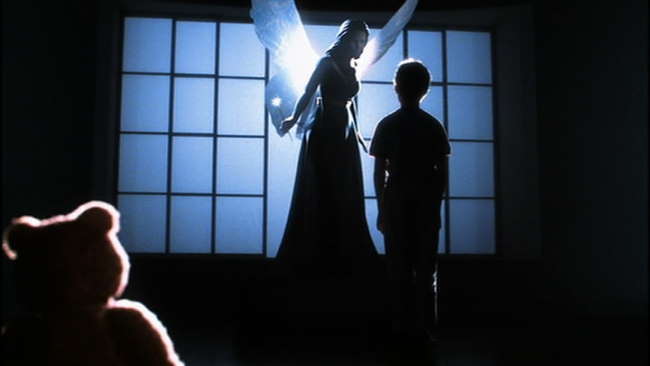
Spielberg's tribute to Kubrick I found was actually not all that bad. Yes, as a Kubrick fan, I will admit that of course I would have wanted to see how the film would have turned out had he lived to see it finished, but for what Spielberg came up with, I think his interpretation is a pretty good one. It actually does feel very much like a Kubrick film, largely because Spielberg worked with the notes, storyboards, and early screen treatments that his friend had spent years assembling. It actually can be very difficult upon a close examination to tell where Kubrick's vision ends and Spielberg's begins (the apparently Spielbergian ending was actually Kubrick's idea). One can tell watching it that Spielberg really wanted to be show his respect for Kubrick, even if he could not perfectly replicate the director's ideas.

Even disregarding the obvious details about whether this is a Spielberg or Kubrick film, it is actually really well made in its own right. AI is surprisingly effective in exploring the age-old question of just what it means to be human (a subject that fascinated Kubrick). The androids we see actually do feel human, their emotions appear genuine even when balanced with their uncanny appearances. There is also a bitter sense of hopelessness that emerges throughout, as the viewer knows very well that David's goal of becoming a "real-live boy" is impossible, and yet they can easily relate to his struggle and desire to be loved. Haley Joe Osmond actually makes a very good android, balancing his uncanny appearance with emotional depth that is not immediately obvious.

Now for the really daring part that will no doubt get a lot of readers very angry with me because it relates to the final act of the film. This was of course the part where David is found buried in the ice after humanity's extinction; the part that gets the most flak. I felt this might have actually been the strongest part of the film. Of course, the idea behind it (which was Kubrick's, by the way) makes a lot more sense when you realize (as I did, thanks to class readings) that the beings who find David are not in fact aliens (as they are often mistakenly assumed), but extremely advanced robots searching for their own origins. It is here that David really gets to show his humanity, and where the film's themes of whether a machine can think or feel are resolved. The ending offers closure to David's story, but also allows David to "grow up" in a way (though he still looks like a child).

Munich (2005)


I really don't get what everyone else saw in this movie. To me, the plot amounted essentially to "some guys kill some other guys so Geoffrey Rush decides the logical response to run around Europe blowing up random Arabs." The film claims to be based on a true story, but the only part that I have been able to definitively verify actually happened was the mass murder of 11 Israeli athletes which sets the film in motion. After seeing it, I felt skeptical about how much of the rest of the film was real and a strong desire to get dirt on the movie. This is a strange reaction, I know, to such an acclaimed feature. Far from a tense thriller, Munich is nothing but a racist, sexist, and in general poorly executed film and a waste of time.

I found the movie frustrating and impossible to follow, and those were the parts that didn't seem racist or sexist (more on that later). There was a lot going on at once and it was never clear what was supposed to be happening at a given moment. I remember my professor mentioning in class some of the techniques Spielberg used to make the narrative easier to follow and I just wanted to blurt out "uh... did we see the same movie?" I found the main cast dull and unrelatable, and strangely enough, hard to tell apart. While it is true that they did look different, none of them really had anything to make them stand out in terms of personality. They were just a bunch of guys with a set of vaguely defined skills that were required to kill some people. There was a French guy, Louis, who apparently had detailed information on the terrorists, and absolutely no explanation is given for how or why he does this; especially given that the parts of the film which allegedly detail his operation instead opt to focus entirely on his father's cooking.

To bring up the film's racism, the same can be said for much of the cast. The "targets" are apparently supposed to be people involved with the terrorist operation, but it isn't made clear how they are involved. None of the men targeted are seen among the terrorists when they are shown at the beginning (or in later flashbacks), and beyond a few vague lines of dialogue it is not made clear why they are the targets. This gives the sense that the protagonists are not actually going after terrorists, but that they are just blowing up random people who happen to have an Arabic background. It almost seems like Spielberg is promoting the idea that being Middle Eastern is automatically linked to terrorism, especially as the viewer is meant to feel emotionally invested in the actions of the so-called protagonists.

Now we can get into the sexism that is prevalent throughout Munich. Throughout the movie, I remember wondering if it would really have hurt to have some female operatives in the team. Now one could argue that the reason the actual task force is all men has to do with the historical events that inspired the film, but that still does not excuse the poor treatment of the few women who do appear. For most of the film, there is only one woman who has any kind of role in the story; Daphna Kaufman, Avner's wife who serves mainly to motivate him. She is generally depicted as submissive towards him, making little in the way of her own choices or thinking for herself.

The real bit of wasted potential comes in the form of Jeanette, someone who could easily have had potential to be a very interesting and strong female role. Her character is that of an assassin apparently hired to kill the protagonists. She is built up as a professional who doesn't let her emotions get in the way. Now, if she had been introduced earlier in the film, she could have made for a very strong and memorable antagonist. We could have gotten to know her on a psychological level, and then she would become an interesting part of the movie. Maybe they could have even gotten into what makes her work and allow her to become somewhat relatable, adding to the moral ambiguity. Of course, Spielberg does none of these things. Instead, Jeanette is shoved into the end of the film where she ends up feeling very out of place, appears out of nowhere, and then gets killed. There is so much wasted potential here.