Pageviews from the past week

Saturday, 6 June 2015

Apocalypse Now: The River to Insanity


Francis Ford Coppola's Apocalypse Now makes for a compelling piece of study. This film is legendary for its stories of troubled production, so much so that entire books have been written about it and there was even a critically-acclaimed documentary, Hearts of Darkness: A Filmmaker's Apocalypse that chronicled the experience of filming Apocalypse Now. Even before running over budget there were casting problems. First Coppola struggled to get stars like Gene Hackman and Steve McQueen to even consider the project, before going on to cast Harvey Keitel as Willard only to fire him a week after shooting began and hire Martin Sheen to take his place. That is not even getting into the problems faced when Marlon Brando arrived on set. Even when shooting began, a massive typhoon destroyed the sets, Coppola had to check himself into a hospital for malnutrition and dehydration, and Martin Sheen almost died from a seizure.

Interestingly, Apocalypse Now was not the first attempt to adapt Joseph Conrad's novella Heart of Darkness. Orson Welles had previously attempted to adapt the same material in 1939. Welles' interpretation would have stuck more closely to the original book by preserving its 19th-century setting but he had an unusual concept for how it would be structured. Welles envisioned a project in which the central character of Marlowe would be played by the camera; allowing the audience to literally experience the narrative through his eyes. Unfortunately, much like Coppola roughly four decades later, Welles's film went over budget and he had to stop when he was unable to comply with a need for the expenses to be cut by $50,000.

Looking past the difficult production and more closely at the film itself, Apocalypse Now provides a terrifying look at the true face of war. This three-hour epic uses Conrad's novella as a base to examine the insanity and chaos of the Vietnam War and how it shapes and changes those who fight. There is no true good or evil, nor is there any true cause. There is only chaos with some small objective just out of reach. All this is seen through the eyes of an army captain named Benjamin Willard (Martin Sheen) who serves as a reflection of the audience's experiences.

From the beginning of Apocalypse Now, it is clear that Willard is messed up in the head. His opening narration makes that much abundantly clear. The opening depicts an extended shot of military destruction juxtaposed with shots of Willard's confused facial expressions. Willard is likely dealing with a psychological condition commonly faced among soldiers called post-traumatic stress disorder (PTSD). The precise symptoms may vary but generally veterans afflicted with this condition find it hard to adjust to civilian life. They often have difficulty relating to relatives and are haunted by memories of things they endured in wartime. There are recorded cases of PSTD affecting soldiers as early as World War I (known then as "shellshock" and generally dismissed as a sign of cowardice) but it is only a more recent development that any effort has been taken to address it.

From Willard's description, he is a man who has ended up in his current position due to PTSD. He could not handle being at home (as he himself states, "hardly said anything to my wife until I said yes to a divorce") and presumably re-enlisted in the army as a result. For now he is stuck in a hotel room in Saigon, but it is hardly comforting for him. From his opening narration, Willard is still experiencing nightmares and flashbacks to prior experiences. He feels trapped, and all he wants is some mission to keep him occupied.


All this is displayed visually in the film's extended three-minute intro which plays to The Doors' song The End. This intro consists of a single shot of the jungle. It is initially quiet until a helicopter flies by, with the sound of its rotors greatly slowed down. As the music begins to play the area becomes covered by an ominous green mist, presumably napalm (a chemical weapon used by the Americans in Vietnam). Then suddenly the trees go up in flame. It becomes harder to see anything through the mix of fire and mist, and within this confusion is juxtaposed the face of Captain Willard.

It is worth noting that no obvious objective seems to be present here. There are no soldiers of either side anywhere to be seen. It is nothing more than chaos at its simplest form. It appears to be the Americans who are responsible for bombing the environment seemingly for no reason. However, the images of Willard's face reveal a new interpretation. What is being shown in this opening is not the actual war, but a glimpse into Willard's mind and how he perceives the war.


That mission comes in the form of Colonel Walter E. Kurtz (Marlon Brando), a rogue Green Beret officer who has been conducting unauthorized operations in Cambodia. Here is where the madness truly starts to show itself. The officers who recruit Willard basically ask him to kill an officer for doing his job. Kurtz's rogue tactics are actually winning the war, and yet instead of giving him medals his superiors are ordering his death. This becomes even more ironic when considers the fact that in real life, the United States failed Vietnam.

Willard is assigned to a Navy Patrol boat that is supposed to get him to his destination without knowing where they are going. The crew of this boat consists of what Willard identifies as "kids". None of them seem to have any real patriotic feelings about the war. Chief Phillips (Albert Hall) is just a guy who does what he is told and the others are ordinary men presumably drafted into a war they don't understand. This is most obvious with Chef, who is established to be from New Orleans and seems a fairly nice guy. He is even in a respectable profession, being an actual chef (more specifically a saucier) who was drafted into the war and ended up working in mechanics because he did not like army cooking.

Lance on the other hand is described by Willard as someone who looking at "you'd never think he fired a weapon in his life". Lance is an innocent seeming man at first, and yet out of all the patrol boat crew he is probably hit the hardest by his experiences in the war. Unlike the other men, Lance goes on to embrace the war, not out of any sense of duty but simply because he becomes one with the chaos. Lance almost seems to get an adrenaline fixation during his experiences.

Eventually, Willard is on a patrol boat and encounters "air cavalry" who take the insanity of war to whole new levels. After briefly passing a television crew (one of whom is played by director Francis Ford Coppola in a cameo appearance) Willard encounters Lt. Colonel Bill Kilgore (Robert Duvall) who takes the insanity to whole new levels. Kilgore and his boys seem to be extremely inconsistent in their motives and goals. A name like Kilgore proves to be quite fitting for a man who never seems to take the Vietnam War seriously. This aspect of his character becomes even clearer by the fact that he never seems to dress appropriately for combat, wearing a bright yellow scarf and a blue Civil War officer's cap instead of the helmets worn by everyone else.


When he is first seen he proceeds to throw around playing cards onto dead VC (he claims they are calling cards meant to let "the Charlie" know who was responsible for this massacre). When Willard manages to find Kilgore, he completely ignores him and continues his... shenanigans. Kilgore completely ignores his orders in favor of partying and only displays the slightest bit of interest when he discovers that Lance Johnson happens to be among Willard's crew. Even then, he ignores Willard until late at night when he turns a massacre into a beach party, and only agrees to do his job when he learns that the dangerous village at the mouth of the Nung River has great waves for surfing.

This leads to the film's most famous sequence, where Kilgore leads his team of helicopters on what seems to be an unauthorized attack on the village. This already starts to bring out a double standard: Willard's superiors want Kurtz dead, but seem to have no objection to Kilgore who is also conducting unauthorized attacks on the VC and winning. Once again, Kilgore never seems to take the situation seriously, casually talking with Lance about surfing before hand and later even stopping to drink coffee in the middle of the fighting.

Kilgore then reveals his favorite tactic for attacking Vietnamese villages: "We come in low over the rising sun, and about a mile out we put on the music". That music turns out to be a piece called Ride of the Valkyries, originally composed by Richard Wagner for a series of operas titled Der Ring des Nibelungen. This is meant as a psychological technique to scare the Viet Cong soldiers below, but there is another side: playing music this loud alerts them to their presence and gives them time to prepare.

During the same scene, Chef also gets to observe that Kilgore's own boys aren't all there in the head either. Some of them sit on their helmets, which technically makes them more vulnerable targets. When asked why, one of them simply responds "So we don't get our balls blown off". These guys seem to be more concerned about an extreme chance of losing what they see as defining their "masculinity" than they are about the more likely scenario of getting shot in the head and dying. These men seem to see what they are doing less as an actual military campaign and more like a game.

When the choppers come in, they cause immediate chaos. As the music plays, a large village is reduced to rubble. Houses are destroyed and people are gunned down in the street. The villagers never stand a chance against the might of the American military, and the one thing that comes anywhere near being a challenge (a single anti-aircraft gun) is quickly dispatched. By the time the helicopters finally land, the village is in ruins and, like the forest in the opening, filled with that same ominous green mist.


The chaos is further emphasized once the choppers begin to make their landing. Kilgore's men manage to destroy the village, massacre its citizens, and promptly begin kidnapping the survivors. As all this is happening, two men stand with megaphones yelling over the destruction about how they are there to "help" the Vietnamese people. In actuality, it seems apparent that the opposite is the case, and this one scene helps call to mind just how much good America actually did for Vietnam during the war. The strange part is that all this was done so that a few people could go surfing.

Kilgore barely seems to register the chaos around him as he sends people surfing. As he tells Lance, "you're either going to surf or fight" and when called out on making such an insane decision he proceeds to state plainly "if I say it's safe to surf this beach, it's safe to surf this beach." In reality it hardly seems safe to surf the beach, considering the shooting that is still going on. Kilgore goes on to deliver the movie's famous line "I love the smell of napalm in the morning" and describes the damage the stuff can do before casually saying "someday this war's going to end." The way he says it has a strange tone, in that he doesn't want the war to end, he wants it to keep going so he can keep partying. In the redux version, Kilgore makes one final appearance when he leads an entire squadron of helicopters in search of the patrol boat to reclaim his stolen surfboard.


After leaving Kilgore, Willard continues his journey upriver. From here things start to get bleaker. Chef, despite being one of the more rational members of the group, convinces Willard to go with him on a brief expedition to find a mango. Willard agrees to this, but they fail to accomplish this end. Instead, both men find themselves scared when a tiger lunges toward them and charge back to the boat. Willard's narration offers a very simple piece of advice: "Never get off the boat, unless you're going all the way."

The next stop is a small supply depot where Willard tries to get fuel and also receives passes to "the show", which turns out to be a group of playboy models posing for the entertainment of the male soldiers. The men are driven into a frenzy by this encounter, calling attention the era's all-male military. There were no female soldiers in those days, it was all men trapped together, and it was also not unusual for them to subsequently be aroused in the presence of a woman. These three women are basically being treated as objects by the men, who have not seen women for some time, which also proves to be dangerous to the point where they literally have to be evacuated.

Even as the three models are loaded into a helicopter the men scramble for their attention, one going as far as the hang on the skids and another trying to hang from his legs (pulling his pants down in the process). This aspect of the characters is thoroughly deconstructed in the redux version, where a later scene involves the same models being confronted by Willard and his crew in an old medical camp. Once again, Chef and Clean both seem to treat the women as objects for their pleasure, but neither is cast as being in the right for doing so, and this more personal encounter allows the women to show that they are in fact human beings.

Act One ends on a dark note when Chief follows protocol and decides to investigate a Sampan that happens to be passing by. Willard tells Chief not to stop, but the latter ignores him claiming that the VC have used these boats to smuggle weapons. Once again, this attempt at a simple "police action" draws attention to how inefficient America was in dealing with the crisis in Vietnam. The search is extremely disorganized and consists mainly of Chief and Chef yelling at each other while Clean handles a large machine gun. Chef constantly points out the reasons why this search is unwarranted but Chief forces him onward anyway.

Eventually, in all the confusion one panicked woman makes a sudden move and Clean immediately opens fire on everyone in the boat. Even worse is that given how disorganized the search has proven Clean comes dangerously close to killing Chef, who was right in the line of fire. It turns out what the woman was concerned about was a dog, prompting Chef to call everyone out on their negligence and poor management of the situation. However, the chaos is emphasized further when Lance fights with Chef over the dog, and Willard has to shoot a surviving woman to emphasize that his mission takes priority.


Willard himself notes that "those boys were never going to look at me the same way". Willard has a mission: to kill Colonel Kurtz, and while he can't reveal it to the other men just yet he has to emphasize the priority of his mission. He does this by shooting the one survivor of the river boat massacre when Chief tries to take her to a hospital. He is showing that he is simply not just of the crew but someone else entirely.

At this point, the title of "Apocalypse Now" starts to become more meaningful. While the story does not literally depict the apocalypse, the general tone begins to have an apocalyptic feeling. This is evident from the numerous crashed helicopters (and at one point a crashed airplane) that the boat passes. It sometimes seems like Willard and the crew are the only living things left in the world. The world might not actually be ending, but as far as the characters are concerned, it might as well be with the destruction around them.

A crucial part of defining any post-apocalyptic scenario is the breaking down of social order, and that comes when Willard encounters the final checkpoint, Do Lung Bridge. This place is pure chaos. Two sides are shooting at each other in the dark, the only light coming from the occasional fireworks. If there was ever at some point any belief in a cause for holding this place it is gone now. When the boat first arrives men are scrambling into the water with briefcases pleading to be taken away from this nightmare. The entire battle seems like a pointless cycle as well: the Americans blow up the bridge, the VC destroy it, repeat.

Willard goes ashore with Lance, who in perhaps not the smartest move keeps the dog under his jacket, and attempts to find the commanding officer. The problem is there seems to be no organization or structure. He eventually manages to find a trench occupied by a few other soldiers. One seems to be firing blindly and when asked who is in command simply asks "ain't you?" It seems these soldiers have no more of an understanding of what is going on than Willard does. He then encounters another soldier named Roach and asks him the same question. Roach simply says "yeah" and walks away.


This attitude seems a little bit strange. Roach does not seem to be interested in telling a superior officer where to find his commander. Willard sums it up when he returns to the boat and simply says "there is no CO". This takes on a different meaning when one considers a remark made by Willard near the very end. When Roach says "yeah" he means he knows who is in command, but it is not so much who as what. It is no human being who is in charge of this situation, but the jungle itself. That is where they get their orders from. Roach very likely knew this, but did not want to say anything to Willard as he is not ready to grasp that realization just yet.

The loss of any clear human authority marks the final breakdown of social order. As Willard points out in his narration past Do Lung Bridge "there was only Kurtz". Passing the bridge marks the final departure from anything resembling "civilization", with the journey continuing into the wilderness. The American army is no longer here to protect or assist the crew, a fact they are constantly reminded of as they encounter the old wreckage of American vehicles with no signs of life present anywhere. Without any protection, it is here that the boat crew begins to die off.

The first to go is Clean in a brutally abrupt shift in mood. The scene begins on an optimistic note (or at least as optimistic as Apocalypse Now can get) with the crew opening mail that they received at Do Lung Bridge. Lance once again brings out the recurring motif of mist, this time in the form of "purple haze" that surrounds him and the boat. Meanwhile, Clean gets a touching audiotape from his mother describing her plans for when he gets home. Everything seems calm until the VC provide one final attack. Clean is shot and killed almost instantly, before the tape is even finished. His mother still continues to talk of her plans to invite family members to celebrate his return home while his body is sprawled out in plain view over the deck. This component becomes even darker when one considers that Lawrence Fishbourne was only fourteen at the time of filming and lied about his age to get the part.


Clean's death hits the men pretty hard, as though they have not already been through enough trauma. Shortly after this encounter the crew is attacked by what they might consider "savages" who start firing arrows. In theory, there is no real harm at this point, the arrows are fake and just meant as a psychological weapon, but only Willard is able to figure it out. In fact, throughout the film Willard has seen things differently from everyone around him. In a strange, twisted sort of way, Willard's confused state of mind arguably gives him the clearest perspective on everything that is happening. In that sense, he could be considered the sanest character in the entire film despite his obvious need for therapy.

Unfortunately, Willard is the only one who can see clearly what is going on. None of the crew listen and instead begin firing recklessly. They are firing in plain sight at people who have likely spent their whole lives in the jungle and thus know how to survive in it. Like Do Lung Bridge, everyone is firing blindly, and this leads to the death of Chief, who is impaled by a spear once he tries to pull out a machine gun. Chief collapses to the deck, but his final action is a failed attempt to impale Willard on the tip of the spear in his chest.

Willard tries to take this opportunity to release the two surviving members of the crew. Chef immediately recognizes the absurdity that Willard has to kill another American, but agrees to continue onward anyway. This ties back to Willard's statement after escaping the tiger: "never get off the boat, not unless you're going all the way." Chef is not ready to get off the boat yet, and he is the kind of person who is not ready to go all the way. Lance on the other hand is, and he got off the boat a long time ago, back when he started putting on the war paint.

At the compound, Willard encounters a strange character played by Dennis Hopper who identifies himself as "a photojournalist". This man has come to idolize and respect Colonel Kurtz in more than a few ways. He seems to be unable to express anything besides pure admiration when telling Willard about the Colonel, even when admitting that said Colonel threatened to kill him if ever takes a picture of him again. Meanwhile, in Chef suggests waiting at the boat for Kurtz to arrive when they are told he is away. Once again, this ties back to Willard's statement of "never get off the boat". Chef is unable to go all the way. He is not ready to get off the boat, but Lance is, and he does. In fact, Lance is so fargone by this point that he blends in, disappearing almost entirely among Kurtz's followers for much of the remainder of the film.


Willard finally gets his chance to confront Kurtz, leading to the famous sequence in which the Colonel is kept entirely in shadow. Kurtz is clearly not all there in his right mind, but he talks to Willard about what he has been through. Kurtz learns that Willard is there to "terminate his command" but Willard himself is already starting to question his mission. After all, Kurtz is a decorated officer who only became a Green Beret because he threatened to quit if the army did not let him.

After everything Willard has been through, it is hard to call Kurtz's methods "unsound". While the ethics of his tactics could be debated, it is hardly any more "unsound" than massacring an entire village to go surfing or shooting an innocent woman to ensure the mission continues as planned. Kurtz himself goes on to describe his disturbing experiences in the field. He speaks of an incident in which his platoon vaccinated a group of children in a village, only to return moments later to find every child who was vaccinated had their arm hacked off

It is somewhat ambiguous precisely what Kurtz's views on the Vietnam War are, but everyone in the film has some way of dealing with it. Willard tries to distract himself from the war. Lance learns to embrace it and becomes one with the chaos. Chef tries to reject it. Chief simply does what he is told and tries not to ask questions. Clean spends a lot of time thinking about going home. Kilgore tries to make Vietnam resemble what he considers home. Kurtz on the other hand has been in combat longer than any of these people. He has seen war can do to anyone. 

He is himself basically winning the war for the Americans despite their desire to kill him, but he no longer seems to consider himself part of the army. Even more curious is that Kurtz seems to know he does not have much longer to live. He is dying on a psychological level and has no intention of stopping Willard from completing his mission. It is just a question of Kurtz preparing the doubting Willard and making sure he dies the way he wants to. At the same time, Kurtz wants Willard to understand what he has endured. To do this, he takes Willard captive and holds him during the night in an uncomfortable situation, leading to one of the film's most disturbing sequences.

Chef is back on the boat and, true to Willard's advice earlier in the film, has refused to get off. He is frightened by Kurtz's compound and tries to conduct a radio test with the presumed intent of ordering an air strike, as was instructed by Willard. Willard is being held captive during the night outside a bamboo cage with barbed wire strapped around his neck. Kurtz approaches dressed in war paint, a reminder of who he once was and a symbol of who he has become. He then proceeds to throw an object in Willard's lap.


That object turns out to be Chef's severed head. Kurtz apparently killed him to prevent the air strike (as is evidenced later on, when someone can be heard trying to reach the boat on the same radio, implying the previous conversation had been cut abruptly). However, if Kurtz simply wanted to prevent the air strike he could have just stopped short of killing Chef or simply threatened to kill him if he did. The fact that Kurtz goes to the extreme of placing the man's severed head in front of Willard suggests an intended message. The question is what is Kurtz trying to say?

The obvious message is that Kurtz wanted to make an example of Chef, but perhaps not in the way one might normally expect. It was not that Chef was going to kill him, but in the way he would kill him. Willard himself points out toward the end of the film that Kurtz expected to die, but wanted to do so in a way that he considered honorable. He wanted to go out "like a soldier, standing." While Kurtz wanted his people "exterminated" he did not wish for this to happen until after he died. Forcing Willard to experience this nightmare is his way of telling him.

For the first time in the entire film, Willard actually displays fear. Up until now, he has basically tried to block out everything besides his mission. He has tried not to think about anything else going on in the war and to ignore it when possible. Kurtz is now forcing him to confront the horrors of war, literally face to face. Seeing that an innocent man has been killed so brutally and having the head staring back at him serves as Willard's first glimpse into the true face of horror. Willard tries to kick the head off him in the hopes of hiding, but there is no way to escape. Even after the head falls off his lap it continues to stare back at Willard, and with his bindings there is no way for him to escape.

Having had his eyes opened to the horror, Willard is eventually freed by Kurtz and allowed to walk around the compound. He is not kept as a prisoner, as no attempt is made to ensure he stays, but Kurtz knows he is not going anywhere yet. There is not exactly anywhere else for Willard to go at this point. He has already gone as far as the journey will allow, and there is no going back without finishing the job. All Willard can do is learn about the man he was going to kill and wonder why everyone wants Kurtz dead.

By this point, Willard no longer considers himself an American soldier, even though he says in his narration "they were going to make me a major for this." He is simply a man with a job to do, and to complete the task of killing Kurtz Willard strips himself of the remnants of his military background. He does not even register the messages coming in over the radio. First off, he refrains from wearing any obviously military clothing and rejects any type of firearm in favor of a simple machete. In theory, Willard could have just stepped off the boat to approach Kurtz, but instead he goes through the water.

As Willard notes in his narration "Everyone wanted him dead, him most of all. Even the jungle wanted him dead, and that's who he really took his orders from." This ties back into Willard's encounter with Roach back at Do Lung Bridge. When Roach was asked if he knew who was in charge and simply said "yeah" he was referring to the jungle, not to any human tasked with organizing the men. Willard also embraces this same idea. He notes that "everyone wanted him dead" but it is the "jungle" that seems to finally convince him to go through with the task. Instead of simply stepping off the boat, Willard dives into the river and emerges now a warrior of the jungle, not particular to any one nation.


Willard moves toward Kurtz and proceeds to do what the entire film has built up to him being responsible for doing: killing Kurtz. Willard approaches Kurtz, though taking him somewhat by surprise and thus failing to give him the dignified death he desired. Willard proceeds to slash at Kurtz repeatedly, all intercut with shots of the slaughter of a water buffalo. As Kurtz falls to the ground, he utters one final line that describes everything he has seen in his life before he dies: "the horror, the horror." Willard leaves the compound, encountering Lance whom he takes by the hand as both return to the patrol boat.

The film ends as the two remaining men begin their journey back to what might once have been considered "civilization" but neither one is in any position to be going back. Willard knows there is nothing left for him, and Lance is left in a confused state of mind not unlike that of Willard in the film's opening moments. These two men may still be alive and the job may be done, but this is far from a happy ending. For both the survivors, there is nothing to go back to. Even when and if they ever leave Vietnam, they will never truly leave behind the horrors they have endured in the war. Lance is starting to end up in a similar position to where Willard was at the beginning, but Willard himself has gone even further. For him there is no escaping the horror. In a way, he is starting to become a new Colonel Kurtz, beginning to understand how he was affected and why he changed the way he did. 

In the end, questions of what defines sanity are raised. Willard may be the sanest person in the film and even he is clearly in need of psychiatric treatment. Ultimately, the entire war is insane, and everybody involved only serves to emphasize that point. Everyone in the film is forced to confront the insanity of war one way or another, and each reacts differently, but only a handful of people can truly grasp the chaos and the madness and learn to confront it. As Kurtz himself describes it: 

"Horror has a face, and you must make a friend of horror. Horror, and moral terror are your friends. If they are not, then they are enemies to be feared. They are truly enemies."

Thursday, 4 June 2015

Summer Blockbuster Cast-A-Thon Links!


This was a little later than I anticipated but the good news is that we won. The Prime Minister of Canada has been rescued and the Neo-Nazi communist hippy ninjas have been defeated. The Prime Minister says he would like to thank everyone who helped rescue him, and he wants to invite you all to his house for burgers.

In the meantime, we should take this moment to recognize those who did everything in their power to save the Prime Minister during this unfortunately dark crisis. Here is a list of everyone who took part:


  • Over at Big Screen, Small Worlds we got quite a diverse group of characters. He got a few superspies, some tough action girls, and even an actual ninja to help defeat the Neo-Nazi communist hippy ninjas.
  • Dell on Movies also assembled quite the team, which he referred to as "the Ladies and their Johns"... literally (all of the men are named John). We got some old-fashioned blaxploitation, two Schwarzeneggers, and Rambo, as well as some dangerous female assassins, a tough female cop, and one of action cinema's most iconic heroes (that isn't played by Schwarzenegger or Stallone).
  • A surprise entry that came in at the last minute, Ramblings of a Cinephile brought up a selection that included a few classic action heroines (and some more obscure ones as well) along with a classic anti-hero and a Man in Black.
  • Finally, over here at Hitchcock's World I took some inspiration from Team Fortress 2 and came up with a balanced team of six men and six women. These included two superspies, a trained Navy SEAL, and Jesse Ventura.
Thanks a lot to everyone who participated. I'm not sure what I'm going to do next just at the moment, but I hope to see you all again in my next blogathon.

Wednesday, 3 June 2015

A Discussion of Fear From Within the Mouth of Madness


In his essay An Introduction to the American Horror Film, film scholar Robin Wood argues that the horror genre is defined by the presence of a "monster". This does not have to be a literal monster, but it serves a specific role which he identifies as the central formula of horror films: “Reality is threatened by the monster”. Similarly, in his essay Why Horror? Noel Carroll raises the question of why viewers are attracted to a genre that by its very nature is meant to scare them. His solution to this “Paradox of Horror” is that the monster is an anomaly that challenges the viewer’s understanding of the world around them and arouses their curiosity. John Carpenter’s 1994 horror film In the Mouth of Madness plays on the ideas of both authors and brings them into question.

The most common form of the human monster is the mad scientist, as depicted by characters such as Elsa in Splice or Dr. Pretorius in The Bride of Frankenstein, as well as Dr. Victor Henry Frankenstein himself, to an extent. A similar idea is explored by In the Mouth of Madness, but with the mad scientist replaced by a mad artist. Through this choice, In the Mouth of Madness distorts and twists the ideas of Carroll and Wood. It forces the viewer to constantly question their ideas of what defines the monster, what can be considered an anomaly, what is normal, and what it is that is being challenged.

Throughout the movie, the idea of what is normal begins to change, and with it the identity of the monster and the nature of the reality its presence challenges. The viewer’s idea of what distinguishes normality, the anomaly, and the monster is constantly challenged as the narrative progresses. Instead of one monster, the film suggests that anyone could be a monster under the right circumstances, and ultimately leaves the viewer to question who is really the monster. Cane himself is by his very nature a human monster. It is through his books that the abjection between fiction and reality is created. In the context of the film, Cane is the original monster, and possibly the most powerful, though it is suggested that even he may not have complete control over everything.

He disrupts what is seen as real by exposing the real world to be a work of fiction; all created from his imagination. At one point Cane even displays a literally monstrous side with a growth on his back—a cue to the audience of his role in the story. Cane disrupts and challenges the normal ideas of reality by revealing the world to be nothing more than an illusion. The characters who read his book In the Mouth of Madness—his agent, Trent’s partner Linda Styles (Julie Carmen), and eventually Trent himself, all find their ideas of what is normal challenged, and in the process become monsters themselves.

Cane might not be the only monster, but he is the driving force behind the film. The other monsters to appear are extensions of his character. With the possible exception of the unseen “Old Ones” that Cane says inspired his writing; even the few instances of literal monsters are constructs of his mind and therefore extensions of his character. This idea is set up early on, when Trent and Styles arrive at the Pickman Hotel, and Styles comments on how the greenhouse is empty but used to be “filled with strange growing things”, and how one night the townspeople saw something moving inside.

Trent immediately recognizes her description as being from the plot of Cane’s novel The Hobbs End Horror (itself a reference to Lovecraft's story The Dunwich Horror). Later, Trent encounters this monster in the form of Mrs. Pickman (Frances Bay), who experiences a grotesque transformation and is seen in the greenhouse. At first, this sub-plot does not seem to contribute directly to the overall narrative, but it marks the point in the story where Trent, Styles, and many of the supporting cast begin to show their status as monsters.

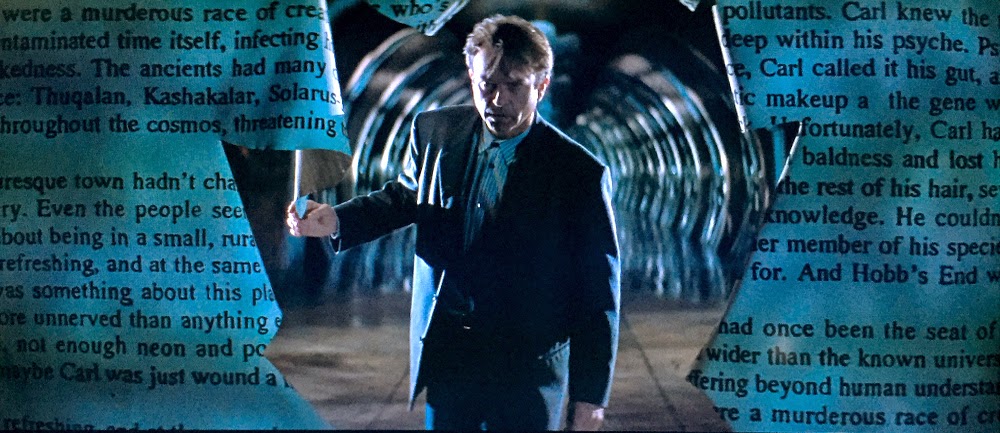
One of the few scenes to clearly show literal monsters occurs when Cane finishes his book. The scene begins with Cane showing that he is capable of warping reality when Trent suddenly finds himself in the former’s writing room. Cane finishes typing the book and declares it “all done” before entrusting Trent to return it to the world. Cane explains that “you are what I write” and states that nothing within this world existed before the story began. Cane continues to emphasize the idea of the world being fiction when he embeds his fingers in his face and tears it apart like a sheet of paper, exposing a black, empty void. The camera looks back at Trent from inside the void. From this side, the door that was behind Cane is replaced by a page from a book. Though the hole prevents the page from being read clearly, the text that is visible refers to Hobb’s End, suggesting that the viewer is literally looking into a page from one of Cane’s books. As Trent approaches the hole, Styles begins reading part of the manuscript, which describes in detail precisely what is happening.


The presence of Cane as the writer allows the film to further create this disruption through the use of abjection, an idea proposed by Julia Kristeva which suggests that horror resides in the middle of established social boundaries such as the living and the dead, human and animal, and male and female, or in this case between reality and fiction. The horror of In The Mouth of Madness comes not from Cane himself or from the Lovecraftian "Old Ones" he claims have influenced his work, but from the idea that everyone within this world, including Trent, is a fictional construct whose every action is dictated by the author and who only exist to serve the needs of the story.

Moments of abjection between reality and fiction recur throughout the film, beginning with Trent and Styles encountering a town that should not exist—later in the film it vanishes entirely, along with Styles who was literally written out of existence by Cane. The confusion is further emphasized when Trent finds himself reading one of Cane’s books while exploring the town, and comments that “I’m reading this thing like it’s a guidebook.” This idea of the abjection between reality and fiction reaches its peak in the film’s final moments. Trent sits down in a movie theater with popcorn and watches the film adaptation of the Sutter Cane story In the Mouth of Madness. A brief montage reveals that the film adaptation of the book is literally the film the audience has just finished watching. Reality as the viewer understands it is being disrupted by the idea that their reality is fiction. Trent constantly finds himself trying to rationalize his encounters, but upon seeing himself in his own movie, he is forced to finally realize the truth that none of his world is real.


This idea of monstering goes further. While Cane can be seen as the monster, the film also plays with Carroll’s idea of the anomaly to turn the rest of the cast into monsters themselves. Trent sets this idea up early in the film when he describes the experience of reading Cane’s books. “Pulp horror fiction, they all seem to have the same plot,” he says. “Slimey things in the dark. People go mad. They turn into monsters.” This is precisely what happens later in the film. Cane himself is an anomaly in In the Mouth of Madness, but in keeping with Wood’s ideas of what defines the monster, the anomaly shifts over the course of the film.

In a conversation between Trent and Styles, the latter justifies her love for Cane’s writing by suggesting that “Right now reality shares your point of view. What frightens me is what would happen if reality shared Cane’s point of view”. She goes on to suggest that “sane and insane could easily switch places if the insane were to become the majority”. This discussion sums up Wood’s idea of the monster challenging "normality", a term he uses in a loose sense meaning simply “conformity to the dominant social norms.”

Normality changes over the course of the film, initially with the characters believing that what they are experiencing is reality until Sutter Cane exposes them to the repressed truth. As the narrative progresses, more people become aware and are infected by it in ways that a man like Trent would view as insane. This challenging of Trent’s understanding of sanity is first experienced when he is faced by a man he later describes as a “lunatic with an ax”. The man in question steps out of a bookshop, crosses the street in broad daylight holding an ax, walks toward the diner where Trent is eating with his employer, smashes the glass and then asks Trent “do you read Sutter Cane.” This man is killed by the police, and naturally his actions are dismissed as being the product of mental illness.


Later on, it is revealed that this man was actually Cane’s agent. He was also the one person who read In the Mouth of Madness and as a result was not only aware of his fictional status, but also of the role Trent would eventually play in the narrative. It is now brought into question whether the actions of Cane’s agent were insane. At first, the agent can be seen as a monster, but when his perspective is revealed, it suggests that Trent may in fact be the real monster. In addition to reality and fiction, the abject also occurs between sanity and insanity, and the viewer is left to question their definitions of both.

Freud’s original concept of “madness” was that it was connected to a person’s own past, but in In the Mouth of Madness it is suggested that insanity is simply a label for any behavior that violates what the majority of the population see as normal. Trent’s own sanity is brought into question, ironically, by his very efforts to rationalize his experiences while everyone around him is turning into what he would consider monsters. This development in Trent’s character ties back to Styles’ comment earlier in the film: that which the viewer would consider insane has started to become the majority, and a character like Trent whom the viewer might ordinarily view as sane appears to be insane by the sheer nature of failing to conform to what has become normal.

The idea that Cane transforms people into monsters is explored more literally through the character of Styles. From her introduction, Styles is a horror fan who attempts to address Carrol’s very question of why viewers are attracted to horror films, as raised by Trent. As a Sutter Cane reader, she finds herself more open to the possibility that his books are real, an idea she begins to develop soon after entering Hobb’s End. When they first arrive at the hotel from Cane’s book The Hobb’s End Horror, Styles displays an uncanny ability to point out minor details about it without looking. She is also the second character to have her reality challenged, after Cane’s agent, when she is forced to read In the Mouth of Madness.

After this scene, Styles becomes a more explicit puppet of Cane’s, having sex with him oblivious to a monstrous outgrowth on his back, experiencing peculiar transformations, and displaying abrupt shifts in personality. With no build up she begins attempting to seduce Trent, much to his shock and confusion. She has herself become a monster, challenging what Trent would see as normal. Styles behaves in ways that he would deem insane, such as swallowing the keys to Trent’s car. She even briefly becomes a literal monster when her body is shown contorting into a quadruped form, walking on both her hands and feet with the sounds of bones cracking heard as she moves.

In the Mouth of Madness is one large distortion of the theories presented by Wood and Carroll. It plays on the idea of the monster disrupting what is normal and challenging the viewer’s understanding of reality by forcing the viewer to question their ideas of reality and what is normal. By leaving the viewer unsure of what they can call normal, the film also brings into question precisely what it means to be a monster or an anomaly. In the end, Cane can be seen as a monster, but he is also a tool used by the filmmakers to explore the question of just what makes someone a monster, and it is through him that the ideas of Wood and Carroll are tested.

Tuesday, 2 June 2015

Blindspot: Back to Bataan (1945)


I'll be honest here and admit that I did not go into this one with high expectations. Back to Bataan was a film that had been sitting in my drawer for years. The truth is the only reason I had it was because of this one time I found it among some low-priced DVDs and I happened to be a big John Wayne fan at the time. If it hadn't been for him I probably would have overlooked this one entirely. Going in now offered a better understanding of why the film was made, but that was really about it. I expected this film to be basically American propaganda and I was more or less right, as you can expect from a Hollywood film made just as World War II was ending.

Though the film begins with a disclaimer claiming that the story is based on real events, Back to Bataan is really a sequel to a 1943 combat film called Bataan. That film centered on a small ragtag group of American soldiers who were forced to band together in order to make a stand against the Japanese. Bataan basically ended with everybody dying and the last man standing trying to take as many Japanese soldiers with him as he can. There was then a title card which promised that one day America would return to avenge its fallen soldiers and retake Bataan.

Unfortunately, real life failed to deliver on that promise, so a sequel was made to "fulfill" it: Back to Bataan. That's literally all this film is: it's an American fantasy made to fulfill a so-called promise made in a single film two years earlier because reality didn't work out the way people wanted it to. John Wayne plays the role of Colonel Joseph Madden, an army officer given some kind of top secret mission to unite members of the Filipino resistance against the oppression of the Japanese. Meanwhile, a middle-aged teacher named Bertha Barnes (Beulah Bondi) is running a school at a local village in which she tries to force American values on provide a proper education for Filipino children. Unfortunately for her, the village is invaded by Japanese soldiers who show they mean business by hanging the principal over the American flag. Then some stuff happens and Madden suddenly decides to try and help the village or something while we occasionally get glimpses of Japanese atrocities.

One thing I only found out after seeing Back to Bataan is that the filmmakers were trying to keep up to date with current events in the war and had to keep changing the script according to major developments. Unfortunately for them, it really shows. The story gets extremely disjointed and confusing as the film develops, probably the result of all the abrupt changes being made to accommodate what was going on in the actual war. None of the characters really seemed particularly memorable, and plot threads seem to come and go out of nowhere. Even the basic military objectives of the main characters weren't very well explained.

There were also plot threads that never really seemed to connect; like the film begins and ends with the liberation of a Japanese POW camp and then takes the time to identify several of the captives... and it has no connection to the rest of the story. It never ties into the central plot, none of the POWs named make an appearance outside of those scenes, let alone have a part in the actual narrative. The POW raid itself was also ridiculous, considering it happened in the most unsubtle way imaginable and in real life the Americans would probably have been slaughtered.


In many ways, Back to Bataan is really a product of its time. While some credit could be given to there being at least an attempt to present strong sympathetic Filipino characters, most of them are stereotypes by today's standards and the choice to cast Anthony Quinn, a white actor, as someone who is supposed to be Asian can definitely leave a bad taste for modern viewers. Also true to propaganda of the era, the Japanese are given no humanity. The only Japanese character of note is a single officer (the rest are anonymous soldiers) who is also a very obvious stereotype and treated as a monster. While historically the Japanese did commit some horrifying war crimes and ran POW camps that calling inhumane would be an understatement, this part of the film has definitely not aged well.

The only thing that I would say makes Back to Bataan at all a worthwhile experience for anyone is from a purely historical perspective. It does offer some insight into American views of World War II and makes sense for scholars who want to study this film and how it fits into contemporary cinematic reactions to the war. So for academics and scholars this film might be okay to look at, but for casual viewing there are better options as far as John Wayne movies go. Personally, I'd say John Wayne's later propaganda film The Green Berets is a better choice; as much as most people today would disagree with its pro-Vietnam messages at least that one was somewhat entertaining and had a coherent story. There isn't much of that in Back to Bataan.

Tuesday, 26 May 2015

Why Are Found Footage Films So Successful?


We've been seeing a lot of these "found footage" films over the last few years, but what exactly defines a "found footage" movie? There is some dispute on the matter but generally the "found footage" label refers to any film which uses, as the name implies, the approach of being presented as found footage. These films are fictional stories shot in a documentary-like way to look like people actually filming the events as they happen. The "found footage" genre is most commonly associated with horror, but it can (and perhaps should more often) be applied to other genres as is the case with movies like Europa Report (science fiction) and End of Watch (police procedural).

The found footage film has a long and complicated history. A likely precursor (and perhaps also a source of the genre's association with horror) is early gothic literature. Among the best examples of this would be the stories of H.P. Lovecraft, which were often presented as "found manuscripts". Many of his longer, more science fiction-based stories such as At the Mountains of Madness, The Whisperer in Darkness, and The Shadow Out of Time were written in the form of scientific reports describing what the protagonist experienced. His earlier stories The Hound and Dagon were both presented as suicide notes written by an unidentified narrator.

One of the most likely candidates to be an early precursor to the found footage horror film is Lovecraft's The Call of Cthulhu. The story is structured in the form of a "found manuscript" written by "the late Francis-Waylon Thurston, of Boston" (as a note at the beginning informs the reader). Already, the basic setup is reminiscent of the structure of many found footage horror films, where the protagonist's fate is known from the beginning and the story is presented as his record of the events leading up to his demise, similar to The Blair Witch Project or Paranormal Activity.


The Call of Cthulhu even has the narrator using his manuscript to provide a detailed account of his investigation into a series of ancient legends, with the ominous implication at the end that he meets his end at the hands of the Cthulhu Cult that has been referred to throughout.  A similar structure can also be found in Lovecraft's earlier story The Temple, which is presented as a message in a bottle chronicling the final days of a German U-Boat crew. Lovecraft was also heavily influenced by Edgar Allen Poe, who used a similar structure for his story Ms. Found in a Bottle, which is precisely what its title implies. The idea of "found footage" is basically a modern update on the "found manuscript" model from early horror literature, with the main difference being that the protagonist is using a video camera to record what happens instead of writing it in a journal.

As a style of film, found footage goes back a long way. The 1913 short The Evidence of the Film centered around a crime being solved when the footage from a camera that was recording nearby is revealed to have captured the face of the culprit. One of the earliest films to use the modern idea of a found footage structure is the 1980 exploitation film Cannibal Holocaust, which centered around a group of characters watching footage recorded by a documentary crew who disappeared and are later found dead. However, the film that is responsible for popularizing the found footage horror film is the 1999 film The Blair Witch Project.


This was a film made with almost no budget, featuring a group of unknown actors acting under their own names. It even lacked a script; instead favoring an outline of the basic plot while allowing the actors to improvise. The "story" was basically that the viewer was seeing the recorded footage (presumably recovered sometime after) of three amateur filmmakers who disappeared while trying to shoot a documentary investigating a local urban legend, similar to The Call of Cthulhu's structure as a manuscript written by a man who died as a result of investigating an ancient legend.

To the surprise of the filmmakers, it proved to be a huge hit at the box office. The film's reputation for instill fear spread quickly, and naturally it was not long before the big studios in Hollywood started to take notice. This led to a short-lived series of attempts to replicate the success of The Blair Witch Project, most of which were unsuccessful. There was even an attempt to cash in by way of a big-budget sequel, Blair Witch 2: Book of Shadows, which was a critical and commercial failure. These efforts died down for a time, until by total chance something similar happened in 2007.

Like The Blair Witch Project, Paranormal Activity was a found footage horror film made with next to no budget and unknown actors. It was also presented in a similar way, with the film being presented as footage recorded by a man living with his girlfriend while both are being haunted by an unidentified but apparently supernatural entity. At first, it was a spectacular failure, until a copy ended up in the hands of Steven Spielberg. The initial plan was to remake the entire film with a larger budget and recognizable stars, but in the end a test screening of the original version was arranged, and proved to be a remarkable success with its audience.


Suddenly, there was a revitalized interest in the found footage genre, and since then there has been a wave of different titles: Cloverfield, Apollo 18, and Chronicle being notable examples. Many of these fit the same template as first established by The Blair Witch Project, with low budgets and unknown actors. They also used the same structure of being presented as footage recorded by the characters, typically building up to their inevitable or at least implied doom at the end. Because of this structure, likely borrowing from The Call of Cthulhu and similar short stories, the found footage genre is often associated with horror.

However, this is not always the case. They may not be as common, but there are found footage films in other genres. In fact, a lot of the best found footage films are the ones that try to work in other genres such as Europa Report (science fiction) and End of Watch (police proceedural). There are a few different reasons to take this approach. From an aesthetic standpoint, the found footage film structure can allow for a documentary or home video-like feel that adds a layer of authenticity. End of Watch uses the structure of a cop recording his everyday life to create the feeling of following two real cops on their everyday adventures. Europa Report is literally structured as a documentary, even incorporating interviews in addition to footage from the mission, making it feel like an actual step forward for the space program instead of a simple science fiction narrative.

There is also a very simple reason why studios continue to produce found footage films: they are almost guaranteed to be a success. Found footage films are often made with low budgets and, outside of a few rare exceptions such as End of Watch and Europa Report, unknown actors. From a purely financial standpoint, unknown actors can be paid less than stars (though from an ethical perspective one might argue otherwise). The format also means less money goes into equipment and reduces the number of personnel who need to be hired, and more of what little expenses are present can go into the minimal effects. This in turn ties into the idea of Return on Investment (ROI).


The ROI is a formula which serves a simple function: creating a percentage of a product's income relative to the expenses that went into its production. In the case of cinema, a movie that is considered financially successful would be one that makes more money at the box office than its original budget. The found footage format is practically designed to allow for low budgets that are easily surpassed by the numbers at the box office. This is the main reason for the recent wave of found footage horror films: they make money.

Saturday, 23 May 2015

Roads of Fury


I'll admit that when I first heard of Mad Max fury road I was somewhat skeptical of its quality. It also seemed to be quite a bit different from the first three Mad Max films, though those films were quite a bit different in themselves. I never fully understood the appeal of Mad Max (though I have been informed that I may have been watching the version that dubbed over the Australian accents). Mad Max: The Road Warrior and Beyond Thunderdome both still proved to be entertaining movies. It did seem a bit odd that they chose someone other than Mel Gibson to take on the title role, but as more information became available I gradually started to warm up to it, especially when I found out just after its release that it was being directed by the same person behind the last three films.

Continuing on with the post-apocalyptic theme of the previous two Mad Max films, Fury Road puts us right back in the chaotic world where Max (now played by Tom Hardy) is just trying to survive despite constant physical and psychological torment from everything around him. He happens to be kidnapped by the servants of warlord Immortan Joe (Hugh Keays-Byrne) whose face, similar to the villain of The Road Warrior, is always concealed behind a mask that makes it hard to understand what he is saying (not that it matters much). Immortan Joe happens to run an empire of sorts, controlling the local people by withholding a large supply of water.

After a somewhat disorienting and chaotic first 20 or thirty minutes during which Max has to wear a strange mask, he gets mixed up with Imperiator Furiosa (Charlize Theron), a mysterious one-armed woman trying to help Joe's wives escape and take them to a better life. This group of characters soon finds themselves stuck in a "war rig" on the run from Immortan Joe, with his henchmen Nux (Nicholas Hoult) also getting stuck with them. Tension mounts as the unlikely heroes find themselves forced to work together and make a stand against their relentless pursuer.


One thing that helped to win me over when I first saw the trailers was the presence of Charlize Theron as Imperator Furiosa. She seemed like she had potential to be a strong female character and that seemed somewhat refreshing. After all, the Mad Max series is not exactly known for its strong female leads. In Mad Max the only female character of note was the title character's wife, who served mainly as a motivation for him with her death. The closest person to a strong female lead in The Road Warrior didn't even get a name, simply being credited as "Warrior Woman". There was also Tina Turner, but she didn't get involved until Beyond Thunderdome. Seeing a strong female character taking center stage was a nice change, and they delivered with Furiosa.

The funny thing is that they may have gone above and beyond on that front; to the point where Max ends up being more of a supporting role and the story ends up being more about her, as well as the group of heroes being predominantly female in an unusual move for this kind of film. That's not to say that the film is perfect in this regard. The supporting cast includes Immortan Joe's wives and later in the film a group of women from Furiosa's past, and I did find a lot of these characters were noticeably underdeveloped. All of them were enjoyable and competent women who got to take part in the action scenes at some point but aside from Furiosa they never seemed to get anything that distinguished them individually.

In fact, there is a distinct feminist message here that was not as clearly present in the first three Mad Max films. The title is somewhat misleading as it implies the film is about Max, which is arguably true of the first three installments. This time around, Max is more of a supporting role (though the opening makes it look like he is going to be the central character). From the trailers, one would think that this follows a similar pattern to The Road Warrior or Beyond Thunderdome where Max finds himself becoming the only hope of getting Furiosa where she needs to be. It's actually the other way around: she is the real protagonist, and Max is more like her sidekick. If anything, Furiosa is the one taking charge, Max is just her backup.


From the moment we first encounter the wives of Immortan Joe, it becomes clear that they are more than just objects (there's even an emphasis on the women freeing themselves, using what looks like an extremely heavy pair of pliers to remove their chains while Max still looks like a prisoner for some time after). Really, the dynamic of the film seems to be more about the predominantly female cast and their two male companions coming to recognize each other as equals. This is emphasized by the fact that Immortan Joe's army is made up almost exclusively of men who look like skinny versions of the Engineers from Prometheus, and that the women Furiosa seeks to protect (note that it's another woman protecting them, Max is just helping her) are explicitly identified by Joe to be good only for reproductive purposes. Immortan Joe is the embodiment of patriarchal society, and taking him out makes way for a new world in which men and women are equal.

Another area I can give credit to Fury Road for is in its production design. The landscapes have changed but the general aesthetic is very true to Miller's previous three installments, especially evident in the vehicles. Much like before this is a world in which people kill each other for fuel, and Fury Road definitely retains the bizarre-looking trucks and motorcycles that defined the previous installments. For that matter even the plot makes perfect sense: it's a road movie. How is it that an entire franchise based around people trying to survive on the road never thought to center its story on a road trip until now?


My final verdict is that Mad Max: Fury Road is a surprisingly worthy addition to the series. It has its flaws, I won't deny that, but it's a compelling story with some amazing action and a few interesting characters. It certainly brings some new elements to the series while also retaining a lot of what defined its predecessors. There is also plenty of tense and exciting action within a compelling world. It is definitely worth watching, and I would recommend checking it out.

Friday, 22 May 2015

So Fetch Friday: Stop Motion Triple Bill


It's been a rough week. I'm still stuck in this dull class on the business of filmmaking. The good news is that I have been able to do some more LEGO stop motion animation and it's been fun. I've managed to two three new ones that go in some odd directions. Basically, I've started a series of bizarre shorts that seem to take place in a small LEGO town and each center on strange antics faced by its various inhabitants. This is fun because it seems that with each episode the world seems to keep growing, and once in a while I'm able to add some new characters either though my own collection or buying a LEGO set. Naturally, these can get really weird. I mean, this is a world where a double-decker couch that someone apparently just left by the side of the road has become the primary hangout place, Xena the Warrior Princess is living in a modern urban environment, a person can literally cause a global crisis simply by getting drunk, a man can rule an entire "kingdom" consisting of a single baseplate in the middle of the sidewalk, and Galadriel is working as a consultant for the local police department.


Naturally I've been buying a lot of LEGO over the past few weeks. I've largely been going after their City sets (not that I have anything against their other lines, City is just a lot easier to keep up with), but I've also managed to obtain one of their The Hobbit sets and immediately came up with a few bizarre ideas on how to use my new Galadriel minifigure. I also managed to pick up the Double-Decker Couch made famous by The LEGO Movie, which has now become the official hotspot of the strange town these shorts take place in. One thing I can really say about LEGO is that they are making some great progress on the field of gender representation. This is especially notable in their City sets, where they are making a clear effort to include more female cops, and constructions workers, and there are at least three different sets (four if you count that accessory set) with female firefighters. That's not to say there isn't still room for improvement (they are after all still selling Disney Princess sets and juniorized themes aimed toward girls) but I'd still say they are doing good so far.

Unfortunately, I haven't had as much time for watching movies. I'm also still trying to sort out what went wrong during my attempted screening of Nightcrawler last week. Evidently everyone else saw something I didn't, but I can't seem to figure out what it was. I've been told it might have been connected to my mood when I saw the film. I don't know, maybe that's all it was. Maybe that's why I couldn't see what everyone else did. Maybe my theory that the Oscars are a sham is proving more right than ever before. I don't know what happened. Then again, I criticized this film for not putting female cops or firefighters into the background so maybe I'm going crazy.

One movie I did get to see, however: Hot Pursuit. It wasn't anything spectacular but it was still a lot of fun, perhaps more the kind of thing to watch on Netflix than in theaters but it's alright. There was some good humor (though I wasn't entirely sure about the surprisingly large number of jokes about Reese Witherspoon's height). Part of me also wished they'd gone through with the homoerotic undertones that were being included throughout (as is normal for a buddy film). Of course the plot is basically the same as Clint Eastwood's The Gauntlet only now with some lesbian undertones but that's beside the point.


On Banshee, I got an immense amount of satisfaction when I saw the bastard responsible for killing my favorite character take a shotgun to the face. Normally I would not be laughing upon seeing half of someone's head get blown off but this guy had it coming. Even before he killed Siobhan he was a menace who was basically a threat to everyone and had proven insanely hard to kill. Seeing him finally get it was satisfying both as retribution for killing the best character on the show and just knowing his status as a threat had been eliminated. Then things got intense because Lucas went ahead and orchestrated a heist on the local army base but was found out. All three of his partners got captured but Hood and his partner (who happened to be the husband of one of the captured accomplices) then managed to get in and go Hot Fuzz on the camp. They managed to save two of them (the third got abducted by a survivor of Hood's rampage) but lost the husband in the process.

Unfortunately, this was also the last episode, and it ended on a dark note. Hood apparently decided he was done being the sheriff and wanted to retire. He seemed to be talking to Proctor, and for once found himself not trying to incarcerate him. The two of them just seemed to be talking casually, and it almost looks like Hood is going to change sides. Now I've got to wait for season 4 to come out (and I don't know when it will be available through HBO on Demand). Between that and waiting for season 3 of Hannibal to appear on Netflix, I need to find some new shows.

After a few attempts to find something new, I ended up settling on The Killing, a police show which as far as I can tell has absolutely nothing to do with Stanley Kubrick's 1957 heist film that coincidentally has the same title. This is a dark show, as you could expect from a program literally called The Killing. The first episode was a bit confusing, since there seemed to be three separate plot threads and it was only at the end that it started to become clear how they were connected. I think there might have been some Twin Peaks influence here as well in terms of its structure; right down to the whole series being set in motion by the mystery of who killed a teenage girl.

Speaking of Twin Peaks, there is some really great news about the 2016 revival. Whatever contractual issues were going on, they've been resolved. David Lynch is back in action and ready to direct this revival of his beloved 90's soap opera series. In fact they might even be going beyond the original plan of 10 episodes. This is amazing, so we finally get closure to the series after all: that or it just raises even more questions, either way it will be great to see what happens next. We'll finally learn what happened to Agent Cooper, and it already looks like just about every member of the original cast who is still alive is hoping to return, including some of the actors whose characters died in the original series.


Meanwhile, on Game of Thrones, Tyrion's journey to see Daenerys is becoming even more stressful. He really should have just stayed in that "wheelhouse" with Varys. First he was taken by Jorah and pulled through Valeria where he was nearly infected by stonemen, now both have been abducted by slave traders who apparently want to take them to Slaver's Bay despite the actions of Daenerys (perhaps there is some sort of underground slave market going on?). Tyrion was almost killed but managed to delay his murder for now. Hopefully he can escape from this mess, though how that's going to happen, if at all, I don't know.

On a darker note it turns out, not surprisingly, that Baelish is not the best hope for Sansa Stark after all; in fact he is actually selling her out to Cersei. Come on Stannis, what's taking you so long? Get down to Winterfell and rescue Sansa already! It's bad enough that she had to marry that psychopath Ramsay (who is very unsubtly implied to have on multiple occasions married women and then murdered them), but things are going to get far worse when Cersei gets her hands on her. On the other hand, Brienne was supposed to be nearby. What's she waiting for?

Sansa's sister, on the other hand, is only doing slightly better. Her life isn't in any immediate danger, but she is stuck in an old building constantly washing corpses for people who refuse to explain why she has to do so. Eventually it turned out that the faces of these corpses are kept in the basement, and Arya is apparently not ready to become "nobody" yet. From what was stated, it sounds like Arya is going to have adopt a new identity of some sort. I'm not quite sure what that entails at this point, but I guess we'll find out.


Stuff From Other Bloggers

Tuesday, 19 May 2015

Thursday Movie Picks Meme: Movies Based on a Graphic Novel/Comic


This week, the theme for Wanderer's Thursday Movie Picks Meme is movies based on a comic book or a graphic novel. That seems pretty straight forward, right? Well, it turns out there is a slight catch: they have to be based on a non-superhero comic or graphic novel. My experience with graphic novels is unfortunately limited, so this proved to be a difficult selection, but I have to pick out three films so here is what I found. Interestingly, for all three cases I have not read the graphic novels they were adapted from, but I did try to pick some interesting and very different movies.

V For Vendetta (2005)


You remember that guy Guy Fawkes who tried to blow up the English Parliament that one time back in the Renaissance? No? Well, you'll remember him after seeing this dystopian adventure from the creators of The Matrix. Okay, technically this isn't a biopic of Guy Fawkes, but it does feature Hugo Weaving donning a mask resembling his image and recruiting Natalie Portman to help him start a revolution against a fascist government led by John Hurt. This is certainly a dark film but it does have Stephen Fry to help add some comic relief, at least as much as you can get in a film that gets as violent as this.

Blue is the Warmest Colour (2013)


This is about as far from superheros as you can get. Based on a French graphic novel titled Le bleu est une couleur chaude, this is the heartbreaking story of the relationship between two young girls who find themselves sexually attracted to each other, and their relationship over the following decade. It's an interesting look at homosexuality in that for once it doesn't focus on the obvious problems like homophobia in society, but instead suggests that being in a homosexual relationship is not all that different from being in a heterosexual one. In other words, a gay couple has to deal with more or less the same challenges as a straight one. Having studied astronomy, I can also say it is amusing how unintentionally accurate the title is: blue light has more energy than red light, which in turn means that when looking at main sequence stars larger ones that have more energy and are therefore hotter are blue, so in a sense blue really is the warmest colour.

Snowpiercer (2014)


I still stand by everything I've said about how Snowpiercer could have benefited greatly from a wider range of female characters (I do find it hard to believe that these revolutionaries clearly need all the help they can get and only one woman in the back of the train was willing to help them, while the only other female character involved was literally just there as a condition to get a man to join them). Yes, Tilda Swinton has an odd role but she isn't in it for very long. That said, Joon-ho Bong's sci-fi film adapted from the French comic Le Transperceneige is otherwise an interesting film with some tense action scenes and creative worlds in the form of each individual piece of the train.

Friday, 15 May 2015

I'd Rather Be Running With the Shadows of the Night


I was looking for something to watch and found myself looking through recent additions to Netflix. I was surprised to find Nightcrawler on there. This was a film I had not given much attention when it came out, but I remembered a lot of my fellow bloggers were raving about it so I thought maybe I'd give it a chance and see what all the fuss was about. After all, everyone else seemed to like it, and it was nominated for Best Original Screenplay. It also seemed to have a decent premise as well, which seemed interesting. The environment could have made for a great setting too. It's a real shame this one didn't live up to what I was promised.

Lou Bloom (Jake Gyllenhaal) is a down-on-his luck individual trying to find some form of job with which to make money. By total chance, he happens to witness a car accident and encounters a man filming it. This inspires him to (illegally) obtain a camcorder of his own and begin recording gruesome incidents around Los Angeles. He then sells these recordings to a local news station where he works with Nina (Rene Russo), a woman who does... something news-related (it's not really very well explained). He then travels around town videotaping crimes and accidents for the news and starts to use ethically questionable tactics.

Seems okay in theory, but I find myself wondering just what it was my fellow bloggers saw that I didn't. I really wanted to like Nightcrawler but to be honest, I found this movie kinda boring. Jake Gyllenhaal's talent is wasted on a dull character who has no emotional investment, and I can't say I had much interest in Rene Russo either. The environment itself also proved a disappointment. I was hoping for something along the lines of Taxi Driver, where the nighttime environment creates an interesting world and adds to the tense atmosphere, but I didn't get that at all. What I did get was some guy with no real personality running around with a camcorder photographing crime scenes.

The actual crime scenes themselves were quite convincing, so I can give the movie credit for that, but if I just wanted to see those it would be far easier to just look up pictures of the real thing. I did also have some concerns about the apparent lack of women in this film, since Nina didn't seem to be that prominent a character and most of the other women who appeared with victims of crimes and accidents. I saw not a single female cop or female firefighter at any of the crime scenes depicted. Maybe I'm crazy for calling out the movie on that area, since I don't know anyone else who is bothered by these types of things, but I did find it unsettling.

It's a shame really, because Nightcrawler could have been an interesting movie, with a compelling world and some intriguing ideas, but in the end it felt more like a poor man's Taxi Driver. In fact, don't bother with this one at all, just watch Taxi Driver. That is a film that is able to do something worthwhile with the nightime world of an urban environment. It is actually an interesting film with a compelling narrative, even if it might lack any female cops (which is probably due to the time it was made). Nightcrawler had some potential but didn't seem to use it, which leaves me asking this question: why do so many people like this movie?