Pageviews from the past week

Thursday, 11 June 2015

So Fetch Friday: Back on Track


Wow, it's been a few weeks since I last did one of these. Things have been a bit hectic lately. I've still got this class to worry about, but fortunately I've only got two more (excruciatingly boring) lectures to attend before I'll be done with it. It has been hard to really think about anything. I have managed to see a few movies over the past few weeks. I've also got a few assignments that have been causing trouble lately. For the first time since I was in highschool I've had to do some really confusing mathematics about box office revenue and none of it is making a whole lot of sense right now.

Last week of course I saw Back to Bataan and I also finally got a chance to watch the theatrical version of Apocalypse Now which was quite the movie. I even wrote a whole analysis of that film. I also got a chance to revisit a great comedy that I had not seen in years: Bill and Ted's Excellent Adventure. Watching it now a lot of the humor did make a bit more sense than when I first saw it. There were a few historical figures I'd never even heard of before I first saw Bill and Ted. There were a couple I was somewhat familiar with, like Abraham Lincoln, Napoleon, Socrates, and Joan of Arc, but it was not until much later that I even realized that Ghenghis Khan or Billy the Kid were actually real people. I also was not exactly familiar with Freud at the time either (in fact I think I initially confused him for Jules Verne, seriously). Naturally seeing it again when I actually knew a bit more about all these people allowed the film to make a bit more sense.

The rock and roll puns also made a lot more sense now that I actually have some familiarity with 80's rock music. I did know something about most of the bands that Bill and Ted kept referencing at least, and amusingly there actually is at least one instance where a pun was not intended but it works retroactively. When Bill and Ted first meet Billy the Kid and sit down to play cards with him, Bill tells Ted "Dude, you got to have a poker face like me!" Obviously there was no intended reference here, but when you consider that Lady Gaga now has a song called "Poker Face" it actually makes that line funnier.

Unfortunately I did not get to finish the movie. I was in the middle of the climactic sequence where Bill and Ted deliver their report with all their historical figures when the film started glitching. I'm not sure what happened, I didn't see anything wrong with my DVD. For some reason it just started skipping, freezing, and rewinding and I had no idea what to do. That was somewhat annoying but it was still a pretty fun movie up until that happened. Also, amusingly, I found out that Ted's father had a bit part in Eraserhead. He was the guy who operated the machine that turned Jack Nance's brains into pencils.

I also got to see Now You See Me, a curious film that brought out some intriguing ideas. It did have a compelling narrative and I'll admit that I did not see the twist at the end coming. The only trouble was it was hard to tell who was supposed to be the hero in this story. Maybe that was the intention, I'm not sure, but I never could tell who I was meant to be rooting for. I also had some uncertainties about the part where the French Interpol agent decides to cover up the presence of a corrupt law enforcement officer and let a man rot in jail for a crime he didn't commit because "some things are better left unexplained." It just seemed like a weak motivation for an otherwise fairly strong character.

Of course, the real amazing parts in that movie were every scene in which the characters were debunking illusions. They did a pretty great job of creating all the magic tricks and then finding clever explanations for how the magicians pulled them off. There were even a lot of clues in plain sight that didn't make sense until they were explained later.


I've finally been talked into seeing The Hunger Games: Mockingjay Part 1. I'm not the biggest fan of the series, but this one had some interesting ideas. The first Hunger Games was alright, and Catching Fire was basically the same movie again so it was nice to at least see something new. I liked the idea of focusing on the propagandist aspects of the revolution more than the actual fighting itself. That's a side of revolutions that often gets overlooked to s seeing a lot of emphasis on the process of generating support was a pleasant surprise and I found that part to be very interesting.

Apparently they're remaking Point Break and released a trailer for the new version... which seems to bear very little resemblance to the original at all. I wasn't the biggest fan of Point Break in general, and I'd argue it to probably be Kathryn Bigelow's weakest film (at least from what I've seen of her work). To be totally honest, it always felt like it had its priorities skewed, because I actually found the love story between Johnny and Tyler to be far more interesting than the central plot involving the former going after the bank robbers and developing homoerotic relations with their leader. During that final scene where Johnny Confronts Bodhi I kept thinking "no, I want to see what happened with him and Tyler." I know this is going to be an unusual position for me, but honestly I think Point Break would have been a far better movie if the romance with Tyler had been the primary focus and the stuff with Bodhi was just a side plot.

In any case, this remake doesn't look like it's going to be all that good. They seem to have completely changed the character of Bodhi from a reckless adrenaline-addicted surfer to a Robin Hood-esque outlaw robbing the rich and giving to the poor (why?). It also looks like they've completely dropped the whole character of Tyler (who I'd say was the best part of the original) or at least reduced her to an even smaller supporting role. It doesn't look like it's going to be worthwhile.


Additionally, it seems that Ridley Scott is trying to make another science fiction film. This first trailer has not given me the best impression, but it does have Jessica Chastain which is a positive (and she seems to be good in everything). On the other hand, I know that while I haven't always hated them, a lot of Scott's more recent films have... not always been up to standard. I might want to wait until I find out more about this film The Martian before I decide if I'm going to go see it. There are some decent ideas and it looks like they might be going the hard science fiction route so if that's the case I'd be open to finding out more. I know a lot of people were disappointed with Prometheus but it has occurred to me that his two big science fiction films, Alien and Blade Runner are drastically different stories. Perhaps trying something new in the science fiction genre instead of trying to repeat a previous success will get Ridley somewhere.


On Game of Thrones we finally got the long-awaited meeting between Danearys Targaryen and Tyrion Lannister. Tyrion managed to prove his worth and has now officially become the new advisor to a queen who actually seems to recognize his intelligence. Tyrion has also started to develop a few good skills in combat. Unfortunately, Daenerys still has to attend what amount to Gladiatorial games and watch people fight to the death for the crowd's amusement. She is not happy about this. Worse still, those ominous masked men who hate her are also getting more powerful, and they've even resorted to murdering civilians to emphasize their point. Daenerys managed to escape with the help of Drogon (who she is apparently getting better at controlling). If she can handle Drogon maybe she'll start to release the other two dragons. This should be interesting.

Meanwhile, something horrible happened to an unfortunate young girl and I'm sure everybody who saw the episode knows what I'm talking about. Arya stark encountered a character who we haven't seen in a while, Meryn Trant. It's been so long since we last saw this guy I didn't even recognize him at first until I read up on the episode later. In any case, we learned one nasty thing about this man when Arya followed him into a brothel. He was presented with a bunch of prostitutes, nearly all of them looking like they were in their 20's, and he responded to every single one with "too old". Yeah, it turns out one of Cersei's top lieutenants is a pedophile, and the really horrible part is that Arya herself almost ended up an unwilling client. It's a darn good thing she was kicked out before Meryn saw her.

Finally, just when I was finally starting to gain respect for Stannis as more than a tyrant he goes and commits the brutal atrocity of murdering his own daughter. The act of murdering his own daughter is bad enough, but it gets worse because the way in which she was killed was to be burned alive. From what was shown, I suspect Melisandre had a hand in forcing the decision. I find myself starting to wonder if she is like the Hannibal Lecter of Westeros: someone who is very good at getting into people's minds and then using that to manipulate them to her own ends. If that is in fact the case, Stannis isn't even really in charge, she just wants him to think he is.

Suddenly I'm beginning to reconsider what I said before about how Stannis is probably the best hope for Sansa. The best case scenario is that Brienne gets her act together and devises an extraction plan to storm Winterfell and then teach Sansa to stand up for herself so she can stop being the victim all the time. Come on Brienne, where are you? We haven't heard anything from you in the last few episodes.

I started season 3 of The Killing and it has brought about a few surprises. At the end of Season 2 we finally found Rosie Larsen's killer. Now for Season 3, it looks like they've decided to try and bring out a new plot. We've got the two central characters still but a lot of the storylines from the previous seasons seem to have been dropped, and I think I have mixed feelings on the subject. Part of me is a bit unsure about this choice. I can see why they might have dropped the plot about the Larsens, since that was concluded in the previous season, but they also seem to have dropped the whole storyline about Darren Richmond. I guess I can still see why he is no longer given any focus but it might have been nice to at least give him a cameo or something now and then.

On the other hand, the new story that is unfolding looks like it could be interesting. The focus is shifting towards runaway teenagers and some sort of mystery that is gradually unfolding. A girl has been murdered, another has disappeared, and the latter's friend "Bullet" is struggling to cope. Meanwhile, a number of bodies have been found revealing that something bigger is going on. Linden tried to get out of being a cop but she is back in again, and ready to solve the case. There does seem to be something interesting about the relationship between Holder and Bullet. I'm half-expecting a plot thread where he becomes a father figure to her. Seeing Hugh Dillon (Ed Lane from Flashpoint) show up as a prison guard also proved a pleasant surprise, and I could not help noticing that the prisoner he's guarding seemed to remind me a lot of Cyrus "The Virus" Grissom.


I'll just have to get through one more week and finish the final assignments and then I can be done with this class permanently. It's hard to stay committed to blogathons at the moment but as soon as I'm done I'll try to find some time for them, so if anyone wants to invite me to join in on a blogathon, next weekend would be the time to do it. The good news is that I might have a new blogathon for the summer. I don't want to say too much, since it's not 100% set in stone yet, but I can tell you I'm looking at making a formal announcement as soon as my class is done, with the blogathon itself taking place near the end of August.

I do think this one has potential to be something interesting. It will definitely be something different for me. I love coming up with ideas for cast-a-thons, they are a lot of fun and I am open to doing more in the future, but right now I think it will be good to try something new. This concept will also be based on film analysis and the type of in-depth critical research that has made my articles so compelling. In other words, it should be quite fitting to my academic experience. Even better is that I'm pretty certain that this one can appeal to a wide audience with a variety of different tastes. As for the actual content of the blogathon, I'm not going to reveal anything until I'm certain it's happening (though so far it's looking good). I do believe that if I do go through with it though, you'll all like it.

Stuff From Other Bloggers

Tuesday, 9 June 2015

How Zulu Deconstructs British Imperialism


Cy Endfield's 1964 film Zulu depicts a historical event which, at the time, might have been seen as a triumph of British Imperial might. This was the Battle of Rorke's Drift, fought on 1879 during the Anglo-Zulu War in South Africa. One cannot deny the military genius of the men who orchestrated this action, during which 100 British soldiers stationed in a single post managed to survive against thousands of attacking Zulu warriors with very few casualties. Endfield's film depicts the events of the battle, but also took liberties in his depictions of what happened. There is in fact a good reason for this, since Zulu is not so much a dramatizing of what historically occurred, but using the story of Rorke's Drift as a springboard to criticize the entire foundation of the British Empire.

Perhaps the most obvious component of this deconstruction is in the treatment of the Zulus themselves. While it is true that the film is primarily shown through the perspective of the British soldiers and no particular individuals among the Zulus are given specific characterization there is a concerted effort to develop them as an interesting collective antagonist. To do this, the movie goes out of its way to subvert the obvious stereotypes that would come from this situation. To put it into perspective, let's look at how Natives were treated in many westerns of the era.

Though it was starting to become less common with movies like The Searchers (a film which still cast the Native Americans as villains but allows them some depth) laying the groundwork for change, the typical image of Native Americans was to cast them as nothing more than savages. These characters would be stripped of any shred of humanity and instead would be nothing more than an obstacle or a pest that needs to be eradicated. Many old westerns, Stagecoach and to a lesser extent Red River being famous examples of this practice. Often they were not the primary antagonist and usually served the purpose of fulfilling one or two action scenes, usually a chase that would often end when the Calvalry came in to save the brave heroes.

Zulu  makes a point of thoroughly deconstructing this view in its treatment of the African Natives. Many of the characters, the majority of them English or Welsh men born into the notoriously repressive and bigoted Victorian era, hold such views of the Zulu tribe. However, the opening reveals that the Zulus are in fact a force to be reckoned with, as is shown with a report (narrated by Richard Burton) which provides some simple facts: a garrison of British soldiers at Isandlwana (a hill in South Africa) has been attacked by Zulus and "in spite of gallant resistance" were overpowered and annihilated.

Only the gruesome aftermath of the battle is shown (though it would later be dramatized in a prequel film, Zulu Dawn) but it is clear that the British army is hardly superior in any way, much as they may like to make themselves look like they are. It is likely that many of these soldiers were confident in their abilities, believing that 1200 men trained to handle rifles and some artillery would be sufficient to keep an army of men with hide shields and spears at bay. In reality, it turned out not to be enough. The Zulus' seemingly primitive weapons turned out to be quite effective, and there is a good reason: they are brilliant tacticians.


At first glance, it is not hard to see why the close-minded soldiers of the British empire might have assumed the Zulus to be an easy threat to deal with. From what is seen, however, the Zulus are very good at handling their spears (it is later also shown that they can handle firearms when necessary). They are very clever when it comes to devising a battle plan. They have one other strength the British do not: a thorough understanding of the environment. Most of the British soldiers seen later in the film simply complain about the heat and dry weather of South Africa, but the Zulus are able to turn it to their advantage and use it to make themselves harder targets.

This shot of Isandlwana is immediately followed by a scene which offers a glimpse into a Zulu village during a wedding ritual. The Zulus are observed outside of a wartime situation (if only briefly) and it is shown that they have a culture. It may not be a culture that a typical member of the film's intended audience can fully understand, but nonetheless it is a culture with rules, social standards, and customs. They may not conform to European standards, but there is no way the Zulus can truly be seen as "uncivilized". This sequence may be brief, but it is the first step in deconstructing any notion of the Zulus as "savages" by showing that they are in fact people.

The same scene also makes a point of highlighting a less favorable aspect of Victorian society, its treatment of women. The only two Caucasian individuals present in this scene are a missionary named Otto Witt (Jack Hawkins) and his daughter Margaretta (Ulla Jacobson). Otto is posed a question by King Catewayo which he translates as whether he is "happy to see so many brides married to so many women at one time." This leads to a short discussion with Margaretta in which Otto points out a custom in Europe at the time: "Young woman accept arranged marriages with rich men."

This brings about the subject of women's rights, not a central focus but it addressing it here does highlight the fact that the British Empire was flawed in many ways. It brings up the prejudices of society at the time, opening the door for exploration of two other major forms of discrimination: classism and racism. In fact, the entire empire was in many ways built on bigotries and a belief in superiority. To provide a better known example, there are plenty of stories of how the British treated citizens of India when it fell under their rule. Many Englishmen genuinely believed themselves to be superior to the Indian population, and yet despite all its might it lost its influence there to an Indian man who relied exclusively on peaceful protest.

Even once the focus shifts to Rorke's Drift and the British soldiers stationed there, there is still an emphasis on making it clear that the Zulus are not "savages". There are several conversations dedicated to precisely this. Upon hearing about the massacre at Isandlwana and the number of levies who died, Bromhead dismisses them as "cowardly blacks". He is immediately called out on it by the man who informed him, Adendorff (Gert van den Bergh), who points out not only that those levies died on his side but also that it is the Zulus who are the main threat. Later on, Swiss mercenary Christian Ferdinand Schiess (Dickie Owen) calls out two Welsh soldiers both named Jones (Richard Davies and Denys Graham) for dismissing the Zulus as "a bunch of savages" pointing out how much more maneuverable the Zulus are than either of the two soldiers.

Early in the film, Adendorff demonstrates a common war tactic used by the Zulus, which is simple but remarkably effective at surrounding and trapping their enemies. When the Zulus arrive at Rorke's Drift and begin their attack, they prove a formidable danger which the British soldiers struggle to hold back. Their tactics prove to be in many ways a force to be reckoned with, and in a way it earns their respect. In one short but notable clip, a group of Zulus are signaled to stand down when the wagon carrying Otto and Margaretta passes them, showing that while the Zulus may be warriors, they do have a moral code (even if it is not necessarily clear what that code is).

In many ways, Bromhead serves as the embodiment of Victorian social ideas. When he is introduced he is a typical upper-class Victorian gentleman, and he makes a point of showing it. His introductory scene shows him taking an expedition to hunt animals for fresh meat while the soldiers under his command are given what is described as "horse meat in axle grease." He then proceeds to ride his horse while a group of black servants carry his dinner on foot behind him. He even goes as far as to put on a fancy cape, even though nobody else is around to see him. It soon starts to become clear that there is a clear hierarchy in the regiment. There are different levels and in general the officers are seen as separate to the enlisted men who are simply expected to do as they are told. There also seems to be a clear separation between the Welsh men and the English men, neither of whom are particularly fond of each other. Finally, there is a divide between the walking soldiers and the sick in the hospital.


Lieutenant John Rouse Merriott Chard (Stanley Baker) serves as a disruption to the established hierarchy. Unlike the other men, Chard is not a soldier but an engineer, making him an outsider. He has never been combat before and only ends up taking command on a technicality, as he has seniority to Bromhead. When Chard is first seen working on the bridge, he is shown organizing a diverse team of men which includes people of different ranks as well as black workers. Chard even engages in some social discussion with a Welsh private and allows him to look through his binoculars for a moment. Through Chard everyone is to be put on equal footing.

Chard first interrupts the established structure when he takes command over Bromhead, presumably a more experienced officer who has prior to now been in charge. In order to keep the regiment organized, Chard and Bromhead have to work together, as equals, with neither one being superior to the other. Furthermore, Chard also enlists the help of Adendorff, a Boer (meaning his is likely of Dutch heritage) who is once again an outsider who also knows far more about the Zulus than any of the British soldiers.

When Otto and Margareta show up, they both become problematic for Chard's command. This is because Otto represents another major aspect of Victorian society: religion. His aim is to warn the camp of a threat they already know about. Furthermore, his efforts to help only make things worse, as he hinders any effort to unify the base. In a way, Otto can be seen as trying to reinforce the established norms since his efforts create divides in the men who would be united under Chard's command. While he may be well-intentioned (trying to help the wounded) he proves unreliable, which is demonstrated when he is revealed to have hidden a bottle and eventually gets drunk. In the end, the only way to break free is to get Otto off the post.

Tying back to the conversation between Otto and Margareta at the beginning, her experience at Rorke's Drift proves to be a difficult one. That discussion makes it clear that most Englishmen have little expectations for their women beyond getting married and offering children (preferably sons). When she arrives at the camp the soldiers immediately begin to display these same views. Most of them are either indifferent or actively desiring her sexual affection. One or two even talk about trying to marry her. However, from what is seen she does appear to be capable of more than just having children. From what is shown she has some medical knowledge and she also knows something about what is going on.

There is also a scene in which a wounded man tries to rape Margareta. He likely expected her to passively accept it, but she does not take it so easily. Instead, she shows that she has the capacity to be stronger by fighting back and breaking free of his control. The same scene also brings up another challenge to Victorian ideas of how women should behave, when Schiess tells the two Jones soldiers that King Cetswayo has a regiment of female warriors called "Ripen at Noon". This regiment is never seen, but the idea of a competent female soldier, let alone an entire platoon of them, would have been radical for the era (and even for 1964 when Zulu was first released). This idea barely seems to phase the two soldiers, one of whom simply replies with "That's pretty," helping to emphasize the fact that the entire British Empire is structured on backwards thinking and the only people who see the world clearly are the non-conformists.


Otto's alcoholism allows an oppurtunity for Margereta to finally begin to stand on equal ground with the men. The general attitude of the time would have said that a father was expected to protect his daughter, but now those roles have been reversed. When it becomes clear that the soldiers have to get Otto away from Rorke's Drift, Chard could have enlisted any of his men to do the job. Instead, he entrusts Margareta to get take him away. He not only trusts her to protect her father, but also that she knows precisely where she is going and that she can make it safely. Chard might not be ready just yet to give her a rifle and let her take part in the battle, but he is starting to realize that being a woman does not automatically make Margareta inferior to him on an intellectual level. By entrusting her to take care of her father and sending the two of them alone, Chard also forces Margareta to become more self-reliant, and realize that she too can be strong. Once again, the British values of supremacy are challenged.

When the actual battle starts, the tone quickly shifts. While at the beginning the men may have had some sense of imperial might, the feeling changes from British strength to a simple desire to survive. The soldiers know they are outnumbered and their odds of surviving are next to impossible, and the film makes no secret of their fear. As the Zulus first march upon the surrounding hills, the soldiers are forced to realize that they are not up against any savages, but a powerful military force (if perhaps one structured differently from theirs). The image of English supremacy can no longer be enforced, and it is simply a question of how not to die.

This adjustment in tone is reflected in the uniforms of the soldiers. When they are first seen the men at Rorke's Drift proudly display bright colors of red and white (a typical combination for English uniforms of the era). Their tunics are clean and their helmets are shining. As the battle progresses, the impression of their clothes begins to fade. The uniforms of Chard and Bromhead both begin to accumulate dust. Towards the end of the film it starts to become more common to see men wearing torn uniforms or only being partially dressed. In the cases of Chard and Hitch (David Kernan) their uniforms are stained with injuries sustained in battle. Others, like Corporal Allen (Glynn Edwards), lose any identification of their national background entirely.


Hitch and Allen are an especially notable case, as they perform a task which proves essential to keeping the soldiers going: handing out ammunition. However, both have been injured and display it very clearly. Allen loses his tunic and instead spends the rest of the film wearing nothing more than medical bandages over his chest (while being unable to use one arm). Hitch meanwhile is shot in the leg and has to crawl. In other words, the one force giving the soldiers any chance of surviving is controlled by two wounded men who are clearly in pain as they struggle to drag the box of ammunition around, hardly fitting to the imperialistic image of the British Empire as unstoppable.

The final scene, set the morning after the battle, serves to complete the deconstruction. By this point, the British soldiers are faced with one last attack by the Zulus and just barely manage to hold them back. This final action is preceded by a confrontation between the British and the Zulu warriors during which the latter performs what is likely a war chant. Throughout the film, there has been talk of a choir within the regiment, and one of its most prominent members, Owen (Ivor Emmanuel) admits that they are talented.

This leads to a "battlefield singing contest" wherein the soldiers begin to sing their own war chant, a modified version of Men of Harlech. The two war chants are juxtaposed together and serve as counterparts to one another. This one moment is brief, but it shows that ultimately the soldiers are not so different from what they have prior to now viewed as savages. The Zulus are people too, and an intelligent civilization. Once again, it is Chard to orders the men to begin singing, and just has he has challenged Victorian attitudes toward class and gender, he is now finally putting the Zulus on the same level, acknowledging them not as savages but as a worthy opponent. It is only this final recognition of the Zulus as skilled warriors rather than dismissing them as incompetent savages (as was likely the mistake made by the men at Isandlwana) that allows any form of Victory to take place.

After this confrontation, the Zulus make one last charge but are repelled. It seems that the British soldiers have won, but upon seeing the massive pile of Zulu corpses in front of them, there is little satisfaction to be gained from this aparent victory. There is no glory to be found, only relief found in any of the soldiers making it out alive. Even that is not wholly worthwhile with the fact that there were numerous casualties sustained in the battle, even if it was less than would be expected from these particular circumstances. Bromhead, who began the film embracing the values of an upper-class Englishman, admits to feeling sick and ashamed. Chard also admits that he would not want to go through this experience again.


When the Zulus finally return, it is a moment that at first seems completely hopeless. For the soldiers, it is remarkable that they have managed to keep going as long as they have and put up any kind of resistance against impossible odds. Much of the camp is in ruins with only a smoldering wreck left from the hospital. Most of the soldiers that remain are too tired or injured and in no condition to keep fighting. Bromhead, subverting any imperialistic ideology, is ready to accept his demise at the hands of the Zulus. The only reason anyone is left in the end is because the Zulus decide to spare them (again, subverting the view of them as savages) considering them worthy opponents.

The montage sequence which ends Zulu concludes the idea through the use of irony. Richard Burton's narration returns to identify the participants of the Battle of Rorke's Drift who won the Victoria Cross. In any other film, this would have been seen as a great achievement. Perhaps there could have been a scene in which the soldiers are congratulated for their efforts and honorably receive the award to illustrate the significance of their accomplishments. It would be a grand moment, but the way it is presented in Zulu, these awards are anything but a great accomplishment. Instead, Burton's narration is played over shots displaying the immediate aftermath of the battle.

The narration is first heard over a shot of soldiers trying to bury the bodies of fallen Zulu warriors (of which there are many). Burton then begins to name the individual men who won the Victoria Cross, all of whom are stressed and tired. Schiess is still struggling to recover from the leg injury he had before the battle started. Of the five privates identified: Hitch, Hook, the two Joneses, and Williams; one is still wounded and the others are clearly tired, stressed, and could not care less whether they get any recognition for what happened here. The same can be said for Corporal Allen, who is clearly in pain from his injuries. It is likely that many of the wounded soldiers have suffered permanent damage (which was the case for the real-life Frederick Hitch), and those that have not would have a good chance of developing PTSD (a condition not recognized at the time).

Likewise, Surgeon James Henry Reynolds (Patrick McGee) also has his hands full as he is busy trying to look after the large number of injured men. As the only doctor present, Reynolds has to look after everyone himself, adding even more stress to his situation. When the name of James Langley Dalton is mentioned, he is shown placing a sheet over the face of a dead man. He may be alive and uninjured, but he seems more concerned about the people who have been lost over the previous day than what he personally may have contributed to this particular action. Bromhead is seen approaching a small cavalry division, but much like the others he seems to be more relieved to be alive than proud of his victory. In contrast to his entrance at the beginning, Bromhead approaches the men on foot, but barely seems to notice them. He is more interested in sharing affection toward their horses.

The final name that is mentioned is John Rouse Merriott Chard, the man responsible for devising the strategies that allowed them to hold as long as they did. Chard is far from proud of his victory, however. Unlike the others mentioned, he is seen alone, far from anyone else. He stands over the graveyard where the Zulus' bodies have been buried, and proceeds to plant a shield as a gravestone, presumably an act he views as a sign of respect. Much like Bromhead, there is no pride in his success. In fact, Chard seems to lack even the relief of making it through in one piece. He finishes the deconstruction of British Imperialism, by recognizing and visually acknowledging the Zulus as intelligent human beings and that the Empire he fought for is not all perfect.

In the end, Zulu could not be a more fitting title for this film. The focus may be on the British soldiers, and depict what at the time might have been considered a triumph by the English military, but underneath it is more about the Zulus. It is a film that exposes the darker side of British colonialism not as an unstoppable force bringing order to the world but a flawed system of government constructed on backwards thinking, hatred, and bigotry. It is only when these elements are finally recognized and cast out of society that any progress or hope can emerge.


Saturday, 6 June 2015

Apocalypse Now: The River to Insanity


Francis Ford Coppola's Apocalypse Now makes for a compelling piece of study. This film is legendary for its stories of troubled production, so much so that entire books have been written about it and there was even a critically-acclaimed documentary, Hearts of Darkness: A Filmmaker's Apocalypse that chronicled the experience of filming Apocalypse Now. Even before running over budget there were casting problems. First Coppola struggled to get stars like Gene Hackman and Steve McQueen to even consider the project, before going on to cast Harvey Keitel as Willard only to fire him a week after shooting began and hire Martin Sheen to take his place. That is not even getting into the problems faced when Marlon Brando arrived on set. Even when shooting began, a massive typhoon destroyed the sets, Coppola had to check himself into a hospital for malnutrition and dehydration, and Martin Sheen almost died from a seizure.

Interestingly, Apocalypse Now was not the first attempt to adapt Joseph Conrad's novella Heart of Darkness. Orson Welles had previously attempted to adapt the same material in 1939. Welles' interpretation would have stuck more closely to the original book by preserving its 19th-century setting but he had an unusual concept for how it would be structured. Welles envisioned a project in which the central character of Marlowe would be played by the camera; allowing the audience to literally experience the narrative through his eyes. Unfortunately, much like Coppola roughly four decades later, Welles's film went over budget and he had to stop when he was unable to comply with a need for the expenses to be cut by $50,000.

Looking past the difficult production and more closely at the film itself, Apocalypse Now provides a terrifying look at the true face of war. This three-hour epic uses Conrad's novella as a base to examine the insanity and chaos of the Vietnam War and how it shapes and changes those who fight. There is no true good or evil, nor is there any true cause. There is only chaos with some small objective just out of reach. All this is seen through the eyes of an army captain named Benjamin Willard (Martin Sheen) who serves as a reflection of the audience's experiences.

From the beginning of Apocalypse Now, it is clear that Willard is messed up in the head. His opening narration makes that much abundantly clear. The opening depicts an extended shot of military destruction juxtaposed with shots of Willard's confused facial expressions. Willard is likely dealing with a psychological condition commonly faced among soldiers called post-traumatic stress disorder (PTSD). The precise symptoms may vary but generally veterans afflicted with this condition find it hard to adjust to civilian life. They often have difficulty relating to relatives and are haunted by memories of things they endured in wartime. There are recorded cases of PSTD affecting soldiers as early as World War I (known then as "shellshock" and generally dismissed as a sign of cowardice) but it is only a more recent development that any effort has been taken to address it.

From Willard's description, he is a man who has ended up in his current position due to PTSD. He could not handle being at home (as he himself states, "hardly said anything to my wife until I said yes to a divorce") and presumably re-enlisted in the army as a result. For now he is stuck in a hotel room in Saigon, but it is hardly comforting for him. From his opening narration, Willard is still experiencing nightmares and flashbacks to prior experiences. He feels trapped, and all he wants is some mission to keep him occupied.


All this is displayed visually in the film's extended three-minute intro which plays to The Doors' song The End. This intro consists of a single shot of the jungle. It is initially quiet until a helicopter flies by, with the sound of its rotors greatly slowed down. As the music begins to play the area becomes covered by an ominous green mist, presumably napalm (a chemical weapon used by the Americans in Vietnam). Then suddenly the trees go up in flame. It becomes harder to see anything through the mix of fire and mist, and within this confusion is juxtaposed the face of Captain Willard.

It is worth noting that no obvious objective seems to be present here. There are no soldiers of either side anywhere to be seen. It is nothing more than chaos at its simplest form. It appears to be the Americans who are responsible for bombing the environment seemingly for no reason. However, the images of Willard's face reveal a new interpretation. What is being shown in this opening is not the actual war, but a glimpse into Willard's mind and how he perceives the war.


That mission comes in the form of Colonel Walter E. Kurtz (Marlon Brando), a rogue Green Beret officer who has been conducting unauthorized operations in Cambodia. Here is where the madness truly starts to show itself. The officers who recruit Willard basically ask him to kill an officer for doing his job. Kurtz's rogue tactics are actually winning the war, and yet instead of giving him medals his superiors are ordering his death. This becomes even more ironic when considers the fact that in real life, the United States failed Vietnam.

Willard is assigned to a Navy Patrol boat that is supposed to get him to his destination without knowing where they are going. The crew of this boat consists of what Willard identifies as "kids". None of them seem to have any real patriotic feelings about the war. Chief Phillips (Albert Hall) is just a guy who does what he is told and the others are ordinary men presumably drafted into a war they don't understand. This is most obvious with Chef, who is established to be from New Orleans and seems a fairly nice guy. He is even in a respectable profession, being an actual chef (more specifically a saucier) who was drafted into the war and ended up working in mechanics because he did not like army cooking.

Lance on the other hand is described by Willard as someone who looking at "you'd never think he fired a weapon in his life". Lance is an innocent seeming man at first, and yet out of all the patrol boat crew he is probably hit the hardest by his experiences in the war. Unlike the other men, Lance goes on to embrace the war, not out of any sense of duty but simply because he becomes one with the chaos. Lance almost seems to get an adrenaline fixation during his experiences.

Eventually, Willard is on a patrol boat and encounters "air cavalry" who take the insanity of war to whole new levels. After briefly passing a television crew (one of whom is played by director Francis Ford Coppola in a cameo appearance) Willard encounters Lt. Colonel Bill Kilgore (Robert Duvall) who takes the insanity to whole new levels. Kilgore and his boys seem to be extremely inconsistent in their motives and goals. A name like Kilgore proves to be quite fitting for a man who never seems to take the Vietnam War seriously. This aspect of his character becomes even clearer by the fact that he never seems to dress appropriately for combat, wearing a bright yellow scarf and a blue Civil War officer's cap instead of the helmets worn by everyone else.


When he is first seen he proceeds to throw around playing cards onto dead VC (he claims they are calling cards meant to let "the Charlie" know who was responsible for this massacre). When Willard manages to find Kilgore, he completely ignores him and continues his... shenanigans. Kilgore completely ignores his orders in favor of partying and only displays the slightest bit of interest when he discovers that Lance Johnson happens to be among Willard's crew. Even then, he ignores Willard until late at night when he turns a massacre into a beach party, and only agrees to do his job when he learns that the dangerous village at the mouth of the Nung River has great waves for surfing.

This leads to the film's most famous sequence, where Kilgore leads his team of helicopters on what seems to be an unauthorized attack on the village. This already starts to bring out a double standard: Willard's superiors want Kurtz dead, but seem to have no objection to Kilgore who is also conducting unauthorized attacks on the VC and winning. Once again, Kilgore never seems to take the situation seriously, casually talking with Lance about surfing before hand and later even stopping to drink coffee in the middle of the fighting.

Kilgore then reveals his favorite tactic for attacking Vietnamese villages: "We come in low over the rising sun, and about a mile out we put on the music". That music turns out to be a piece called Ride of the Valkyries, originally composed by Richard Wagner for a series of operas titled Der Ring des Nibelungen. This is meant as a psychological technique to scare the Viet Cong soldiers below, but there is another side: playing music this loud alerts them to their presence and gives them time to prepare.

During the same scene, Chef also gets to observe that Kilgore's own boys aren't all there in the head either. Some of them sit on their helmets, which technically makes them more vulnerable targets. When asked why, one of them simply responds "So we don't get our balls blown off". These guys seem to be more concerned about an extreme chance of losing what they see as defining their "masculinity" than they are about the more likely scenario of getting shot in the head and dying. These men seem to see what they are doing less as an actual military campaign and more like a game.

When the choppers come in, they cause immediate chaos. As the music plays, a large village is reduced to rubble. Houses are destroyed and people are gunned down in the street. The villagers never stand a chance against the might of the American military, and the one thing that comes anywhere near being a challenge (a single anti-aircraft gun) is quickly dispatched. By the time the helicopters finally land, the village is in ruins and, like the forest in the opening, filled with that same ominous green mist.


The chaos is further emphasized once the choppers begin to make their landing. Kilgore's men manage to destroy the village, massacre its citizens, and promptly begin kidnapping the survivors. As all this is happening, two men stand with megaphones yelling over the destruction about how they are there to "help" the Vietnamese people. In actuality, it seems apparent that the opposite is the case, and this one scene helps call to mind just how much good America actually did for Vietnam during the war. The strange part is that all this was done so that a few people could go surfing.

Kilgore barely seems to register the chaos around him as he sends people surfing. As he tells Lance, "you're either going to surf or fight" and when called out on making such an insane decision he proceeds to state plainly "if I say it's safe to surf this beach, it's safe to surf this beach." In reality it hardly seems safe to surf the beach, considering the shooting that is still going on. Kilgore goes on to deliver the movie's famous line "I love the smell of napalm in the morning" and describes the damage the stuff can do before casually saying "someday this war's going to end." The way he says it has a strange tone, in that he doesn't want the war to end, he wants it to keep going so he can keep partying. In the redux version, Kilgore makes one final appearance when he leads an entire squadron of helicopters in search of the patrol boat to reclaim his stolen surfboard.


After leaving Kilgore, Willard continues his journey upriver. From here things start to get bleaker. Chef, despite being one of the more rational members of the group, convinces Willard to go with him on a brief expedition to find a mango. Willard agrees to this, but they fail to accomplish this end. Instead, both men find themselves scared when a tiger lunges toward them and charge back to the boat. Willard's narration offers a very simple piece of advice: "Never get off the boat, unless you're going all the way."

The next stop is a small supply depot where Willard tries to get fuel and also receives passes to "the show", which turns out to be a group of playboy models posing for the entertainment of the male soldiers. The men are driven into a frenzy by this encounter, calling attention the era's all-male military. There were no female soldiers in those days, it was all men trapped together, and it was also not unusual for them to subsequently be aroused in the presence of a woman. These three women are basically being treated as objects by the men, who have not seen women for some time, which also proves to be dangerous to the point where they literally have to be evacuated.

Even as the three models are loaded into a helicopter the men scramble for their attention, one going as far as the hang on the skids and another trying to hang from his legs (pulling his pants down in the process). This aspect of the characters is thoroughly deconstructed in the redux version, where a later scene involves the same models being confronted by Willard and his crew in an old medical camp. Once again, Chef and Clean both seem to treat the women as objects for their pleasure, but neither is cast as being in the right for doing so, and this more personal encounter allows the women to show that they are in fact human beings.

Act One ends on a dark note when Chief follows protocol and decides to investigate a Sampan that happens to be passing by. Willard tells Chief not to stop, but the latter ignores him claiming that the VC have used these boats to smuggle weapons. Once again, this attempt at a simple "police action" draws attention to how inefficient America was in dealing with the crisis in Vietnam. The search is extremely disorganized and consists mainly of Chief and Chef yelling at each other while Clean handles a large machine gun. Chef constantly points out the reasons why this search is unwarranted but Chief forces him onward anyway.

Eventually, in all the confusion one panicked woman makes a sudden move and Clean immediately opens fire on everyone in the boat. Even worse is that given how disorganized the search has proven Clean comes dangerously close to killing Chef, who was right in the line of fire. It turns out what the woman was concerned about was a dog, prompting Chef to call everyone out on their negligence and poor management of the situation. However, the chaos is emphasized further when Lance fights with Chef over the dog, and Willard has to shoot a surviving woman to emphasize that his mission takes priority.


Willard himself notes that "those boys were never going to look at me the same way". Willard has a mission: to kill Colonel Kurtz, and while he can't reveal it to the other men just yet he has to emphasize the priority of his mission. He does this by shooting the one survivor of the river boat massacre when Chief tries to take her to a hospital. He is showing that he is simply not just of the crew but someone else entirely.

At this point, the title of "Apocalypse Now" starts to become more meaningful. While the story does not literally depict the apocalypse, the general tone begins to have an apocalyptic feeling. This is evident from the numerous crashed helicopters (and at one point a crashed airplane) that the boat passes. It sometimes seems like Willard and the crew are the only living things left in the world. The world might not actually be ending, but as far as the characters are concerned, it might as well be with the destruction around them.

A crucial part of defining any post-apocalyptic scenario is the breaking down of social order, and that comes when Willard encounters the final checkpoint, Do Lung Bridge. This place is pure chaos. Two sides are shooting at each other in the dark, the only light coming from the occasional fireworks. If there was ever at some point any belief in a cause for holding this place it is gone now. When the boat first arrives men are scrambling into the water with briefcases pleading to be taken away from this nightmare. The entire battle seems like a pointless cycle as well: the Americans blow up the bridge, the VC destroy it, repeat.

Willard goes ashore with Lance, who in perhaps not the smartest move keeps the dog under his jacket, and attempts to find the commanding officer. The problem is there seems to be no organization or structure. He eventually manages to find a trench occupied by a few other soldiers. One seems to be firing blindly and when asked who is in command simply asks "ain't you?" It seems these soldiers have no more of an understanding of what is going on than Willard does. He then encounters another soldier named Roach and asks him the same question. Roach simply says "yeah" and walks away.


This attitude seems a little bit strange. Roach does not seem to be interested in telling a superior officer where to find his commander. Willard sums it up when he returns to the boat and simply says "there is no CO". This takes on a different meaning when one considers a remark made by Willard near the very end. When Roach says "yeah" he means he knows who is in command, but it is not so much who as what. It is no human being who is in charge of this situation, but the jungle itself. That is where they get their orders from. Roach very likely knew this, but did not want to say anything to Willard as he is not ready to grasp that realization just yet.

The loss of any clear human authority marks the final breakdown of social order. As Willard points out in his narration past Do Lung Bridge "there was only Kurtz". Passing the bridge marks the final departure from anything resembling "civilization", with the journey continuing into the wilderness. The American army is no longer here to protect or assist the crew, a fact they are constantly reminded of as they encounter the old wreckage of American vehicles with no signs of life present anywhere. Without any protection, it is here that the boat crew begins to die off.

The first to go is Clean in a brutally abrupt shift in mood. The scene begins on an optimistic note (or at least as optimistic as Apocalypse Now can get) with the crew opening mail that they received at Do Lung Bridge. Lance once again brings out the recurring motif of mist, this time in the form of "purple haze" that surrounds him and the boat. Meanwhile, Clean gets a touching audiotape from his mother describing her plans for when he gets home. Everything seems calm until the VC provide one final attack. Clean is shot and killed almost instantly, before the tape is even finished. His mother still continues to talk of her plans to invite family members to celebrate his return home while his body is sprawled out in plain view over the deck. This component becomes even darker when one considers that Lawrence Fishbourne was only fourteen at the time of filming and lied about his age to get the part.


Clean's death hits the men pretty hard, as though they have not already been through enough trauma. Shortly after this encounter the crew is attacked by what they might consider "savages" who start firing arrows. In theory, there is no real harm at this point, the arrows are fake and just meant as a psychological weapon, but only Willard is able to figure it out. In fact, throughout the film Willard has seen things differently from everyone around him. In a strange, twisted sort of way, Willard's confused state of mind arguably gives him the clearest perspective on everything that is happening. In that sense, he could be considered the sanest character in the entire film despite his obvious need for therapy.

Unfortunately, Willard is the only one who can see clearly what is going on. None of the crew listen and instead begin firing recklessly. They are firing in plain sight at people who have likely spent their whole lives in the jungle and thus know how to survive in it. Like Do Lung Bridge, everyone is firing blindly, and this leads to the death of Chief, who is impaled by a spear once he tries to pull out a machine gun. Chief collapses to the deck, but his final action is a failed attempt to impale Willard on the tip of the spear in his chest.

Willard tries to take this opportunity to release the two surviving members of the crew. Chef immediately recognizes the absurdity that Willard has to kill another American, but agrees to continue onward anyway. This ties back to Willard's statement after escaping the tiger: "never get off the boat, not unless you're going all the way." Chef is not ready to get off the boat yet, and he is the kind of person who is not ready to go all the way. Lance on the other hand is, and he got off the boat a long time ago, back when he started putting on the war paint.

At the compound, Willard encounters a strange character played by Dennis Hopper who identifies himself as "a photojournalist". This man has come to idolize and respect Colonel Kurtz in more than a few ways. He seems to be unable to express anything besides pure admiration when telling Willard about the Colonel, even when admitting that said Colonel threatened to kill him if ever takes a picture of him again. Meanwhile, in Chef suggests waiting at the boat for Kurtz to arrive when they are told he is away. Once again, this ties back to Willard's statement of "never get off the boat". Chef is unable to go all the way. He is not ready to get off the boat, but Lance is, and he does. In fact, Lance is so fargone by this point that he blends in, disappearing almost entirely among Kurtz's followers for much of the remainder of the film.


Willard finally gets his chance to confront Kurtz, leading to the famous sequence in which the Colonel is kept entirely in shadow. Kurtz is clearly not all there in his right mind, but he talks to Willard about what he has been through. Kurtz learns that Willard is there to "terminate his command" but Willard himself is already starting to question his mission. After all, Kurtz is a decorated officer who only became a Green Beret because he threatened to quit if the army did not let him.

After everything Willard has been through, it is hard to call Kurtz's methods "unsound". While the ethics of his tactics could be debated, it is hardly any more "unsound" than massacring an entire village to go surfing or shooting an innocent woman to ensure the mission continues as planned. Kurtz himself goes on to describe his disturbing experiences in the field. He speaks of an incident in which his platoon vaccinated a group of children in a village, only to return moments later to find every child who was vaccinated had their arm hacked off

It is somewhat ambiguous precisely what Kurtz's views on the Vietnam War are, but everyone in the film has some way of dealing with it. Willard tries to distract himself from the war. Lance learns to embrace it and becomes one with the chaos. Chef tries to reject it. Chief simply does what he is told and tries not to ask questions. Clean spends a lot of time thinking about going home. Kilgore tries to make Vietnam resemble what he considers home. Kurtz on the other hand has been in combat longer than any of these people. He has seen war can do to anyone. 

He is himself basically winning the war for the Americans despite their desire to kill him, but he no longer seems to consider himself part of the army. Even more curious is that Kurtz seems to know he does not have much longer to live. He is dying on a psychological level and has no intention of stopping Willard from completing his mission. It is just a question of Kurtz preparing the doubting Willard and making sure he dies the way he wants to. At the same time, Kurtz wants Willard to understand what he has endured. To do this, he takes Willard captive and holds him during the night in an uncomfortable situation, leading to one of the film's most disturbing sequences.

Chef is back on the boat and, true to Willard's advice earlier in the film, has refused to get off. He is frightened by Kurtz's compound and tries to conduct a radio test with the presumed intent of ordering an air strike, as was instructed by Willard. Willard is being held captive during the night outside a bamboo cage with barbed wire strapped around his neck. Kurtz approaches dressed in war paint, a reminder of who he once was and a symbol of who he has become. He then proceeds to throw an object in Willard's lap.


That object turns out to be Chef's severed head. Kurtz apparently killed him to prevent the air strike (as is evidenced later on, when someone can be heard trying to reach the boat on the same radio, implying the previous conversation had been cut abruptly). However, if Kurtz simply wanted to prevent the air strike he could have just stopped short of killing Chef or simply threatened to kill him if he did. The fact that Kurtz goes to the extreme of placing the man's severed head in front of Willard suggests an intended message. The question is what is Kurtz trying to say?

The obvious message is that Kurtz wanted to make an example of Chef, but perhaps not in the way one might normally expect. It was not that Chef was going to kill him, but in the way he would kill him. Willard himself points out toward the end of the film that Kurtz expected to die, but wanted to do so in a way that he considered honorable. He wanted to go out "like a soldier, standing." While Kurtz wanted his people "exterminated" he did not wish for this to happen until after he died. Forcing Willard to experience this nightmare is his way of telling him.

For the first time in the entire film, Willard actually displays fear. Up until now, he has basically tried to block out everything besides his mission. He has tried not to think about anything else going on in the war and to ignore it when possible. Kurtz is now forcing him to confront the horrors of war, literally face to face. Seeing that an innocent man has been killed so brutally and having the head staring back at him serves as Willard's first glimpse into the true face of horror. Willard tries to kick the head off him in the hopes of hiding, but there is no way to escape. Even after the head falls off his lap it continues to stare back at Willard, and with his bindings there is no way for him to escape.

Having had his eyes opened to the horror, Willard is eventually freed by Kurtz and allowed to walk around the compound. He is not kept as a prisoner, as no attempt is made to ensure he stays, but Kurtz knows he is not going anywhere yet. There is not exactly anywhere else for Willard to go at this point. He has already gone as far as the journey will allow, and there is no going back without finishing the job. All Willard can do is learn about the man he was going to kill and wonder why everyone wants Kurtz dead.

By this point, Willard no longer considers himself an American soldier, even though he says in his narration "they were going to make me a major for this." He is simply a man with a job to do, and to complete the task of killing Kurtz Willard strips himself of the remnants of his military background. He does not even register the messages coming in over the radio. First off, he refrains from wearing any obviously military clothing and rejects any type of firearm in favor of a simple machete. In theory, Willard could have just stepped off the boat to approach Kurtz, but instead he goes through the water.

As Willard notes in his narration "Everyone wanted him dead, him most of all. Even the jungle wanted him dead, and that's who he really took his orders from." This ties back into Willard's encounter with Roach back at Do Lung Bridge. When Roach was asked if he knew who was in charge and simply said "yeah" he was referring to the jungle, not to any human tasked with organizing the men. Willard also embraces this same idea. He notes that "everyone wanted him dead" but it is the "jungle" that seems to finally convince him to go through with the task. Instead of simply stepping off the boat, Willard dives into the river and emerges now a warrior of the jungle, not particular to any one nation.


Willard moves toward Kurtz and proceeds to do what the entire film has built up to him being responsible for doing: killing Kurtz. Willard approaches Kurtz, though taking him somewhat by surprise and thus failing to give him the dignified death he desired. Willard proceeds to slash at Kurtz repeatedly, all intercut with shots of the slaughter of a water buffalo. As Kurtz falls to the ground, he utters one final line that describes everything he has seen in his life before he dies: "the horror, the horror." Willard leaves the compound, encountering Lance whom he takes by the hand as both return to the patrol boat.

The film ends as the two remaining men begin their journey back to what might once have been considered "civilization" but neither one is in any position to be going back. Willard knows there is nothing left for him, and Lance is left in a confused state of mind not unlike that of Willard in the film's opening moments. These two men may still be alive and the job may be done, but this is far from a happy ending. For both the survivors, there is nothing to go back to. Even when and if they ever leave Vietnam, they will never truly leave behind the horrors they have endured in the war. Lance is starting to end up in a similar position to where Willard was at the beginning, but Willard himself has gone even further. For him there is no escaping the horror. In a way, he is starting to become a new Colonel Kurtz, beginning to understand how he was affected and why he changed the way he did. 

In the end, questions of what defines sanity are raised. Willard may be the sanest person in the film and even he is clearly in need of psychiatric treatment. Ultimately, the entire war is insane, and everybody involved only serves to emphasize that point. Everyone in the film is forced to confront the insanity of war one way or another, and each reacts differently, but only a handful of people can truly grasp the chaos and the madness and learn to confront it. As Kurtz himself describes it: 

"Horror has a face, and you must make a friend of horror. Horror, and moral terror are your friends. If they are not, then they are enemies to be feared. They are truly enemies."

Thursday, 4 June 2015

Summer Blockbuster Cast-A-Thon Links!


This was a little later than I anticipated but the good news is that we won. The Prime Minister of Canada has been rescued and the Neo-Nazi communist hippy ninjas have been defeated. The Prime Minister says he would like to thank everyone who helped rescue him, and he wants to invite you all to his house for burgers.

In the meantime, we should take this moment to recognize those who did everything in their power to save the Prime Minister during this unfortunately dark crisis. Here is a list of everyone who took part:


  • Over at Big Screen, Small Worlds we got quite a diverse group of characters. He got a few superspies, some tough action girls, and even an actual ninja to help defeat the Neo-Nazi communist hippy ninjas.
  • Dell on Movies also assembled quite the team, which he referred to as "the Ladies and their Johns"... literally (all of the men are named John). We got some old-fashioned blaxploitation, two Schwarzeneggers, and Rambo, as well as some dangerous female assassins, a tough female cop, and one of action cinema's most iconic heroes (that isn't played by Schwarzenegger or Stallone).
  • A surprise entry that came in at the last minute, Ramblings of a Cinephile brought up a selection that included a few classic action heroines (and some more obscure ones as well) along with a classic anti-hero and a Man in Black.
  • Finally, over here at Hitchcock's World I took some inspiration from Team Fortress 2 and came up with a balanced team of six men and six women. These included two superspies, a trained Navy SEAL, and Jesse Ventura.
Thanks a lot to everyone who participated. I'm not sure what I'm going to do next just at the moment, but I hope to see you all again in my next blogathon.

Wednesday, 3 June 2015

A Discussion of Fear From Within the Mouth of Madness


In his essay An Introduction to the American Horror Film, film scholar Robin Wood argues that the horror genre is defined by the presence of a "monster". This does not have to be a literal monster, but it serves a specific role which he identifies as the central formula of horror films: “Reality is threatened by the monster”. Similarly, in his essay Why Horror? Noel Carroll raises the question of why viewers are attracted to a genre that by its very nature is meant to scare them. His solution to this “Paradox of Horror” is that the monster is an anomaly that challenges the viewer’s understanding of the world around them and arouses their curiosity. John Carpenter’s 1994 horror film In the Mouth of Madness plays on the ideas of both authors and brings them into question.

The most common form of the human monster is the mad scientist, as depicted by characters such as Elsa in Splice or Dr. Pretorius in The Bride of Frankenstein, as well as Dr. Victor Henry Frankenstein himself, to an extent. A similar idea is explored by In the Mouth of Madness, but with the mad scientist replaced by a mad artist. Through this choice, In the Mouth of Madness distorts and twists the ideas of Carroll and Wood. It forces the viewer to constantly question their ideas of what defines the monster, what can be considered an anomaly, what is normal, and what it is that is being challenged.

Throughout the movie, the idea of what is normal begins to change, and with it the identity of the monster and the nature of the reality its presence challenges. The viewer’s idea of what distinguishes normality, the anomaly, and the monster is constantly challenged as the narrative progresses. Instead of one monster, the film suggests that anyone could be a monster under the right circumstances, and ultimately leaves the viewer to question who is really the monster. Cane himself is by his very nature a human monster. It is through his books that the abjection between fiction and reality is created. In the context of the film, Cane is the original monster, and possibly the most powerful, though it is suggested that even he may not have complete control over everything.

He disrupts what is seen as real by exposing the real world to be a work of fiction; all created from his imagination. At one point Cane even displays a literally monstrous side with a growth on his back—a cue to the audience of his role in the story. Cane disrupts and challenges the normal ideas of reality by revealing the world to be nothing more than an illusion. The characters who read his book In the Mouth of Madness—his agent, Trent’s partner Linda Styles (Julie Carmen), and eventually Trent himself, all find their ideas of what is normal challenged, and in the process become monsters themselves.

Cane might not be the only monster, but he is the driving force behind the film. The other monsters to appear are extensions of his character. With the possible exception of the unseen “Old Ones” that Cane says inspired his writing; even the few instances of literal monsters are constructs of his mind and therefore extensions of his character. This idea is set up early on, when Trent and Styles arrive at the Pickman Hotel, and Styles comments on how the greenhouse is empty but used to be “filled with strange growing things”, and how one night the townspeople saw something moving inside.

Trent immediately recognizes her description as being from the plot of Cane’s novel The Hobbs End Horror (itself a reference to Lovecraft's story The Dunwich Horror). Later, Trent encounters this monster in the form of Mrs. Pickman (Frances Bay), who experiences a grotesque transformation and is seen in the greenhouse. At first, this sub-plot does not seem to contribute directly to the overall narrative, but it marks the point in the story where Trent, Styles, and many of the supporting cast begin to show their status as monsters.

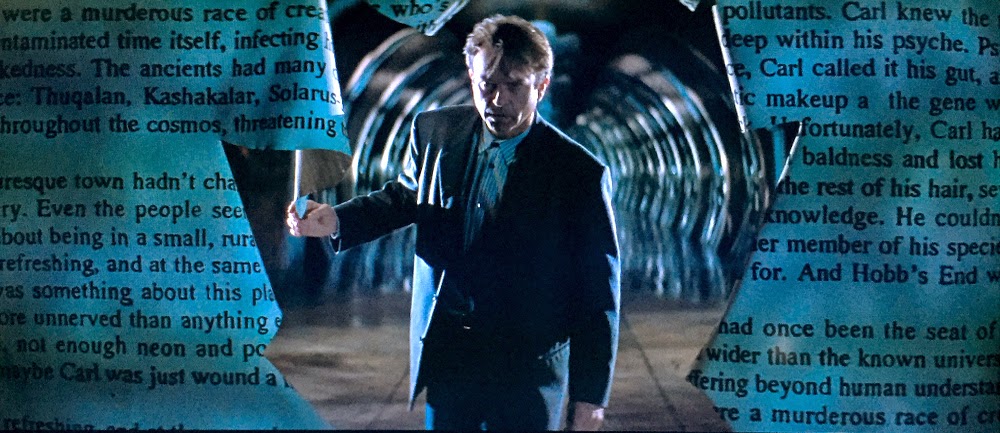
One of the few scenes to clearly show literal monsters occurs when Cane finishes his book. The scene begins with Cane showing that he is capable of warping reality when Trent suddenly finds himself in the former’s writing room. Cane finishes typing the book and declares it “all done” before entrusting Trent to return it to the world. Cane explains that “you are what I write” and states that nothing within this world existed before the story began. Cane continues to emphasize the idea of the world being fiction when he embeds his fingers in his face and tears it apart like a sheet of paper, exposing a black, empty void. The camera looks back at Trent from inside the void. From this side, the door that was behind Cane is replaced by a page from a book. Though the hole prevents the page from being read clearly, the text that is visible refers to Hobb’s End, suggesting that the viewer is literally looking into a page from one of Cane’s books. As Trent approaches the hole, Styles begins reading part of the manuscript, which describes in detail precisely what is happening.


The presence of Cane as the writer allows the film to further create this disruption through the use of abjection, an idea proposed by Julia Kristeva which suggests that horror resides in the middle of established social boundaries such as the living and the dead, human and animal, and male and female, or in this case between reality and fiction. The horror of In The Mouth of Madness comes not from Cane himself or from the Lovecraftian "Old Ones" he claims have influenced his work, but from the idea that everyone within this world, including Trent, is a fictional construct whose every action is dictated by the author and who only exist to serve the needs of the story.

Moments of abjection between reality and fiction recur throughout the film, beginning with Trent and Styles encountering a town that should not exist—later in the film it vanishes entirely, along with Styles who was literally written out of existence by Cane. The confusion is further emphasized when Trent finds himself reading one of Cane’s books while exploring the town, and comments that “I’m reading this thing like it’s a guidebook.” This idea of the abjection between reality and fiction reaches its peak in the film’s final moments. Trent sits down in a movie theater with popcorn and watches the film adaptation of the Sutter Cane story In the Mouth of Madness. A brief montage reveals that the film adaptation of the book is literally the film the audience has just finished watching. Reality as the viewer understands it is being disrupted by the idea that their reality is fiction. Trent constantly finds himself trying to rationalize his encounters, but upon seeing himself in his own movie, he is forced to finally realize the truth that none of his world is real.


This idea of monstering goes further. While Cane can be seen as the monster, the film also plays with Carroll’s idea of the anomaly to turn the rest of the cast into monsters themselves. Trent sets this idea up early in the film when he describes the experience of reading Cane’s books. “Pulp horror fiction, they all seem to have the same plot,” he says. “Slimey things in the dark. People go mad. They turn into monsters.” This is precisely what happens later in the film. Cane himself is an anomaly in In the Mouth of Madness, but in keeping with Wood’s ideas of what defines the monster, the anomaly shifts over the course of the film.

In a conversation between Trent and Styles, the latter justifies her love for Cane’s writing by suggesting that “Right now reality shares your point of view. What frightens me is what would happen if reality shared Cane’s point of view”. She goes on to suggest that “sane and insane could easily switch places if the insane were to become the majority”. This discussion sums up Wood’s idea of the monster challenging "normality", a term he uses in a loose sense meaning simply “conformity to the dominant social norms.”

Normality changes over the course of the film, initially with the characters believing that what they are experiencing is reality until Sutter Cane exposes them to the repressed truth. As the narrative progresses, more people become aware and are infected by it in ways that a man like Trent would view as insane. This challenging of Trent’s understanding of sanity is first experienced when he is faced by a man he later describes as a “lunatic with an ax”. The man in question steps out of a bookshop, crosses the street in broad daylight holding an ax, walks toward the diner where Trent is eating with his employer, smashes the glass and then asks Trent “do you read Sutter Cane.” This man is killed by the police, and naturally his actions are dismissed as being the product of mental illness.


Later on, it is revealed that this man was actually Cane’s agent. He was also the one person who read In the Mouth of Madness and as a result was not only aware of his fictional status, but also of the role Trent would eventually play in the narrative. It is now brought into question whether the actions of Cane’s agent were insane. At first, the agent can be seen as a monster, but when his perspective is revealed, it suggests that Trent may in fact be the real monster. In addition to reality and fiction, the abject also occurs between sanity and insanity, and the viewer is left to question their definitions of both.

Freud’s original concept of “madness” was that it was connected to a person’s own past, but in In the Mouth of Madness it is suggested that insanity is simply a label for any behavior that violates what the majority of the population see as normal. Trent’s own sanity is brought into question, ironically, by his very efforts to rationalize his experiences while everyone around him is turning into what he would consider monsters. This development in Trent’s character ties back to Styles’ comment earlier in the film: that which the viewer would consider insane has started to become the majority, and a character like Trent whom the viewer might ordinarily view as sane appears to be insane by the sheer nature of failing to conform to what has become normal.

The idea that Cane transforms people into monsters is explored more literally through the character of Styles. From her introduction, Styles is a horror fan who attempts to address Carrol’s very question of why viewers are attracted to horror films, as raised by Trent. As a Sutter Cane reader, she finds herself more open to the possibility that his books are real, an idea she begins to develop soon after entering Hobb’s End. When they first arrive at the hotel from Cane’s book The Hobb’s End Horror, Styles displays an uncanny ability to point out minor details about it without looking. She is also the second character to have her reality challenged, after Cane’s agent, when she is forced to read In the Mouth of Madness.

After this scene, Styles becomes a more explicit puppet of Cane’s, having sex with him oblivious to a monstrous outgrowth on his back, experiencing peculiar transformations, and displaying abrupt shifts in personality. With no build up she begins attempting to seduce Trent, much to his shock and confusion. She has herself become a monster, challenging what Trent would see as normal. Styles behaves in ways that he would deem insane, such as swallowing the keys to Trent’s car. She even briefly becomes a literal monster when her body is shown contorting into a quadruped form, walking on both her hands and feet with the sounds of bones cracking heard as she moves.

In the Mouth of Madness is one large distortion of the theories presented by Wood and Carroll. It plays on the idea of the monster disrupting what is normal and challenging the viewer’s understanding of reality by forcing the viewer to question their ideas of reality and what is normal. By leaving the viewer unsure of what they can call normal, the film also brings into question precisely what it means to be a monster or an anomaly. In the end, Cane can be seen as a monster, but he is also a tool used by the filmmakers to explore the question of just what makes someone a monster, and it is through him that the ideas of Wood and Carroll are tested.

Tuesday, 2 June 2015

Blindspot: Back to Bataan (1945)


I'll be honest here and admit that I did not go into this one with high expectations. Back to Bataan was a film that had been sitting in my drawer for years. The truth is the only reason I had it was because of this one time I found it among some low-priced DVDs and I happened to be a big John Wayne fan at the time. If it hadn't been for him I probably would have overlooked this one entirely. Going in now offered a better understanding of why the film was made, but that was really about it. I expected this film to be basically American propaganda and I was more or less right, as you can expect from a Hollywood film made just as World War II was ending.

Though the film begins with a disclaimer claiming that the story is based on real events, Back to Bataan is really a sequel to a 1943 combat film called Bataan. That film centered on a small ragtag group of American soldiers who were forced to band together in order to make a stand against the Japanese. Bataan basically ended with everybody dying and the last man standing trying to take as many Japanese soldiers with him as he can. There was then a title card which promised that one day America would return to avenge its fallen soldiers and retake Bataan.

Unfortunately, real life failed to deliver on that promise, so a sequel was made to "fulfill" it: Back to Bataan. That's literally all this film is: it's an American fantasy made to fulfill a so-called promise made in a single film two years earlier because reality didn't work out the way people wanted it to. John Wayne plays the role of Colonel Joseph Madden, an army officer given some kind of top secret mission to unite members of the Filipino resistance against the oppression of the Japanese. Meanwhile, a middle-aged teacher named Bertha Barnes (Beulah Bondi) is running a school at a local village in which she tries to force American values on provide a proper education for Filipino children. Unfortunately for her, the village is invaded by Japanese soldiers who show they mean business by hanging the principal over the American flag. Then some stuff happens and Madden suddenly decides to try and help the village or something while we occasionally get glimpses of Japanese atrocities.

One thing I only found out after seeing Back to Bataan is that the filmmakers were trying to keep up to date with current events in the war and had to keep changing the script according to major developments. Unfortunately for them, it really shows. The story gets extremely disjointed and confusing as the film develops, probably the result of all the abrupt changes being made to accommodate what was going on in the actual war. None of the characters really seemed particularly memorable, and plot threads seem to come and go out of nowhere. Even the basic military objectives of the main characters weren't very well explained.

There were also plot threads that never really seemed to connect; like the film begins and ends with the liberation of a Japanese POW camp and then takes the time to identify several of the captives... and it has no connection to the rest of the story. It never ties into the central plot, none of the POWs named make an appearance outside of those scenes, let alone have a part in the actual narrative. The POW raid itself was also ridiculous, considering it happened in the most unsubtle way imaginable and in real life the Americans would probably have been slaughtered.


In many ways, Back to Bataan is really a product of its time. While some credit could be given to there being at least an attempt to present strong sympathetic Filipino characters, most of them are stereotypes by today's standards and the choice to cast Anthony Quinn, a white actor, as someone who is supposed to be Asian can definitely leave a bad taste for modern viewers. Also true to propaganda of the era, the Japanese are given no humanity. The only Japanese character of note is a single officer (the rest are anonymous soldiers) who is also a very obvious stereotype and treated as a monster. While historically the Japanese did commit some horrifying war crimes and ran POW camps that calling inhumane would be an understatement, this part of the film has definitely not aged well.

The only thing that I would say makes Back to Bataan at all a worthwhile experience for anyone is from a purely historical perspective. It does offer some insight into American views of World War II and makes sense for scholars who want to study this film and how it fits into contemporary cinematic reactions to the war. So for academics and scholars this film might be okay to look at, but for casual viewing there are better options as far as John Wayne movies go. Personally, I'd say John Wayne's later propaganda film The Green Berets is a better choice; as much as most people today would disagree with its pro-Vietnam messages at least that one was somewhat entertaining and had a coherent story. There isn't much of that in Back to Bataan.